Food and Beverage
Warning: Undefined variable $category_id in /home/juanmonr/juanomatic.net/wp-content/themes/monroy2014/category.php on line 7
Food and Beverage

Three breweries in Long Island City: Big Alice, Rockaway, and Transmitter are all within a manageable walk from each other.
It still amazes me how a decade ago since I moved to New York, there were almost no noteworthy breweries in New York State, save for Brooklyn Brewery and one or two more. Today, however, there many more than I comfortably count, such as Sixpoint, Singlecut, Captain Lawrence, Keegan, and Greenport Harbor. In Long Island City, we appear to be following that trend. We now have three breweries whereas a couple of years ago we had none.
The other day, while hanging out at my favorite hostel/work-space/trivia-night, I saw a postcard showing the three Long Island City breweries: Big Alice, Rockaway, and Transmitter. Placing them on a map like that was an invitation, almost a challenge, to visit all three of them.
All three are within a long but manageable walk from each other. You could also visit all three by biking to each one, as I would almost invariably do.
| Brewery |
Location |
Taproom Hours |
| Big Alice Brewing |
8–08 43rd Rd |
Friday, 5:00 – 8:00 PM.
Their Facebook page lists their hours as 5:00 – 7:30 PM. |
| Rockaway Brewing |
46–01 5th St |
Thursday and Friday, 3:00 – 8:00 PM; Saturday and Sunday, 12:00 – 8:00 PM |
| Transmitter Brewing |
53–02 11th St |
Friday, 5:00 – 8:00 PM; Saturday and Sunday, 12:00 – 5:00 PM.
Their website lists their Saturday and Sunday hours as 12:00 – 6:00 PM. |
You can visit each brewery, one at a time, or take a Friday evening and hop to them all, as their taprooms are all open on Friday evenings. If I get around to visiting all three on a single day, I’ll post a report here.
Update, July 15, 2015: There’s a fourth brewery within striking distance. LIC Beer Project is located on 39-28 23rd Street, which is a few blocks north of Queens Plaza, and open on Fridays, 4:00 – 9:00 PM, and on Saturdays, 1:00 – 9:00 PM.
Seasonal creep
It’s when someone tries to hurry along the next season when we’re still in the midst of the current season. Some examples include Back-to-School sales in July, Christmas decorations in October, and Valentine’s Day swag right after New Year’s Day. I’ll even add registering for spring classes in the second week of the fall term.
I’ll admit that the weather this summer has been downright pleasant, temperatures in the low 80s with very low humidity, which hasn’t resembled the sultry summers of late. But yesterday, August 15, it was downright autumnal. Not only was it chilly enough for me to wear a sweatshirt when I saw the Boogaroos at the free outdoor show at the South Street Seaport last night, there were other signs of autumn:
- There were NFL football games were playing on the big screens at bars across the city,
- At one of those same bars, I saw a sandwich board easel advertising Oktoberfest beers,
- On Thursday, I was handed a beer list that included four pumpkin beers,
- Yesterday afternoon, I swore I saw NYU students beginning to move in to some of the dorms along Washington Square.
I really hate fall, despite the pleasant weather in September and early October. It signals the end of my lighter-than-normal workload, the end of softball season, long bike rides before more difficult to schedule, greenmarkets approach the end of their flavorful harvest, everyone is watching football, and I revert to wearing long pants. But before summer gives way to fall, here’s a few events still going on before it all ends in about two weeks.
Sadly, because the semester is about to start and I have work to do, I’ll probably miss all the outdoor stuff. Dang!

As much as I love getting a bag of freshly roasted specialty coffee, it is painful when you take a 12 ounce bag of coffee to the counter, hand the cashier a $20 bill, and save for being asked if I need it ground, getting nothing back in change.
Thrillist’s Dan Gentile had Lorenzo Perkins, a coffee instructor at Cuvée and executive council member of the Barista Guild of America, brew and taste ten different “second-wave” brands of coffee. For those who are smart enough to avoid knowing these three “waves” of coffee, here’s a brief primer.
- First-wave coffees refer to your father’s canned coffee, such as Maxwell House, Folger’s, and Chock Full o’ Nuts. My parents drank Taster’s Choice for most of my childhood and switched to brewing Peet’s in a press pot only about ten years ago.
- The second wave refers to more specialized brands such as Starbucks, Peet’s, Seattle’s Best, and Lavazza. I’m not sure where a brand like Illy fits in, which is served at theaters, museums, and other institutes of culture, but it comes in a can, already ground fine.
- The third wave refers to the hand-picked coffee beans that are directly sourced from a single farm with the occasional blend that has been carefully “curated.”
The coffees in each wave also vary in price. Whereas a single sixteen-ounce can of first-wave coffee costs about five dollars at the grocery store, a one-pound of second-wave coffee will cost about a dollar per ounce. As I mentioned, third-wave coffee costs about 50% more, and it’s not unusual to pay about twenty dollars for a twelve-ounce bag.

Are you Down to Brew?
Perkins’s tasting and his findings redeemed my silly spending habits: it’s worth overpaying for coffee. He found that Starbuck’s coffee, which I used to consider to be pretty good and will settle for while on the road, smells “gnarly” and tastes “smoky, but not ashy… actually kind of endearing,” and upon having the initial smoky flavor subside, it tastes “very bitter and astringent, but not in an unpleasant way.” For the longest time, I used to be a Peetnik, a subscriber to Peet’s delivery service. I always liked their coffee, but having become accustomed to fruity, third-wave coffees, I can’t drink it anymore. Perkins found that the coffee did have a nice “dark chocolate” aroma. But it let him down in the flavor department. He said it tasted like a cigar, “not a great cigar, more like a Philly. But there’s some sweetness — bittersweetness, but still sweetness — despite tasting super dark.” He also noted that “the darkness would lend itself well to cream,” reaffirming my belief that most people drink coffee as a delivery vehicle for milk and sugar.
Perkins also sampled a third-wave coffee, from North Carolina’s Counter Culture. Here, he noted an aroma of “green pear and cucumber” that seems more familiar to those of us who have been to coffee tastings, known as “cuppings” in the barista world. And the flavor was more suited to hand-picked beans, noting that it was “really juicy and acidic, with a peachy flavor and lots of sweetness.” Doesn’t that sound better than a cigar from the local bodega?
And if you’re wondering if he liked any of the first-wave coffees, he did appreciate the venerable Chock Full o’ Nuts, although he thought Maxwell House tasted “like death.”
I’ll raise a cup of Stumptown’s Burundi Kayanza to that!
Although I much prefer cold brew for hot summer days, there are days that I cannot wait fifteen hours to brew coffee. I need coffee right now, and I’ll settle for iced coffee. If you’re unsure about the differences between cold brew and iced coffee, let’s distinguish between the two as follows:
- cold brew
- coffee brewed with cold or room-temperature water for an extended period of time, between twelve and fifteen hours, and then diluted with ice water.
- iced coffee
- coffee brewed hot at a higher concentration and then served over ice cubes.
I prefer the sweet and complex flavors you get with cold brew. It’s much easier for me to identify the coffee’s “notes,” such as vanilla, caramel, chocolate, etc. It also lacks the bitterness of hot brewing, but you do you have to wait about half a day to extract those flavors. However, when you’re out of cold brew, and the mercury is hovering around 90°, as it is today, pouring hot coffee over ice cubes will do just fine. Also, there’s been backlash against the cold brew craze, which exploded on the coffee scene about four years ago, and some are returning to pouring hot coffee over ice cubes.
The folks at North Carolina’s Counter Culture coffee produced a video for making iced coffee.
Their recipe, posted on their website, uses 30 g of coffee, 335 ml of hot water, and 165 g of ice. I adapted their recipe to brew two small iced coffees, using a Chemex with the following measurements:
- 40 g of coffee: Bella Vista (Antigua, Guatemala) by Tonx
- 450 ml of 195° filtered New York City tap water
- 220 g of ice
While I was glad that I had chilled coffee without resorting to buying it from the local coffee shop, for at least three dollars a pop, I’m glad there will be cold brew tomorrow.

Angel City Brewery produced the White Nite, a white stout that tastes like a stout but looks quite different.

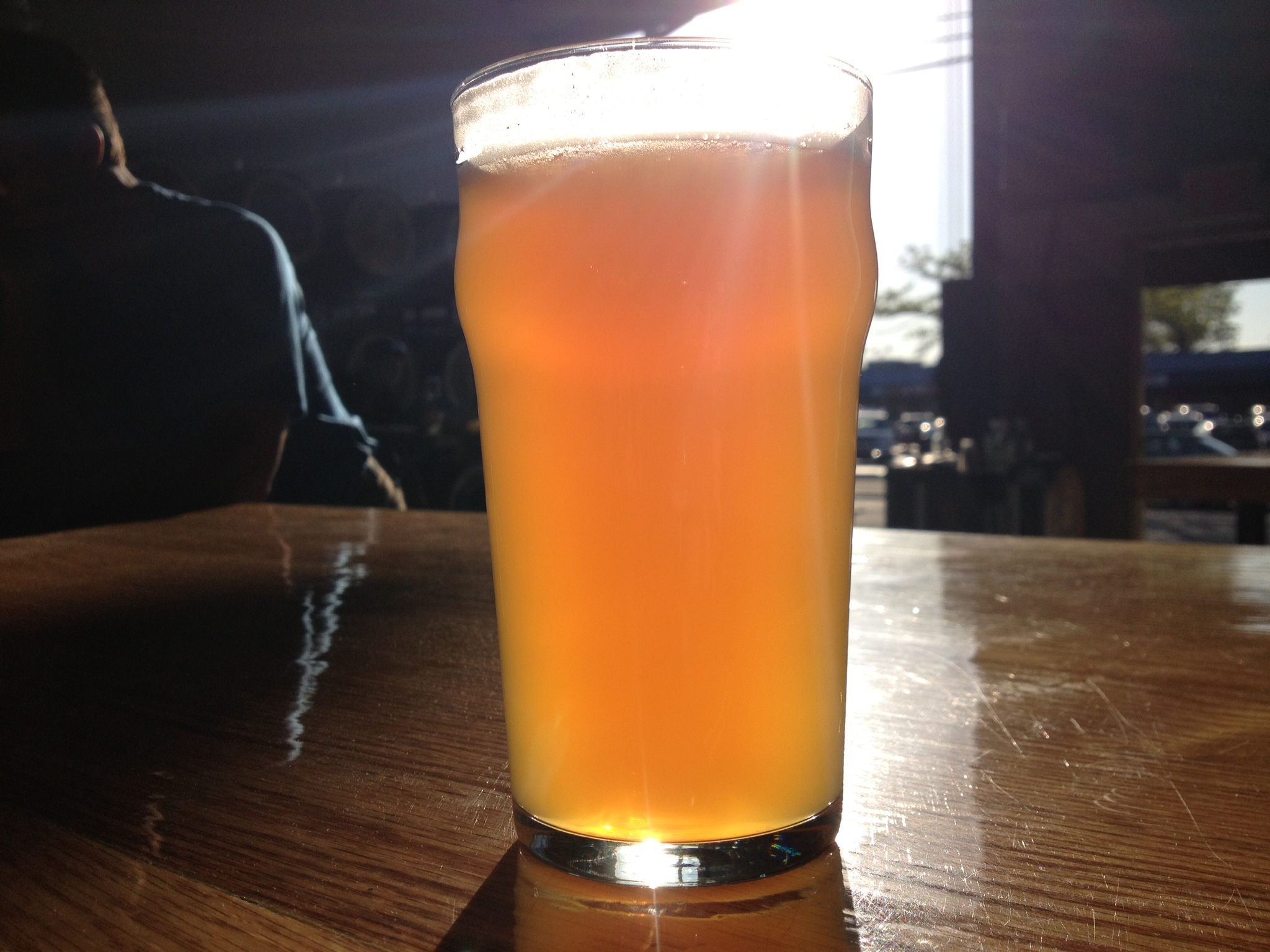
Peekskill Brewery’s Styriana was a pleasant light colored with some very complex flavors.

The JÅN Olympic White Lagrrr! by Singlecut Beersmiths (NY)
One of the beers of the summer has been JÅN Olympic White Lagrrr! by the Astoria, Queens–brewery Singlecut. As you can tell from the name, it’s a white lager, something you don’t see very often.
When we went to Peekskill on Sunday, I had another white lager at the Peekskill Brewery that was made with the same hops that “power” their sour beers, most notably their Simple Sour and The Aristocrats.
As you can tell, it’s white! Or at least it’s pretty light. The Styriana was a pretty solid beer, which scores really high with Beer Advocate reviewers.
This reminded me of a beer I had on the other side of the country at the Angel City Brewery in Los Angeles. It was the White Nite stout. Again, as the name implies, it’s a white stout.
Most white beers, or witbiers are made with wheat, which makes for a light yet tart flavor found in a lot of summer beers. But the Angel City stout does not taste like a wheat beer. It tastes like a stout. Beer drinkers, who are more knowledgeable than me, note flavors ordinarily found in stouts: coffee, chocolate, and earth.
Casual beer drinkers will certainly note flavor first and associate color with that flavor. How many times have you heard someone ask a bartender for a “light beer?” What’s different about these beers is that despite their light color, their flavor is quite strong.
Unless this goes to the logical extreme of brewers producing clear beer, I’m all for watching these independent breweries producing some novel brews.
One of the highlights of riding to Montauk last weekend was stopping at Tully’s Lobster in Hampton Bays for a lobster roll. Growing up in California, I am relatively inexperienced when it comes to lobster rolls, as it’s not as much a thing as it is out here, so I can’t tell you if it’s the best lobster roll in the Hamptons. All I know is that I like what I like, and I like the Tully’s roll a lot.

Another bonus to stopping there for lunch, aside from not having to fight hungry and tired cyclists for scraps at the depleted rest stop in Westhampton, was that I earned airline miles for eating there because the Backbay Grille, the restaurant operation at Tully’s, participates in the Rewards Network dining program. A few friends of mine are really into earning miles while we eat, and we each have stories about getting that surprise email informing you that you dined at a participating restaurant a few days.
That’s what happened to me. I had to have a conversation with myself to figure out where I earned these miles:
Where on earth is the Backbay Grille? Did I really eat there on Saturday?
But I rode to Montauk on Saturday….
Oh, right!
As a VIP member, I get five miles per dollar. My twenty-dollar lobster roll, with tax and tip, earned me 118 airline miles, which puts me 1/169th of the way towards a domestic economy-to-business class upgrade. All I had to do was ride almost as many miles on my bike, 101.8 miles apparently, which makes riding for airline miles a pretty terrible deal.
And if that calculation is not bad enough, because I was cycling, I was primarily eating for energy. I don’t want to know how much I paid per calorie.
Over a year ago, shortly after joining the Aeropress coffee brewers cult, I bought a permanent, metal filter for my Aeropress from Kaffeologie. At the time, they were selling a version of their S filter that was stitched on one side and supported by a metal ring on the other. It turns out that was a flawed design because after a few uses and cleanings, the stitching broke and the mesh filter began to peel back. It was disheartening to order this filter, anxiously await its arrival, only to have it break after three days.

In April 2013, I posted a review on Amazon about the filter, and someone from Kaffeologie who saw the review sent me a replacement. But it wasn’t just another flawed filter. This one had been redesigned with two steel rings to keep the mesh secure. After using it off and on for several months, I can report that this new design is a tremendous improvement because it still works. The rings do in fact offer greater support, and the mesh is still intact.

Apparently, the staff at Kaffeologie actively searches for dissatisfied customers. (They found me on Flickr last night.) They also took the time to send me their redesigned filter, free of charge. Color me impressed.
The above link to Amazon is an affiliate link. If you buy something that link, I will earn a commission fee.
Earlier today, the coffee-by-mail outfit that supplies half of my coffee beans announced that it is merging with Oakland, California–based Blue Bottle Coffee. Tony Konecny, Tonx’s co-founder and namesake, posted the announcement on the company’s blog.
As Tonx has grown we’ve added friends to the team, assembling top talents in green coffee sourcing, coffee roasting, software development, design, marketing, and customer service. One thing we lacked though was a dedicated production facility that would allow us to continue growing and improving. Getting there meant either raising a serious wad of venture capital (no picnic!) or finding a partner in the industry that shared our values and ambitions.
With Blue Bottle, we have found a more established company that still has an innovative startup culture, continues to evolve, and is dedicated to improving people’s experience of coffee on an ambitious scale. And they have resources we could only dream of.
Blue Bottle coffee has had a presence here in New York City for a few years, primarily through a coffee shop and roasting facility in Williamsburg. Although I appreciate the dedication to their craft, they lack the quirkiness and personal touch of Tonx. They strike me as just another Bay Area–business that takes itself too seriously.

With Tonx, I got both great coffee and a measured sense of excitement when our beans arrived. Whenever we received our biweekly box of Tonx, a ritual ensues at our place:
- We play a guessing game: “Africa or Latin America?”
- We read the card that describes the coffee.
- We read the charming note that the staff writes about our silly coffee obsession.
- Finally, we brew two batches: one of the newly arrived shipment and one of whatever beans we have left. With these two batches we can appreciate the new beans.
Even if the new subscription program remains just as good and quirky as Tonx, it won’t be the same with the Blue Bottle label. I liked that mail order was the only way to get Tonx coffee. it felt like something special.

The tasting notes to Tonx biweekly coffee, from Cotecaga in Rwanda, roasted on March 23, 2014.
With Tonx going under the Blue Bottle name, I may as well get coffee from any other “third-wave” coffee roaster, such as Ritual, Heart, Stumptown, or Counter Culture that all do mail-order. Or, better yet, I’ll just get it from one of the local roasters, such as Coffeed, Sweetleaf, or Cafe Grumpy.
Forgive me if I sound like a guy whose favorite band just signed to a major record label because nobody likes that guy. As a fan of their company, I’m happy for the folks at Tonx to see their success. They have come a long way in three years, and now apparently, their success has led to this acquisition. As a consumer, mergers and acquisitions are almost universally bad for us, with a diminished product, higher prices, or both. I hope that this one will be different, but I don’t see how it can be.
Also, it looks like Blue Bottle bought out Handsome Coffee, another Los Angeles–based roaster. I blame this on the Dodgers losing two out of three to the Giants this past weekend.
The folks behind the World Aeropress Championships were actively posting on their website about several different competitions. One of those competitions is in Peru.

Looking at their promotional graphic, I noticed that one of the sponsors listed was USAID: the United States Agency for International Development, a Cold War–era program, started by the Kennedy Administration, to promote economic development. This agency is a part of my never-ending research, but I only studied it in its early years. I’ve haven’t kept track of their activities after 1970.
The agency remains active and, among many other programs, has been promoting coffee industries throughout the world, particularly in Latin America. They’ve also kept the same model of partnering with American corporations to create markets for coffee producers in Latin America.
And here they are sponsoring a regional competition for coffee brewers in Peru.
There are many reasons to hate those K-Cup coffee machines. First, the machines are expensive. Second, the refills are expensive, and thus, the coffee it makes is also expensive. And for the elevated expense, you get coffee that tastes like crap krap.
One way to make being locked in to the K-Cup system more palatable is to use third-party refills that cost significantly less than those sold by Green Mountain.
But according to Techdirt, Keurig is aggressively combating the spread of cheaper refills.
In a lawsuit filed against Keurig by TreeHouse Foods, they claim Keurig has been busy striking exclusionary agreements with suppliers and distributors to lock competing products out of the market. What’s more, TreeHouse points out that Keurig is now developing a new version of their coffee maker that will incorporate the java-bean equivalent of DRM – so that only Keurig’s own coffee pods can be used in it.
The Keurig CEO has confirmed the new DRM-locked machine. He also called it a “game changer” presumably because instead of “giving away” the coffeemaker and charging for the refills, as you do in the established “razor-and-blades” model, Keurig intends to profit from the coffeemaker and the refills. This is how in bad CEO parlance, the “game” has been changed.
Of course, you can save yourself a ton of money and get better coffee at home with any number of coffee makers, like a Chemex or an Aeropress that don’t have DRM or even require electricity.
That’s truly game changing!
The above links to Amazon are affiliate links. If you buy something through those links, I will earn a commission fee.