We signed up for the new OpenHouseNew York membership program, and on Friday, Sarah and I went to the welcome reception for the new members. The reception was held at the Eero Sarinen–designed TWA Flight Center. We had gone last year during the OHNY weekend and spent hours there looking at every nook and cranny of the place. I took dozens of photos of the place last October.
This year, I took a few more photos of places I might have missed the first time around.
Open House New York members mingle at the TWA Flight Center
Sipping a drink at the former Constellation Club.
The flight departure board lists is live!
OHNY members listen to remarks about the terminal.
OHNY members listen to remarks about the terminal.
The flight center today at JFK.
There are no straight lines at the flight center.
The clock is still live. Don’t miss your flight.
The site of the former Terminal 6, the National Airlines Sundrome terminal, designed by I.M. Pei.
New York City Councilman Jimmy Van Bramer, who represents our section of Queens, asking to expand bike share to Western Queens:
There are already 36,000 members of bike share (citywide)…and I want these members to be able to come to Long Island City, Astoria and Sunnyside. Bike Share will help drive tourists to Western Queens…and would help bring people to the world class cultural institutions and restaurants in the area.
Over the the two weekends since New York City Bike Share launched, I have seen a handful of cyclists hurriedly riding the unmistakable blue-and-white bikes around Long Island City. Sarah got her fob in the mail yesterday, and I’m expecting mine any day now.
At the moment, there are no stations in Long Island City or neighboring Greenpoint. The closest ones are at Metropolitan and Wythe Avenues in Williamsburg (2.5 miles away) or at Second Avenue and E 60th Street in Manhattan (2.8 miles away). With a 30- or 45-minute check-out period, these intrepid riders either misunderstand the concept of bike share, are incurring significant late fees, or are only passing through the neighborhood to get a few weekend miles. Imagine if these riders could dock their and hang out in the neighborhood. Our western Queens hamlet would undoubtedly benefit.
Getting to Central Park for my Sunday softball games is pretty easy from Long Island City. I just ride over the Queensboro Bridge and head west on one of the streets in the lower 60s until I reach the Dairy and walk under the drive to the ballfields. The ride takes less than a half hour.
But Sunday was the annual National Puerto Rican Day parade. This one of the biggest parades of the summer, and its route along Fifth Avenue, from 44th to 79th streets, creates a “wall” that is difficult to cross. (The Gay Pride Parade is also big but its route along Fifth Avenue doesn’t block Central Park from the east side, as its north end is in the upper 50s.)
To get to the field, I have resorted to some creative solutions. Sometimes just take my bike on subway to the west side and ride the rest of the way. I once took the subway the entire way to Central Park, but that took much longer than one would expect. Subway service on a Sunday is sparse compared to weekday service. Another time, I took the East River Ferry to East 34th St and rode the rest of the way, but it cost $10 round trip for a five-minute ride.
This year, I took the Williamsburg Bridge, headed north along Avenue A, then west along Ninth Street, and up to Eighth Avenue. The trip was about six miles longer than my usual crosstown trip through the Upper East Side, and took just less than an hour. But I was warmed up for the game, ready to go.
On 44th Drive in Long Island City, there is almost always glass in the bike lane. It’s troubling. Not only does this cause flat tires for unsuspecting cyclists as they commute down this important neighborhood arterial, it also bodes poorly for cars parked on the street. Presumably, someone smashed their windows.
As the weather warms up, I always get questions about buying a bike. The first thing I tell people is that unless you’re willing to spend $500, you’re going to get a disposable bike and should not even bother. Some people continue to solicit advice, but others balk at the price and don’t want to know anymore. They go to K-Mart, and I never see them ride their new bike.
With the launching of the bike share program in New York, I have been advising people to consider it if a bike station is available where they live, work, and play. The yearly membership costs $95 plus tax, a little more than a $103 per year, and it is a good deal for most people who are getting into biking for the first time. I have a pretty solid track bike I use for the city. It runs great. And although I have learned over the years to do my own repairs, I still shell out a lot of money to maintain my city bike. There are still a few things I can’t do, such as truing wheels and replacing a bottom bracket or freewheel hub. And that’s not even getting replacing into consumables, such ragged tires, punctured tubes, broken spokes, stretched chains, and worn chainrings and cogs. If there was an option that would take care of my repairs for a little more than $100 per year, I’d jump on it in a second.
And if I was starting from scratch, $100 per year would be a bargain. Because to buy a new bike for getting around the city, you’re going to need:
A bike. That’ll cost you at least $500 to get something that won’t break down within a couple of months, weigh 40 lbs, and will make you abandon it after one too many miserable rides.
A lock or two. Citi Bike racks are their own locking stations. A decent Kryptonite lock will set you back at least $70 for either a U-Lock or a more versatile chain you can wear around your waist. I also recommend an accessory cable to the front wheel to use in tandem with the U-Lock or chain. (I use the heavy lock to secure the rear wheel and frame.)
A bell. It’s the law around here, and since I’ve installed a bell, I can ride faster. How? I can ride and ding it once or twice to get someone’s attention and keep them from veering into my lane. It works for other bicyclists and pedestrians alike, but not always. Citi Bikes come with a bell.
Lights. I have spent well over $200 on lights over the years. I used to use a version of Sigma Micro lights, but you have to replace the batteries every few weeks. And they’re not very bright. They’re easy to remove, but that means they’re easy to steal, which happened to me a few times, but I’ve learned my lesson and take them off every time. I switched to these USB lights by Blackburn. They’re really bright, they’re rechargable, and easy to remove. Once you learn how to manage the charging cycles, you get a lot out of it. Citi Bikes come with front and rear LED lights.
Helmet. No matter what you’re going to need a helmet. I’m relieved that bike shares don’t issue helmets because that would be a pretty unsanitary practice. But helmets are not expensive. You can get one a decent one for about $40, and if you see expensive ones, it’s because they’re lighter and better at ventilating your head, not because they’re better at protecting your head.
A floor pump. No one believes me that you’re going to need floor pump for home. You need to pump your tires almost every day. Otherwise, you’re begging for premature tire wear and flat tires, not to mention harder rides. Sure bike shops offer free air, but they’re not open when you leave for work in the morning, and they’re not always on your route. Get a stylish pump with a handle made of something other than plastic (those break). Citi Bikes are maintained.
The initial costs of buying a bike make considering Citi Bike worthwhile. And I haven’t even covered repairs. Once the network reaches places like Williamsburg, Greenpoint, and Long Island City and even Astoria, it’ll be a much more compelling option because that’s where I usually go and Citi Bike is not around.
Of course, having your own bike allows you to go wherever you want for as long as you want and ride as fast as your body and bike will go, but if you’re just commuting, the bike share is not a bad way to go.
An eyewitness told me that the van at far right end of the photo had run down this bike rack just moments before I walked by to find it in its fallen state. I had thought that someone had taken down the rack to steal the bike, but my source says there was no bike parked at this rack.
I use that rack from time-to-time, and now some idiot driver took it out. Damn you!
Almost everyday I ride my bike over some sort of bridge, I don’t really understand how so many bottles get broken, but I see a broken bottle I think I should stop and clean it up… well today I finally did.
On Saturday, I went with the New York Cycle Club for a ride to Croton Dam. It was an absolutely wonderful ride, especially since I missed the ride the previous week, partly due to being sick and partly due to being in Philadelphia. I also had a bad cough most of the week, the remnants of said illness, and it made riding a bit more challenging than usual. Seeing the dam and reservoir at the northernmost point of our ride was absolutely worth the effort.
With the coming bike share, there have been some complaints that the racks will ruin neighborhoods and take up “valuable” on-street parking spaces. But we should remember that parking on the street might not be the best idea.
It’s not just fast food that will kill you, you know?
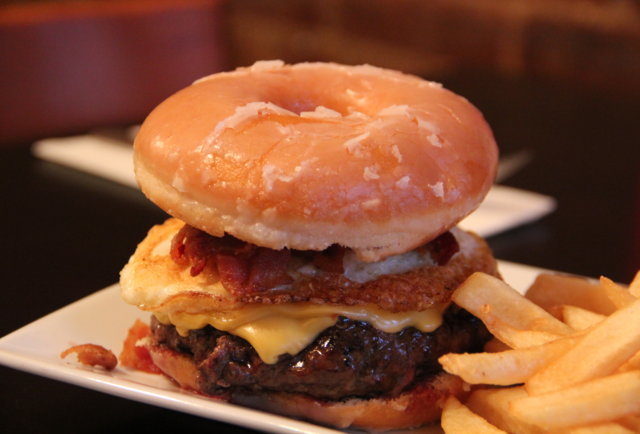
Since Groupon made a splash a few years ago with meal deals, it seems like there has been a glut of offers for pretty unhealthy meals, especially here in New York City. And it’s not just Groupon. Any number of the “daily deals” sites feature pretty savory but fattening food. Today, for example, Thrillist catalogs twenty-one places where one can munch this weekend. Their featured image is of a burger and fries. Topped with bacon. And an egg. And instead of a bun, there’s a donut. I’m old enough to remember thinking this kind of burger was a joke. But now, I’m tempted to dig in.
For a long time, I had complained that New York food catered to bland palettes. Living here for over a decade cost me a healthy tolerance for spicy food and can probably never eat at Los Angeles’s Jitlada unless I move west. But since about 2006 or so, there has been an explosion of comfort food. Have you noticed? How many BBQ have opened in the last seven years? Blue Smoke, Fette Sau, Fatty Cue, Mabels, and Hill Country are among the standouts. Have you noticed how easy it is to get chicken and waffles in New York City? And although I do love a good burger, is it possible to get a burger patty smaller than a half pound that is not considered a “slider”?
Can anyone explain the proliferation of these comfort establishments? Has it been to cater to transplants from the South and Midwest? Is it a way to have flavorful food but still cater to these bland palettes? A cheap way to add flavor is to add salt, sugar, or fat. Adding all three would be a flavor explosion, right? And now it’s easier to get a slice of Paula Deen than it is a slice of pizza.