Culture
Warning: Undefined variable $category_id in /home/juanmonr/juanomatic.net/wp-content/themes/monroy2014/category.php on line 7
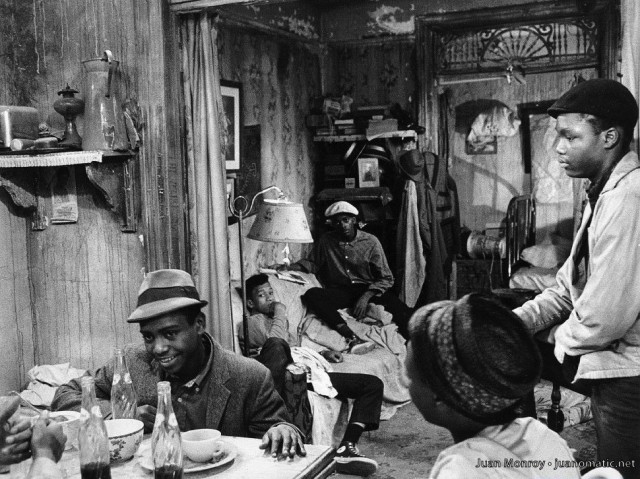
Brooklyn’s Light Industry screens Shirley Clarke’s The Cool World, a gritty look at New York’s street life and a rare, frank look at African-American life in the late 1950s. I screened the film many years ago at a NYU summer session class New York Independents.
If you’re in the neighborhood, see the film on Tuesday, July 17, at 7:30 PM.
Light Industry is at 155 Freeman Street, in Greenpoint, Brooklyn.

Last night was a benefit party for our favorite park in Queens: Socrates Sculpture Park. This year marks the park’s twenty-fifth anniversary and this fundraiser was a great way to kick off its summer season. The party featured a pig roast, which we didn’t attend because of the $200 price for those tickets, but we did arrive just in time for a stunning sunset, which is a common sight along the East River waterfront.
We have taken a fairly passionate liking to this park over the last couple of years. Not only is the park relatively close, it is hosts some great public programs: a weekly farmers market, outdoor screening series, and a few other events, such as last week’s summer solstice festival. It also helps that we can easily bicycle to this park, as it’s a mere two-mile ride, along Vernon Boulevard, from Hunters Point.

The party, dubbed “the Parkside of the Moon” was a party featuring DJs AndrewAndrew, a performance by Jacolby Satterwhite, cocktails mixed with Tito’s Handmade Vodka, and beer from a new Queens brewery, Singlecut Beersmiths.
The Los Angeles Conservancy kicked off its twenty-sixth annual Last Remaining Seats film festival this past week. Sarah and I went last year to watch Sunset Boulevard at the Palace Theater as that Broadway movie house turned 100. and my parents are going to three screenings this month. The festival celebrates the legacy of the picture palaces in downtown Los Angeles. LA’s Broadway was an important hub of movie exhibition, hosting many premieres, as the movie business was developing into a vertically integrated industry, where studios would control the production and the first-run exhibition of their films.

The Broadway theater district would fall on hard times over the years, as just about everything moved out of downtown. One of the first movie theaters to draw audiences outside of downtown was the Egyptian theater. It was the first movie palace in Hollywood.
Larry Harnisch, who publishes the always fascinating The Daily Mirror blog, chronicles the opening of the Egyptian. One of the curious aspects of the new theater was the reserved-seating policy and how they ticketed theater patrons nearly a hundred years ago.
Grauman inaugurated new policies before opening the theatre. He announced on October 7 that the Egyptian would be the first theatre on the West Coast to reserve seats for every performance. Patrons could buy tickets downtown at Barker Brothers’ music department two weeks in advance, or by calling the theatre at Hollywood 2131, 2132 or 2133. Two complete shows ran daily, a matinée at 2:15 pm and an evening screening at 8:15 pm. Afternoon prices ranged from 50 cents to $1, and evening shows cost 75 cents to $1.50.
While the theater’s design and construction are certainly remarkable, I find these mundane details to reveal a great deal about the role of the Egyptian in the history of movie exhibition.
If you wanted to see a show at the Egyptian, you could visit a furniture store, ten miles away from the theater, and buy tickets up to two weeks in advance. Or you could call the theater to order tickets. (I’ve seen ads where patrons could order tickets over the mail as late as the 1950s.) Undoubtedly, the Egyptian was marketed as part of special occasion. It was not a casual movie-going experience, as the case during the Nickelodeon era, 1905–1912, that the picture palaces had essentially killed in the mid 1910s. To draw movie audiences out of downtown, the Egyptian needed to act as a new flagship theater of the American film industry.
As the LA Conservancy celebrates the downtown movie theaters, it’s also important to remember the theater that helped end the golden age of the Broadway movie palace.

As part of this year’s LIC Arts Open, a week devoted to showcasing the numerous art institutions in Long Island City, the Jeffrey Leder Gallery staged an opening of recent paintings and drawings converging on the theme of minimalist techniques. Dina Muenzfeld curated this show, titled Reductive.

Dina saw me shoot photos of Ellen Schneiderman’s opening in February at the same gallery. She must have liked my snapshots because she asked me to shoot the opening. Either that, or she liked that I worked for free.

I was pretty happy with the photographic quality of the shots. There were for the most part very sharp and crisp. Shooting in a gallery is a little tricky because of the competing light sources and their various temperatures
But since I bought a WhiBal card last summer, I have been able to mitigate the light noise. Also I can get pretty true colors, which I did in the photos from the Reductive opening and last July’s Staff Show at Philips DuPury.
The above link to Amazon is an affiliate link. If you buy something that link, I will earn a commission fee.

Our friend Ellen Schneiderman staged a significant show of her paintings at the Jeffrey Leder Gallery, a beautiful two-story brownstone in Long Island City. She paints some very beautiful shades with a mix of intricate layers. She already sold a number of paintings so I recommend visiting the gallery soon if you want to get yours.

In honor of Ellen’s big show, Sarah and I hosted a brunch at our place. About a dozen folks came to wish Ellen well, and then we headed to the gallery where scores of friends, family, and art lovers gathered to celebrate her work and the work of Brandon Friend, who also opened a show that day on the gallery’s second floor.
The show of both artists is on view until April 8, 2012. The Jeffrey Leder Gallery is at 21-37 45th Road in Long Island City.

The fine folks at the Loew’s Jersey in Jersey City launched their annual tribute to Halloween with a Friday night screening of the William Castle classic, The House on Haunted Hill (1956). The tribute continues tonight with separate-admission screenings of Abbott and Costello Meet Frankenstein (1948) and The Cabinet of Dr. Caligari (1920). The latter film, a German silent expressionist masterpiece, will be screened with live organ accompaniment.

Last night’s screening had two treats for architectural nerds. The first is the building itself at the Loews Jersey. It opened in 1929 as an outpost of the MGM-Loews movie empire and at a reported cost of $2 million, it was an example of the picture palaces that not only screened movies but sought to give audiences a transformative experience. The architectural style appears a little behind the times, as it borrows heavily from Gothic, cathedral structures that were common at the turn of the century. By the 1920s, it was more common to see Art Deco as the dominant style, but aside from old Radio City Music Hall, which opened a few short years later, most movie theater architecture remained unchanged since the end of the 1910s.

The second treat came from the movie itself. Sarah and I found that the exterior of the titular house looked familiar, and very similar to the Frank Lloyd Wright-designed Hollyhock House in Hollywood. Poking around the Internet Commons, I found that the exterior shots were of Ennis House, a Lloyd Wright work and has been compared to Hollyhock (below).
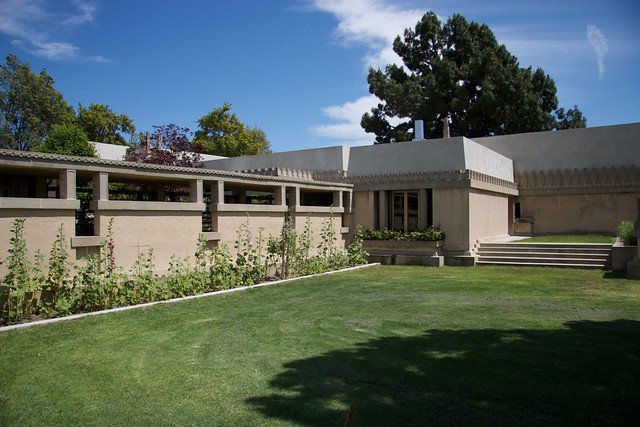
The house has also been used in several movies, including Blade Runner and L.A. Confidential, and it has often been the home and lair of movie villains, an assessment I remember encountering in Thom Anderson’s essay film, Los Angeles Plays Itself. It seems a bit odd that the trip to Jersey City really seem to evoke sentimental feelings to L.A. Maybe it’s time I take a trip to L.A. for more than four hours.
On my recent trip to Los Angeles, I was coming flying back to New York through San Francisco, which was a bit longer than I had originally planned, but while there, I had the pleasure of carefully studying, Television: TV in the Antenna Age, the exhibit of vintage television hardware (and some memorabilia, too) at the SFO Airport Museum.

If you know me, you know that this is exactly the kind of thing that excites so many of my interests—television, once new but deprecated technology, some history, and, yes, the airport location. When I used to travel through here more often when I was younger, the museum had some pretty bland exhibits. I can’t even remember any of them, except for a sports-related one around football season, that were as exciting as the current exhibit.

I spent about an hour going through all of the hardware, and I snapped a lot of photos. Some of the my favorite pieces were the various TV-radio combinations. I like the idea of all-in-one devices, and one was designed to have programmed all of the New York City radio and television stations that you could press a button and it would automatically tune to that station. “It just works.”

The portable television sets were also novel since portability in the 1960s was remarkably advanced fifty years ago. Some of those sets were as small as 4-inches in size, which isn’t much bigger than a current smartphone screen.
If you’re at SFO and have a layover (or, more likely, a delay) stop by Terminal 3 and have a look, or just look at my photo album.

Having just taught a class last week on the advent of widescreen cinema to compete with television in the 1950s, it is very tempting to see Forbidden Planet this Friday and Saturday at the restored Loew’s Jersey theater in Jersey City. Even if you’ve seen this film before, you’ve probably never seen it on the BIG, w-i-d-e Cinemascope screen.
I’ve been wanting to see a film there since it’s been completely restored to its old Nicholas Schenck-glory days, although I won’t not be able to make it, as I’ll be out of town for “fake” Thanksgiving.
The LIC:Space held an optical illusion show at their gallery and at a neighboring taxi garage.

Follow the duct tape arrows to the other space….
Brooklyn’s Light Industry is showing, five times this week, the East Coast premiere of Wang Bing’s Crude Oil.
The film is a fourteen-hour documentary of what it’s like excavating for crude oil in Northwest China. The shift starts on Wednesday at 9:00 am and continues each night 11:00 pm through Sunday.


