Jim and Neven from the Salt and Fat podcastdevote an episode to discussing the role of food in Quentin Tarantino’s Pulp Fiction.
This was one of the better analyses of Pulp Fiction I’ve ever heard (or read). Not only do they catalog the various restaurants in the film, they also analyze the meaning of the coffee shop and of Jack Rabbit Slim’s in the world of film (1990s Los Angeles in the shadow of the 1970s). They also do a great job of connecting the characters to their choices of food.
Brooklyn’s Light Industry is paying tribute to Chris Marker, who passed away last month. As I wrote earlier on this site, you can see two of his best known films on Hulu Plus, but this retrospective is much richer. It begins at 10:00 AM on August 26, continuing throughout the day, and ending with a midnight screening of The Case of the Grinning Cat (2004).
Next month, Yale University is hosting a film conference devoted to European filmmaking after the financial market crash of the late 1920s.and ensuing global economic depression of the 1930s.
The conference does not appear to have a website so I am reproducing the conference announcement, which I received via email, for anyone who might be interested.
After the Crash: European Film ca. 1929-1930
September 14-15, 2012
Auditorium, Whitney Humanities Center, 53 Wall Street, New Haven, CT
All featured films screened on restored or archival 35mm prints (unless noted) with English subtitles.
In the history of Europe, 1930 was particularly marked by the impact of the Depression in the aftermath of the American stock market crash of 1929. This impact could be seen, for example, when Miguel Primo de Rivera, prime minister of Spain and head of a military dictatorship, was obliged to resign due to a financial crisis and by 1931 the king was forced to flee as republican and socialist parties won a big majority in local elections. In 1930 Germany also saw increased polarization in its political world as the communists, socialists and Nazis emerged as rivals in a struggle for power that culminated in the Nazi take-over of 1933. The Soviet Union, which was less directly affected by the Depression, saw a brutal collectivization campaign in this year and ominous show trials. The period around 1930 was also fateful for European film as sound film began to replace silent film at an accelerating pace. The conference will address the implications of this ongoing shift both in terms of its impact on filmmaking, production and distribution, and in terms of how the introduction of the talkies exacerbated the language barrier between and within European countries and became a severe problem in helping different cultures relate through film
Friday, September 14th
3:00 PM Menschen am Sonntag (People on Sunday) (Kurt Siodmak, Germany, 74 mins. Blu-ray)
Preceded by Regen (Rain) (Mannus Franken and Joris Ivens, the Netherlands, 14 mins. DVD)
Over the last couple of weeks, George Stoney (born 1916) and Chris Marker (born 1921), two documentary filmmakers with careers dating back to the 1950s but with very different filmmaking styles, passed away.
Stoney was someone who made documentary films than just about anyone else who has lived, but his teaching at NYU liberated his most recent work. Because he earned income from teaching, he could afford to make documentary films about topics of his choosing, not simply because they paid the bills. He could document a conversation with the philosopher and activist Paulo Friere, Finding Friere, or he could be an active agent in community television. His life is documented in George Stoney: A Life on Film and the generically named George Stoney Documentary, two shorts both available on YouTube.
Marker was more of a film essayist than a visual documentarian: he used the documentary form to explore deeper, more philosophical themes that were not always inherently visible. Because of the stylistic complexity and multimodal narration of his films, Marker has been a darling of film scholars, and he shows up on many film studies syllabi. I showed Sans Soleil in a spring 2011 version of my History of Cinema III course at Queens College.
If you haven’t seen any of Marker’s films, there are high quality streaming versions on Hulu Plus of his two most popular films, courtesy of the Criterion Collection: the science fiction short La Jetée from 1962, and the fictional memoir and essay film Sans Soleil from 1983.
These two luminaries of the documentary from will be celebrated at December’s Visible Evidence XIX Conference in Canberra, Australia.
The Arclight Cinema in Hollywood is going to commemorate the 60th anniversary of the Cinerama widescreen process by screening a bunch of films in the three-strip process. While this process could envelop the audience, it was also very expensive to produce and project. The process would be surpassed by anamorphic processes, such as Cinemascope or Vista Vision, that used only one camera and the same 35mm film stock and projection systems as before.
My cousin is getting married that weekend in Los Angeles so if I can go, I might head to Hollywood for a screening or two. In fact, I am tempted to sneak out of the reception to go to the 11:00 PM screening of 2001: A Space Odyssey on Friday the 28th.
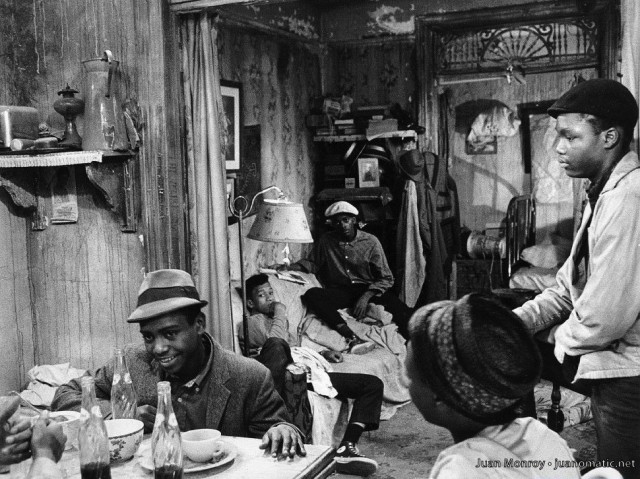
Brooklyn’s Light Industry screens Shirley Clarke’s The Cool World, a gritty look at New York’s street life and a rare, frank look at African-American life in the late 1950s. I screened the film many years ago at a NYU summer session class New York Independents.
If you’re in the neighborhood, see the film on Tuesday, July 17, at 7:30 PM.
Light Industry is at 155 Freeman Street, in Greenpoint, Brooklyn.
This semester’s History of Cinema course concluded with the contemporary Hollywood entertainment economy. One of the themes we continually encountered was Hollywood pursuing spectacle and scale in order to remain relevant. This contrast with what we have seen throughout the semester with emerging cinemas relying more on New Wave priorities of stylistic experimentation and character development.
One of the main topics we covered was the new exhibition technologies of 3D and Digital Projection. While these have been around for decades, and for over a century in the case of 3D photography, the new push for faster frame rates seem as a new way for Hollywood to separate itself from other cinemas from around the world.
David Bordwell has recently covered the campaign for 48 frames per second—double that of the traditional sound film frame rate of 24 frames—led by Peter Jackson and James Cameron as a way to eliminate the artifacts visible in their digital-effects-heavy films. I won’t repeat everything he has to say in that illuminating article but I found a few points relevant for our discussion.
In order for theater owners to adopt new hardware, there needs to be a viable path to recovering those costs with profitable software. It’s hard to imagine filmmakers with a better profit potential than Jackson and Cameron.
By pioneering new projection technology, it will be hard for other filmmakers—both within and outside of Hollywood—to match them in terms of spectacle.
Bordwell is right when he points out the 48 fps debate overlooks the entire issue of story. It’s not that the two are mutually exclusive. It’s just that they are almost working with an entirely different medium than other filmmakers.
We have seen in various other nations numerous attempts to foster a strong national cinema. International co-productions and complex financing arrangements were such methods, but while they might have matched (or approached) the scale of a Hollywood film, they rarely accomplished any sustained success. What had worked was making films with a strong personal vision, complex characters, and drawing on rich sources such as history, politics, or philosophy. These films might not have yielded immediate financial successes, but films like these kinds fostered a strong sense of national identity and also became the hallmarks of international cinema. I tried to screen films of these type throughout the semester.
As filmmakers chase the apex of digital realism, we should not let the digital revolution foreclose what made the cinema, not just entertaining and spectacular, but an international art form.
There’s so much to cover with Raise the Red Lantern (1991), a film I screened in this week’s History of Cinema class. There is the film’s historical portrayal of Chinese feudal society in the early twentieth century. The particular depiction of misogyny is also instructive because it reveals a great deal about the treatment of women in this polygamist family. However, for this review, I want to discuss the way the film’s style portends the fatal ending and that endlessness of the women’s subjugation.
Warning: Spoilers are afoot
Think of the film as depicting a cycle.
First, we see the new mistress coming to the home and being introduced to the older mistresses. As we see each one, we understand that each mistress almost perfectly represents a generation of women. We know little of the Second Mistress other than her desire to bear a son for the Master. The Third Mistress, on the other hand, was at one time a working opera singer. The Fourth Mistress, as a university student, stands as the most ambitious of them all. Each one is more professionally and socially accomplished than the previous one. However, each of these “generations” are compressed into a matter of years, although the actual length is indiscernible.
Second, the Master’s physical absence throughout the film amplifies his power, especially compared to the mistresses, servants, and even Doctor Gao. The Master is conspicuously absent for most of the film. The film employs a variety of tricks to obscure him, such as cutting away at a key moment, having objects block or screen him, or simply framing him from a great distance to render him indistinct. Such techniques give him a spiritual quality that makes him almost immortal.
Third, the film foreshadows the ultimate doom for two of the mistresses. When we see the Third Mistress on the roof of the building, which will be of great narrative significance in the film’s penultimate scene, she resembles an apparition. Her red dress contrasts with the blue sky and monochrome stone structure of the house. As the wind blows and she sings, she has a ghostlike quality. This not only a sign of her fate but also a manifestation of women whose spirits are unsettled. Fourth Mistress punctuates the spiritual tone of that scene when she later confides with First Mistress, “This place is haunted.”
Finally, after the Third and Fourth mistresses’ fates are sealed, we see a Fifth Mistress join the house. She is presumably the youngest of them all.1 As the cycle begins anew, there are some unsettled ghosts in the house. Fourth Mistress attempts to “unleash” Third Mistress’s ghost by lighting her lanterns and playing a gramophone recording of her singing. Moreover, Fourth Mistress has apparently gone mad. Her life is spared but the trauma of witnessing, and to some degree causing, Third Mistress’s death. But the house and its generations of tradition continue undisturbed. The film suggests that there will be no end to this cycle.
It seems significant to note that Fourth Mistress’s downfall begins on the day she turns twenty years of age. ↩
In Tuesday’s History of Cinema class, I discussed some ways that Hollywood franchises spawn entertainment vehicles beyond movies. One such vehicle is the Broadway musical, such as the 2008 Shrek: The Musical Broadway production. In an off-the-cuff remark, I said, “At least, there hasn’t been a Star Wars musical.” One student proved me wrong.
Although Star Wars: The Musical is not a Broadway show, produced in conjunction with George Lucas, LucasFilm, or 20th Century-Fox. It is a work produced by fans of the franchise, available for free download.
Earlier today in my History of Cinema III, I screened one of my favorite films from last spring’s version of the same class: Andrei Tarkovsky’s The Mirror. I remember sensing that last year’s students enjoyed the spatial and temporal puzzle of the film. This year, I don’t think they enjoyed it as much.
The film is indeed challenging. It lacks any substantial screen time for the protagonist. Instead, we only hear a disembodied voice. However, we see Margarita Terekhova for the majority of the film. And, if I may spoil the film a bit, she plays the roles of the protagonist’s wife Natalya and mother Maroussia. This is a common strategy in the film, and it certainly was not done due to budgetary concerns.
There are many big themes in the film, including mortality, family, history, and even Russian society. The protagonist’s relationships with his mother and wife are perhaps the most important as they are both embodied by the same person in most of his memories. However, the two themes that struck me when I first saw the film and continue to inform my interpretation are memory and imagination. As the protagonist dies, he reflects on his life and the important people and events. As spectators, we see all of the events from his perspective. This is why we see actors playing multiple roles, as his association between them is so close that his subjective consciousness can’t distinguish them.
We also see how certain motifs recur throughout the film, such as the 1935 fire, the departure of his father, the red-headed girl he adored when he was a boy, and the Leonardo da Vinci monograph. All of these recur throughout the film in strategic places as he tries to make sense of his life. In each of them, he is able to explain them against his own memory of them and his grasping with what it means now that he’s approaching the end of his life. We can see his concern with legacy when he considers his son in nearly all of his memories, as he remembers himself through his son’s body.
The students either seem confused, bored, or underwhelmed by this representation. It’s also possible that I oversold the film, when I compared it to Persona. I screened the Bergman film earlier this semester, and it was a hit.