Scholar
Warning: Undefined variable $category_id in /home/juanmonr/juanomatic.net/wp-content/themes/monroy2014/category.php on line 7
A local bar in Long Island City was showing the telecast of the Grammy Awards last night. From where I was sitting, you could see it on two TV sets, each set at two different refresh rates. If I turned to my right, the video looked relatively normal, as it was set at 60 Hz. But if I turned to my left, the video looked like a soap opera. It was set to 120 Hz, double the frame rate of the first.

“Transferring from one frame rate (30 Hz) to another (24 fps) causes some distortion in this kinescope of Ben Grauer (1949) by National Broadcasting Company. Wikimedia Commons.
The subject in the foreground of the image, such as your telegenic host, appears to move out of sync from the background. Some people might like that effect as it allows the figure in the foreground “pop” from the background, but it is a far cry from the creative blur and shallow depth-of-field that we like in still photography. Instead of looking professional, it looks cheap.
Motion Interpolation
There’s a technical reason for the “soap opera effect.” The refresh rates of the TV signal and the TV set don’t match. In the case of last night’s Grammy Awards telecast, CBS was broadcasting the signal at 1080i/60. That means it has a resolution 1080 lines. The “i” means that the video signal is interlaced, how the television “draws” the picture. It first draws the odd lines (e.g., the first, third, and fifth lines all the way through the 1079th line.), and then it then draws the even lines (i.e., second, fourth, six, all the way through the 1080th line.), and so forth.
The “60” refers to the signal refresh rate: it refreshes 60 times per second. Historically, it is 60 due to the “refresh” rate of alternating current in the United States (60 cycles per second). To draw a full picture, it requires two fields: one odd and one even. Thus a 60 Hz interlaced signal is equivalent to 30 video frames per second.

The television to my right was set to 60 Hz. It was taking the broadcast signal and basically passing it on to the display without any significant processing. The television on the left, on the other hand, was set to refresh the screen 120 times per second. One way to make that work would be to take the 60 Hz screen and double it by drawing each frame twice, but that would be wasting a key feature of the TV set. Instead, most high frame-rate TV sets will draw intermediate fields to approximate the look of motion captured at 120 Hz. Since the signal contains only 60 fields, the processor in the TV “guesses” what the intermediate field should be. Perhaps, a processor with the proper algorithm could make the fields look “natural,” but I’ve yet to see do so. Consequently, when I can, I disable the high refresh mode on any television set I watch and have access to the remote control.
Adapting a Faster Refresh Rate
One possible solution would be increase the frame rate of the signal, increasing it to 120 Hz. While older sets could just drop every other frame to display the signal at 60 Hz, that doesn’t seem feasible as it would require new cameras to record at 120 Hz, higher bandwidth to broadcast the signal, and reconfiguring a ton of video hardware. But this is not the first time we’ve dealt with differing frame rates. In fact, we’ve done this for almost 90 years since the coming of sound. Here are some common frame rates for film and video.
| Medium |
Resolution |
Frames/fields per second |
Application |
| silent film |
N/A |
usually 16 frames |
movies before 1927 |
| sound film |
N/A |
24 frames |
movies after 1927 |
| NTSC video |
525 lines |
30 frames, interlaced |
TV in North America and where alternating current is 60 Hz |
| PAL video |
576 lines |
25 frames, interlaced |
TV in Europe and where alternating current is 50 Hz |
| HD 720p |
720 lines |
60 fields |
high-definition broadcast, low-bandwidth streaming broadband |
| HD 1080i |
720 lines |
60 fields |
high-definition broadcast |
| HD 1080p |
1080 lines |
60 fields |
high-definition broadband, Blu-ray |
You’ve probably watched all of these types of content on a video screen at one point or another, and it’s probably not looked as bad as what I see when I look at a 120 Hz television set. The fact that we’ve been able to watch movies on television for over 60 years without discussing a frame rate issue is quite impressive. While battling insomnia last night, I tried to figure out how film, at 24 frames per second, was adapted to television, at 30 frames per second. As I tossed and turned, I remembered something from the closing credits of many TV shows.
Telecine
Posed with the challenge of transferring film at 24 frames per second to video at 30 per second, you can probably imagine a few solutions. Allow me to eliminate some of them with the following requirements.
- You can’t drop or add any frames because the result would look jittery.
- You can’t speed up or slow down the film because it would shorten the length of the film and change the pitch of the audio.
How do you do it?

The short answer is run it through a telecine machine. While that explains what to do, it doesn’t explain how it works. The best description of a telecine explains that the solution requires both interlacing and electronically blending the frames. That allows you to maintain each film frame and the total running time of the original film.
The most common approach is known as a 2:3 pulldown. This process involves recording every four film frames on five video frames (or ten video fields). Below is a graphic from Wikimedia that illustrates the process.
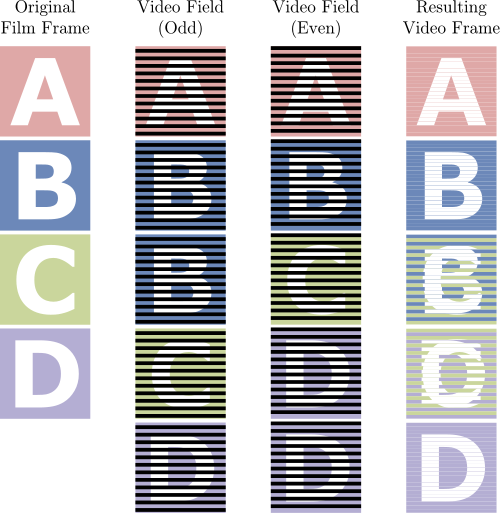
Each film frame is captured at least twice on a two or more fields. The first field, for example, captures the odd field of the first film frame. The second field captures the even field of the first film frame. The third and fourth fields do the same to the second film frame, but the fifth field doubles back and captures the odd field of the second frame. The sixth field then captures the even field of the third film frame.
This table might do a better job at outlining the process of capturing four film frames in ten fields.
| Video Field |
Film Frame |
Odd or Even |
Result |
| 1 |
1 |
odd |
TV Frame 1 |
| 2 |
1 |
even |
| 3 |
2 |
odd |
TV Frame 2 |
| 4 |
2 |
even |
| 5 |
2 |
odd |
TV Frame 3 |
| 6 |
3 |
even |
| 7 |
3 |
odd |
TV Frame 4 |
| 8 |
4 |
even |
| 9 |
4 |
odd |
TV Frame 5 |
| 10 |
4 |
even |
If you’re wondering if there’s something to this ratio, in fact, there is.
4:10 is equal to 24:60. There are 24 film frames in one second of a film as there are 60 video fields in a second of NTSC video.
It’s Better Not to Guess
Interlacing and blending probably wouldn’t work too well when the frame rates are doubled, such as displaying a 60 Hz signal on a 120 Hz display, but it does suggest alternatives to interpolating intermediate frames. The reason the telecine worked so well, other than jagged interlaced artifacts that can be easily smoothed out, is because it didn’t “guess” what was in the image. It used the image itself.
No matter how much writing you do, you can always improve. Arguably, the two best writing guides you could ever read are:
And just in time for the beginning of the semester, you can buy the thirtieth-anniversary edition of Zinsser’s book for your Kindle for $2.99.
The above links to Amazon are affiliate links. If you buy something through those links, I will earn a commission fee.
The Incredible Story Of Marion Stokes, Who Single-Handedly Taped 35 Years Of TV News:
She’d feed a six-hour tape into the recorders late at night. She’d wake up early the next day to change them (or conscript family members to do the same if she wasn’t home). She’d cut short meals at restaurants to rush home before tapes ended. And when she got too old to keep up, she trained a younger helper named Frank to run the various recording equipment.
Having researched television news over the years, it’s surprising where you’ll find some of this material. I’ve seen some tapes for sale at flea markets or on eBay. Sometimes a rogue producer will donate a copy of a news program to a library or museum. A television station will submit a program for an award, such as a Peabody Award, and the material was kept. And where would we be if not the for the television news archive at Vanderbilt University? And weren’t they once sued for copyright infringement?
Sadly, the producers of these programs are often a last resort either because they simply don’t have the material or they’ll charge an exorbitant amount of money to access this footage. After begging and promising not to publicize the material, I once paid NBC News $75 for a thirty-minute, episode of Chet Huntley Presents from 1963 that I used for a conference paper.
According to this story, the Internet Archive is going to digitize the material and make it available on their website. That sounds great but also really daunting. Let’s look at the math. If indeed Stokes recorded 140,000 Extended Play tapes, at six hours each, that amounts to 840,000 hours, or 35,000 full days, or almost 96 years of video. Digitizing analog material, such as VHS, happens in real time, plus the time it takes you to load the tape, press play, and start the recording. That’s going to take a lot of VHS decks, each connected to video capture card and a relatively zippy computer.
Crowdsourcing might be a solution. I have a VHS deck and an Elgato analog video capture card lying around. Can I sign up to digitize 100 hours or so of this? Or will a donation suffice?
It’s been years since I’ve used Microsoft Word for anything other than opening documents that people send me over email. In 1996 and even in 2006, it was simply unthinkable to have a Mac without Microsoft Word. But today, there are so many other tools that do a better much job at specific functions than using only Word.
For writing long manuscripts, I use Scrivener because it stores your research and also makes it easy to focus on a particular part of your paper. If I need to prepare a document with some layout and defined styles, then I’ll turn to Pages. For a linear document where the content is more important than the layout, then I’ll use Byword.
For taking notes and preparing for class, I’ve been using OmniOutliner. If you think about it, a class lecture or a presentation is basically a sequential list of points you want to communicate. Outlining them allows you to list the major topics and to drill down to elaborate on those topics. The best part of the outliner is that you can easily rearrange any part of your outline. I’ve recommended it to students as a note-taking solution, but most starving students balk at the price.
Earlier today, I found Fargo, a free HTML outliner that stores its files in your Dropbox. It lacks a lot of features compared to OmniOutliner, although it works great for a web app. But Fargo has one feature that OmniOutliner doesn’t have: it publishes to your WordPress blog, which is how I posted this entry.
If you want to see how an outliner is superior to a word processor for certain tasks, try Fargo.
Trying to escape from rampant marketing is especially tough right now because of the all-consuming Christmas season and the impending release of Anchorman 2 on Christmas Day. It’s everywhere.
We discussed movie marketing and trailer in my American Film Industry class this last week. One example of clever marketing was the Ron Burgundy phenomenon. If you’re not keeping track, he’s been on…
And if scotch-flavored ice cream wasn’t enough, you can add to the list, actual scotch whiskey.
This much marketing makes me suspicious of the film product.
The Japan Society in New York is celebrating Yasujiro Ozu’s 110th birthday by screening his 1960 film Late Autumn. They are hosting a raffle of great Ozu prizes for all ticketholders, including exclusive commemorative materials from Shochiku, as well as a special reception afterwards.
Thursday, December 12, at 7:00 PM.
The Yale University Art Gallery is screening two Bruce Conner films generated by the assassination of John F. Kennedy in 1961: Report (1967) and Television Assassination (1975).
The screenings will be followed by a discussion with Marisa Nakasone, Marcia Brady Tucker Senior Fellow, Prints, Drawings, and Photographs, and J.D. Connor, Assistant Professor, History of Art, Yale University.
Thursday, November 21, 5:30 PM
Yale University Art Gallery
1111 Chapel Street (at York Street)
New Haven, Connecticut.

The Motion Picture Association of America adopted an age-based movie rating system in 1967, taking effect the following year. Initially, there were only four ratings.
| Rating |
Restriction |
| G |
General Audiences: All Ages |
| M |
Mature Audiences: Parental guidance |
| R |
Restricted, 16+ with parent |
| X |
Adults Only |
These ratings replaced the all-or-nothing system in use since the 1930s, colloquially known as the Production Code, and segmented the movie audience by age and allowed for adult-themed movies to proliferate.
The ratings have gradually evolved in the nearly fifty years since their introduction. G and R remain largely intact to this day. M evolved to the confusing GP, meaning General Audiences with Parental Guidance, and then to now-familiar PG. And in the 1980s, PG movies that were considered a tad too violent were rated PG–13 as a middle-ground between PG and R. However, the X rating was something almost mythical. In my adolescent-of-the–1980s mind, an X-rated film was always a pornographic film, and anything X-rated was a sexually explicit, adults-only affair. It might still connote that to the kids of today.

Deep Throat and The Devil in Miss Jones at a Times Square theater in New York, May 31, 1980. (AP Photo/Dave Pickoff)
Study film for a few years, and you will learn that the X-rating was applied to many more films, including some that didn’t have much sexual content. For example, the 1969 Haskell Wexler film Medium Cool was initially assigned an X before an appeal reduced it to a more appropriate R rating. The film has no depictions of sex at all, although there is an extended violent sequence of documentary footage, shot by Wexler and his crew, where the Chicago police pummel protestors at the Democratic National Convention. It’s disturbing, but not X-rated disturbing.

Medium Cool (1969) has some violent scenes of the police riot in Chicago.
The X-rating was applied to seventy-two films in its first four years, from 1968 to 1972. This peak coincided with the so-called golden age of porn, beginning in the 1970s.
| Year |
X-Ratings |
Notable Titles |
| 1968 |
3 |
Birds of Peru, The Miracle of Love, Sin with a Stranger |
| 1969 |
13 |
Make Me a Angel, Sex of Angels, To Hex with Sex |
| 1970 |
22 |
The Dean’s Wife, Satanis: The Devil’s Mass, Sexual Freedom In Denmark |
| 1971 |
34 |
Bunny and Clod, The Dirty Movie, Erotic Salad, Snuff |
Whither the X rating? In 1990, the Motion Picture Association of America replaced the X rating with NC–17. The rating was designated for films that were for adults but non-pornographic. Initially, films embraced the NC–17 rating as a desirable substitute for being branded with a pornographic rating or marginalized by not being rated at all.
| Year |
NC–17 Ratings |
Notable Titles |
| 1990 |
18 |
The Cook, The Thief, His Wife And Her Lover, Henry and June, Tie Me Up, Tie Me Down |
| 1991 |
16 |
In The Realm Of The Senses, Dice Rules, Rodney Dangerfield ‘Nothin’ Goes Right’ |
| 1992 |
7 |
Bad Lieutenant, The Loves Of Lady Chatterly |
But as video stores and movie theaters began to associate the new NC–17 rating with the old X rating, fewer films would take the NC–17. Instead, they would surrender the rating, remaining an unrated film, or appeal for a milder R rating. Today, the rating is very rarely used. In the last three years, only five films have taken the NC–17 rating.
| Year |
NC–17 Ratings |
Titles |
| 2011 |
3 |
El Infierno, A Serbian Film, Shame |
| 2012 |
0 |
|
| 2013 |
2 |
Blue is the Warmest Color, Lucky Bastard |
For a rating that has been around longer than the original and fabled X rating it replaced, the NC–17 appears to be a bust. Instead of classifying high-brow, adult-themed films and pave the way for more of them, it has mainly marginalized them away from a theater near you.
The above link to Amazon is an affiliate link. If you buy something that link, I will earn a commission fee.

I was a late adopter to YouTube. I never liked that it used only Flash to display its videos in its early days, making my over-clocked PowerBook get hot from watching a video. I also disliked the low default resolution of its videos. For years, the typical YouTube video had 360 lines of horizontal resolution, which was fine for watching on the web, but if you wanted to use it for close study, you were almost better off watching a VHS and certainly better off finding a DVD.
Over time, I began using it here and there for quickly locating films I hadn’t seen in years. For example, in my experimental film class, YouTube was useful for compiling a screening list. I could locate films I considered screening, and verify that they matched my memory of them. In this case, YouTube was a wonderful resource for teaching and research.
But today, YouTube reminded me how it can be a terrible resource for teaching and research. As a way to search for a specific video, it’s great. But treating it like an archive will disappoint you. It’s simply too impermanent to use as reliable teaching tool. Some videos are so evanescent—here yesterday, gone today— that they may as well have never have existed on the site.
On a WordPress site for my American Film Industry class, I posted separate entries for two films we referenced in the class. Each entry included a embedded video clip from YouTube. As I went to look for review those entries today, the two clips are gone.

The poster image for a clip from Will Success Spoil Rock Hunter? on YouTube.
The first entry included an embedded YouTube clip from a somewhat forgotten film, Will Success Spoil Rock Hunter? (1957). The clip was of an “intermission” towards the end of the film, where the lead actor, Tony Randall, breaks the fourth wall and addresses the audience. As US audiences of the 1950s abandoned the movie theater for the comfort of watching television at home, this forced intermission reminded audiences of the sacrifices television viewing demanded they make: a smaller picture, radio interference, vertical scroll, and snow. And of course, let’s not forget about the interruptions from advertisers, which are an object of satire in this film about advertising.
Although a poster image for the clip still appears on the blog entry, the embedded clip will not play. The error notice indicates that the clip was taken down because the “video contains content from Fox, who has blocked it on copyright grounds.” Fox does indeed own the rights to the film, as the film was released by 20th Century-Fox and will hold the copyright until the middle of this century. But the clip hosted on YouTube allowed me to use it in accordance with fair use doctrine. My use of the clip was for comment and criticism and constituted only a part of my blog post, albeit an important part. The short clip on YouTube and my associated blog post could even serve as promotion for a forgotten film that could be resuscitated. Depictions of the American mid-century advertising industry might have been exploited some years ago. Instead, the clip was taken down, and the film will remain in obscurity.
I posted the second entry, on Jean-Luc Godard’s Breathless, to demonstrate the influence of the French New Wave on Bonnie and Clyde. The clip demonstrated the use of jump cuts in the film. As any student of cinema knows, Breathless popularized the use of the jump cut, and it gave young filmmakers of the 1960s a feeling of “breaking the rules.”Arthur Penn used it extensively, most noticeably in the opening sequence of the film when Bonnie Parker is filled with ennui in her room and becomes excited when a stranger comes to her home.

When I went to review the blog post, the clip was gone. YouTube indicates that the “video is not available in your country.” It’s seriously disappointing that the clip is gone because it robs my students the opportunity to see the nine jump cuts in a thirty-five-second sequence. To demonstrate this, I either have to search for another YouTube clip that will be undoubtedly be blocked in the future or resort to circumventing the copy protection on a DVD to extract that clip.
The Fifth of November has been observed in England since the plot to bomb Parliament in 1605. Activists have reclaimed this day and Guy Fawkes to stand against unjust state and corporate power. Techies can commemorate this day and rebellious spirit with iFixit’s EFF Activist Bundle:

This 5th of November, iFixit is teaming up with the Electronic Frontier Foundation (EFF) to empower technology users (AKA everyone) to take their digital stuff back from government interlopers and corporate money mongers.
What are we reclaiming? Common sense and fair use. iFixit is fighting for your right to repair your stuff. And the EFF is fighting to protect your right to use that stuff without the NSA—or anyone else—peeking over your shoulder.
For $60, start repairing your own digital gear. It’ll pay itself very quickly, as well as raising some funds for the Electronic Frontier Foundation.


