Scholar
Warning: Undefined variable $category_id in /home/juanmonr/juanomatic.net/wp-content/themes/monroy2014/category.php on line 7
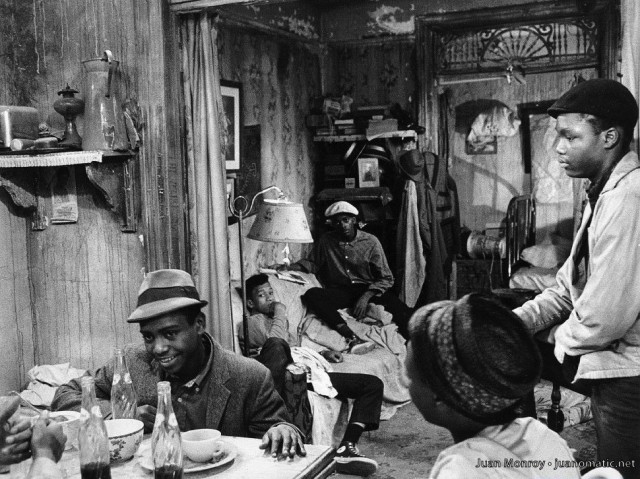
Brooklyn’s Light Industry screens Shirley Clarke’s The Cool World, a gritty look at New York’s street life and a rare, frank look at African-American life in the late 1950s. I screened the film many years ago at a NYU summer session class New York Independents.
If you’re in the neighborhood, see the film on Tuesday, July 17, at 7:30 PM.
Light Industry is at 155 Freeman Street, in Greenpoint, Brooklyn.
The Academy of Motion Picture Arts and Sciences, those responsible for the Oscars, sent a flyer in the mail (how analog, right?) announcing the 2012 Academy Film Scholar Program.
To stimulate and support new and significant works of film scholarship, the Academy Film Scholars program awards grants of $25,000 to two individuals each year. Established scholars, writers and historians are awarded grants to research topics that may include cultural, educational, historical, theoretical or scientific aspects of theatrical motion pictures.
The 2012 application is now available, and the deadline for submissions is 11:59 PM (PST) on October 1, 2012.
Brilliant!
To help raise awareness of the demand for a standalone HBO streaming service, a new site — Takemymoneyhbo.com — has sprung up, allowing members of the public to say (and tweet) how much they’d pay for the service each month.
I said $8 because that’s the same price as Netflix streaming and a Hulu Plus subscription.
(Via The Next Web.)
The Los Angeles Conservancy kicked off its twenty-sixth annual Last Remaining Seats film festival this past week. Sarah and I went last year to watch Sunset Boulevard at the Palace Theater as that Broadway movie house turned 100. and my parents are going to three screenings this month. The festival celebrates the legacy of the picture palaces in downtown Los Angeles. LA’s Broadway was an important hub of movie exhibition, hosting many premieres, as the movie business was developing into a vertically integrated industry, where studios would control the production and the first-run exhibition of their films.

The Broadway theater district would fall on hard times over the years, as just about everything moved out of downtown. One of the first movie theaters to draw audiences outside of downtown was the Egyptian theater. It was the first movie palace in Hollywood.
Larry Harnisch, who publishes the always fascinating The Daily Mirror blog, chronicles the opening of the Egyptian. One of the curious aspects of the new theater was the reserved-seating policy and how they ticketed theater patrons nearly a hundred years ago.
Grauman inaugurated new policies before opening the theatre. He announced on October 7 that the Egyptian would be the first theatre on the West Coast to reserve seats for every performance. Patrons could buy tickets downtown at Barker Brothers’ music department two weeks in advance, or by calling the theatre at Hollywood 2131, 2132 or 2133. Two complete shows ran daily, a matinée at 2:15 pm and an evening screening at 8:15 pm. Afternoon prices ranged from 50 cents to $1, and evening shows cost 75 cents to $1.50.
While the theater’s design and construction are certainly remarkable, I find these mundane details to reveal a great deal about the role of the Egyptian in the history of movie exhibition.
If you wanted to see a show at the Egyptian, you could visit a furniture store, ten miles away from the theater, and buy tickets up to two weeks in advance. Or you could call the theater to order tickets. (I’ve seen ads where patrons could order tickets over the mail as late as the 1950s.) Undoubtedly, the Egyptian was marketed as part of special occasion. It was not a casual movie-going experience, as the case during the Nickelodeon era, 1905–1912, that the picture palaces had essentially killed in the mid 1910s. To draw movie audiences out of downtown, the Egyptian needed to act as a new flagship theater of the American film industry.
As the LA Conservancy celebrates the downtown movie theaters, it’s also important to remember the theater that helped end the golden age of the Broadway movie palace.
Today from Gilt City:
An exclusive, VIP tour for two of the “Piers Morgan Tonight” set.
I’m a cheapskate so I’d never buy something like this. However, if I’m paying $2,500 I would like, at the very least, a lesson on phone hacking.
This semester’s History of Cinema course concluded with the contemporary Hollywood entertainment economy. One of the themes we continually encountered was Hollywood pursuing spectacle and scale in order to remain relevant. This contrast with what we have seen throughout the semester with emerging cinemas relying more on New Wave priorities of stylistic experimentation and character development.
One of the main topics we covered was the new exhibition technologies of 3D and Digital Projection. While these have been around for decades, and for over a century in the case of 3D photography, the new push for faster frame rates seem as a new way for Hollywood to separate itself from other cinemas from around the world.
David Bordwell has recently covered the campaign for 48 frames per second—double that of the traditional sound film frame rate of 24 frames—led by Peter Jackson and James Cameron as a way to eliminate the artifacts visible in their digital-effects-heavy films. I won’t repeat everything he has to say in that illuminating article but I found a few points relevant for our discussion.
- In order for theater owners to adopt new hardware, there needs to be a viable path to recovering those costs with profitable software. It’s hard to imagine filmmakers with a better profit potential than Jackson and Cameron.
- By pioneering new projection technology, it will be hard for other filmmakers—both within and outside of Hollywood—to match them in terms of spectacle.
- Bordwell is right when he points out the 48 fps debate overlooks the entire issue of story. It’s not that the two are mutually exclusive. It’s just that they are almost working with an entirely different medium than other filmmakers.
We have seen in various other nations numerous attempts to foster a strong national cinema. International co-productions and complex financing arrangements were such methods, but while they might have matched (or approached) the scale of a Hollywood film, they rarely accomplished any sustained success. What had worked was making films with a strong personal vision, complex characters, and drawing on rich sources such as history, politics, or philosophy. These films might not have yielded immediate financial successes, but films like these kinds fostered a strong sense of national identity and also became the hallmarks of international cinema. I tried to screen films of these type throughout the semester.
As filmmakers chase the apex of digital realism, we should not let the digital revolution foreclose what made the cinema, not just entertaining and spectacular, but an international art form.
And just in time for the May Sweeps and the summer vacation season, a very special episode of Modern Family….
Disney-owned ABC airs an episode set in Disneyland.
When the family travels to Disneyland, Phil struggles to keep up with Luke.
Really, Modern Family? Again!?!
From my friends in the Queens College Educational Technology Community:
Knowledge in the Digital Age: Teaching, Learning, and the Googlization of Everything with Dr. Siva Vaidhyanathan
All are invited: LaGuardia’s Library Media Resources Center is once again pleased to offer its annual Knowledge in the Digital Age speaker’s event. This year, Dr. Siva Vaidhyanathan has accepted an invitation to speak on the issues revolving around technology in the lives of faculty and students.
When: Tuesday, May 8, 2012 at 2 p.m.
Where: LaGuardia Community College, E Building, Poolside Cafe
Cost: Free
Refreshments: Definitely
LIMITED SEATING AVAILABLE, register ASAP. To do this and to get more information on the event go to:
http://knowledgeinthedigitalage.eventbrite.com/
The Library Media Resources Center and the organizing committee would like to thank LaGuardia’s College Association and the CUNY’s LILAC council for co-sponsoring this event.
Should you need ADA accommodation, please contact Charles Keyes by phone at 718-482-6018 or by email: ckeyes@lagcc.cuny.edu
(Via CUNY Academic Commons.)
While the New York Post received Mayor Bloomberg’s nomination for the Pulitzer Prize in fiction, it was another story that sent a few chills down my spine. Will Hulu be tied to a pay TV subscription?
the move by Hulu toward the new model — called authentication because viewers would have to log in with their cable or satellite TV account number — was behind the move last week by Providence Equity Partners to cash out of Hulu after five years, these sources said.
The major networks founded Hulu to prevent everyone from circumventing revenue-producing way of watching television. The move has been great. It has been a formidable way to get TV shows, and I have been a subscriber of Hulu Plus since the service launched. The appeal has always been that I can watch the television shows I want to watch and when I want to watch them.
This move could threaten the a-la-carte model that Hulu provides in favoring of bundling a package of channels that I’m never going to watch. While the Post article indicates that Providence Equity Partners is behind this strategy, I question that thinking for two reasons.
- the fact that one of the owners of Hulu is Comcast, the biggest and least favorite cable MSO in the United States, and a deal like this really help retains its customers; and…
- Hulu was up for sale last year, but then the sale was pulled due to its “unique and compelling strategic value”.
Free Press has launched an online petition to save Hulu from its possible fate as some “TV Everywhere” service that will only inflate cable bills.
(Via TV News Check.)

There’s so much to cover with Raise the Red Lantern (1991), a film I screened in this week’s History of Cinema class. There is the film’s historical portrayal of Chinese feudal society in the early twentieth century. The particular depiction of misogyny is also instructive because it reveals a great deal about the treatment of women in this polygamist family. However, for this review, I want to discuss the way the film’s style portends the fatal ending and that endlessness of the women’s subjugation.
Warning: Spoilers are afoot
Think of the film as depicting a cycle.
First, we see the new mistress coming to the home and being introduced to the older mistresses. As we see each one, we understand that each mistress almost perfectly represents a generation of women. We know little of the Second Mistress other than her desire to bear a son for the Master. The Third Mistress, on the other hand, was at one time a working opera singer. The Fourth Mistress, as a university student, stands as the most ambitious of them all. Each one is more professionally and socially accomplished than the previous one. However, each of these “generations” are compressed into a matter of years, although the actual length is indiscernible.
Second, the Master’s physical absence throughout the film amplifies his power, especially compared to the mistresses, servants, and even Doctor Gao. The Master is conspicuously absent for most of the film. The film employs a variety of tricks to obscure him, such as cutting away at a key moment, having objects block or screen him, or simply framing him from a great distance to render him indistinct. Such techniques give him a spiritual quality that makes him almost immortal.
Third, the film foreshadows the ultimate doom for two of the mistresses. When we see the Third Mistress on the roof of the building, which will be of great narrative significance in the film’s penultimate scene, she resembles an apparition. Her red dress contrasts with the blue sky and monochrome stone structure of the house. As the wind blows and she sings, she has a ghostlike quality. This not only a sign of her fate but also a manifestation of women whose spirits are unsettled. Fourth Mistress punctuates the spiritual tone of that scene when she later confides with First Mistress, “This place is haunted.”

Finally, after the Third and Fourth mistresses’ fates are sealed, we see a Fifth Mistress join the house. She is presumably the youngest of them all.1 As the cycle begins anew, there are some unsettled ghosts in the house. Fourth Mistress attempts to “unleash” Third Mistress’s ghost by lighting her lanterns and playing a gramophone recording of her singing. Moreover, Fourth Mistress has apparently gone mad. Her life is spared but the trauma of witnessing, and to some degree causing, Third Mistress’s death. But the house and its generations of tradition continue undisturbed. The film suggests that there will be no end to this cycle.


