Scholar
Warning: Undefined variable $category_id in /home/juanmonr/juanomatic.net/wp-content/themes/monroy2014/category.php on line 7

Although I wasn’t one of the 800,000 subscribers who cancelled their Netflix subscriptions, I did cancel their DVD-by-mail part of my subscription and kept the video streaming since I use that more anyway. Two days ago Netflix charged me for the new billing period, which includes only the streaming service, and today I received what should be my last DVD-by-mail from Netflix, at least for now.
This marks the end of an era for me. I joined Netflix in 1998 when my first DVD player, a Toshiba branded deck, came with a card that offered a free trial for an unlimited DVD by mail service. At the time, the service cost $15 a month and you could have 4 disks at a time. I remember wondering, when I first signed up, how are they going to send me a DVD by mail, considering that I was used to getting DVDs encased in those jewel boxes. Little did I know that they had designed those now ubiquitous red-and-white sleeves.
I held on to the service for a few years until I moved to New York, mostly because I thought that the DVDs had to come from California, where the company was based. Little did I know that the service had gone national.
I re-upped in 2004, partly in an effort to get the airline-mile bonus that Netflix offered to new customers. At the time, the subscription offered only three disks for almost $20 per month, and over the years, I scaled back to two disks, then to one disk, and, after this week, to none.
The streaming service proved to be the “disk killer” for me. The convenience of watching a movie or television series, even if it’s not my first choice, is much better than waiting two-to-three days to watch a movie on DVD. I was a bit late the streaming service when it was first offered. I had a Powerbook G4 as my only computer from 2004 until 2009, and the PowerPC chip wasn’t good enough to run the streaming service. I didn’t do Netflix streaming until I bought a Roku in 2009 to watch Netflix Instant through a TV. Since then I have linked my Blu-Ray player, iPad, and iPhone to my Netflix accounts. It’s now possible to see Netflix just about anywhere I can get a 2 megabit Internet connection.
Will I miss the disks? Not really. DVD was always a problematic medium, given its rather short life.
I know that Neflix gets blamed for killing the local video store, and that studios are withholding streaming content from Netflix because they fear that Netflix is going to kill the DVD format and then the multichannel video distributor. I have theories behind the decline of each of these institutions, and I don’t think Netflix has had a substantial role. I’ll save that discussion for another day, but for now, I know that my mailbox will be a little emptier for the time being.
On my recent trip to Los Angeles, I was coming flying back to New York through San Francisco, which was a bit longer than I had originally planned, but while there, I had the pleasure of carefully studying, Television: TV in the Antenna Age, the exhibit of vintage television hardware (and some memorabilia, too) at the SFO Airport Museum.

If you know me, you know that this is exactly the kind of thing that excites so many of my interests—television, once new but deprecated technology, some history, and, yes, the airport location. When I used to travel through here more often when I was younger, the museum had some pretty bland exhibits. I can’t even remember any of them, except for a sports-related one around football season, that were as exciting as the current exhibit.

I spent about an hour going through all of the hardware, and I snapped a lot of photos. Some of the my favorite pieces were the various TV-radio combinations. I like the idea of all-in-one devices, and one was designed to have programmed all of the New York City radio and television stations that you could press a button and it would automatically tune to that station. “It just works.”

The portable television sets were also novel since portability in the 1960s was remarkably advanced fifty years ago. Some of those sets were as small as 4-inches in size, which isn’t much bigger than a current smartphone screen.
If you’re at SFO and have a layover (or, more likely, a delay) stop by Terminal 3 and have a look, or just look at my photo album.

Although it’s how I found out about the Japanese earthquake, I cannot fully believe what I read as “news” on Facebook or Twitter. Not until I can confirm with some kind of journalistic news source. Sorry.
Because I haven’t been able to verify it with an authoritative source, I have been in disbelief over the death of former NYU Professor of Cinema Studies, Robert Sklar. I saw that he had died this weekend on my Facebook News Feed two days ago from some very trusted and accomplished friends, but I haven’t seen anything from the local newspapers or from the university. (I mean no disrespect to fellow NYU alum J. Hoberman, Frances Guerin, and Matt Singer, who all wrote touching tributes to a great scholar.)
[Update: The New York Times has published an obituary on Thursday, July 7, and Richard Allen penned the department’s official tribute on the Cinema Studies website.]
Unlike most Cinema Studies students at NYU, I never took any of his classes. During my years, he taught only the masters-level introduction to historiography, a course I had been excused from taking because of my extensive undergraduate coursework at UCSB. Despite missing out on this ritual of passage at NYU, I had some great moments with Bob Sklar over the years.
For one thing, he needed a lot of help with his computer. Having heard from someone in the department that I was good at “computer stuff,” I was contracted to help him and his wife, Adrienne Harris, an intellectual powerhouse in her own right, with their computers. I did a few things over the years, like get their printers installed and working with their Windows machines, installing and securing their wireless network, and finally convincing them to get an iMac. However, after migrating them to Macs, I never heard from them again about needing help with their computers.
While we waited for downloads and installations, Bob and I would talk. Sure, we chatted about film and my own research, but we didn’t talk about that for long. I think he and I shared a certain weariness about “shop talk.” So we talked about baseball. A lot. He was a Yankee fan, and he held a certain disdain for my loyalty to the Dodgers. It was mostly because, like me, he was a transplanted Los Angeleno (Long Beach, actually), but, unlike me, he rooted for the Angels. The Los Angeles Angels. Not of Anaheim but of the Pacific Coast League. I never argued with him, figuring that he deserved respect for even having been to a PCL game and that he wasn’t a fan of the San Francisco Seals.
One of my favorite recollections of him was when I submitted a Statement of Progress as part of my transition from the masters to the doctoral program. Having managed the Cinema Studies softball team for the prior two years, I thought it would lighten the mood if I included my softball hitting statistics with my statement. Professors Straayer and Sklar were in charge of my meeting, and since they were both baseball fans, I knew my stunt would go over well. Sure enough, Sklar looks over my documents and comes across my softball statistics. He nods approvingly and says, “pretty good. But why no home runs?”
I never talked about Fantasy Baseball, figuring it would be a sore point for him, given that he was one of the developers of the game but never made any money from it. But we did go to a few games together. He was nice enough to take me to a few Yankee games. It was the closest I ever felt to watching a game with my father, other than, of course, seeing a game with my father. I kept a neat and thorough scorecard, and deferred to him on whether it was a hit or an error. For a graduate student with no income duringthe summer months, it was a nice treat to be his guest at those games. And I’m glad that I had enough money left that summer to buy him a beer.
For those of us still adjusting to NYU’s migration from our in-house mail and calendaring systems to those hosted by the everyone’s favorite technology behemoth and personal data farm, it’s been a little tricky to get our mobile devices to synchronize with our mail and calendars. But hey, if every other company uses Google Apps, why can’t we?
Actually, I found myself liking the transition. I now actually use the calendar and the Office-like apps have been pretty handy, especially on my iPad.
However, my biggest challenge since the migration has been getting more than my default calendar to appear on my iPhone and iPad. I was really pleased to see that in today’s New York Times technology section, they offered a solution to my problem. Well kind of.
What the article failed to mention was that we can’t access our Google Apps settings using Google’s default settings page. We have to do it through our host domain. For those of us, at NYU, we have to visit a different page. But once you navigate there, authenticate yourself, it’s just a matter of clicking the right boxes. After that, you have to have your iOS device remove your Google hosted calendars from your device. (Don’t be scared, it’s in the CLOUD.) Add your calendars anew, and a few moments later, your calendars will appear on your device.
This was a first for me.
For my History of Cinema III class at Queens College, I assigned the textbook by Winston Wheeler Dixon and Gwendolyn Foster, A Short History of Film (Rutgers University Press, 2008). This is the first time I’ve taught this particular course and the first time I’ve used this book. I selected it for three reasons:
- It is used in the other History of Cinema courses in the Media Studies department.
- It’s very inexpensive, especially compared to other college textbooks.
- There was an ebook version available, and there’s an audiobook.
The ebook is actually for Kindle, which made me a little reluctant. For one thing, there’s the whole proprietary issue and the students will be locked into a single platform, although you can use Kindle on just about every platform save for your television set. But at the same time, the Kindle is not a bad way to read books, and I thought that the early-adopters in my class would find it a valuable use for their e-readers. Rock on!

What I had forgotten to consider is that when most instructors assign readings, myself included, we do so by listing page numbers. That has worked fine on the other electronic book I’ve used, Campbell, Martin, and Fabos’s Media and Culture (Bedford-St. Martin’s, 2010) because the ebook is only readable using a web browser. And the text shows up with virtual page numbers that correspond to the print edition.
Page numbers on true ebook titles are useless. Formerly, the only way a book would get repaginated would be when the publisher printed a new edition. Now, this happens at the whim of the reader. If you resize the type, the page numbers are instantly recalculated. Turn it sideways on an iPad or an iPhone, the page numbers are again completely revised. One student brought this to my attention, and I was caught unprepared for a solution, although I did come up with one.
Thankfully, chapters remain stable in this new reading experience so I devised a workaround using the chapters. The syllabus now contains a decoder that includes the chapter number and the particular headings.
Instead of assigning
Dixon and Foster, 239–264
I now have to assign:
Dixon and Foster, 239–264. Chapter 8: “French New Wave” to “Italian Cinema in the 1960s”
And the student has to hunt for it.

It’s not the biggest pain, I guess, but there has to be a better way. We could use in-text anchors or something similar to what certain research databases used when reproducing full-text articles in HTML rather than PDF. But we have to remember that there’s no fewer than three commercial ebook formats (the varying flavors of epub from Apple iBooks, Kindle, and Nook) and because one supports some new coordinate system, it doesn’t mean that the others will support it.
[Insert rant about proprietary media formats.]
The above links to Amazon are affiliate links. If you buy something through those links, I will earn a commission fee.
As I mentioned in class on Monday, Cleo from 5 to 7 remains one of the best examples of the French New Wave for many reasons. First, the film is one of the few made by women during this very vibrant period in film history. For the usual reasons, women were not part of the filmmaking fun in this rather male-dominated scene. The fact that Varda was able to break through the gender barrier is certainly remarkable.

Second, the film ties into very contemporary city life. You get a lot of scenes that feature Parisian life quite prominently, especially those parts that young Parisians would find familiar. One such scene is the cafe scene when Cleo enters in plays her song on the radio to see if she can get anyone’s attention. The personalities and conversations in that scene would have rung familiar to anyone in the city at the time.
Third, the film features rather visibly, the concern for formal experimentation and political voice for which the so-called Left Bank filmmakers became known. The formal element of the film was exposed through its chapter structure, which were very clearly seen on screen. Although the story is about Cléo, other characters get their own internal voices portrayed on screen and the chapter titles make that break from the film’s narration quite clear. An early example is when we see Angèle at the cafe trying to console an inconsolable Cléo.

There’s also a fair amount of politics involved, too. You can see that in the clip where Cléo and Angèle are driving around in the taxi cab, and we hear the radio news cover Algeria, which was arguably one of the biggest events of the early 1960s in France and was covered repeatedly by the French New Wave filmmakers.

And, of course, there’s an undeniable element of human drama. The final shot of the film, with Antoine and Cléo looking off into the distance, marks a huge departure from the self-centeredness Cléo exhibits throughout most of the film.

In today’s New York Times, Brooke Barnes writes about the possibility of movie studios adding a new “window,” or a new run, to the existing tiers of home video sales. The new window, called Premium VOD, would begin as little as 45 days after the theatrical run would start and would be facilitated by video service providers (i.e., your cable or satellite company). The move is done to combat slumping DVD/Blu-Ray sales and Internet piracy.
The main opponents to Premium VOD include the movie theaters, which depend on the content, and the retailers of DVDs. Both fear that customers would opt to watch movies at home for a price that is lower than either theatrical exhibition or video disc sales.
Students should consider this in the context of the old run-zone-clearance system that emerged nearly 100 years ago and was pioneered by studios such as Paramount. Also, consider the digital revolution in media and how this marks another transformation in the film industry.
Yesterday, ArsTechnica posted an article about the Motion Picture Patents Company, an early 20th century patent pool and cartel established by Thomas Edison to protect the profits of his and his partners companies. Colorfully called, Thomas Edison’s Plot to Destroy the Movies, the article is an accessible summary of the cartel was formed, how it controlled the film industry at the expense of innovation, and how it was eventually undermined by a group of independent filmmakers, led by Universal’s Carl Lamelle.
ArsTechnica writes about this as a cautionary tale of how large companies who control a media industry, such as Internet access, recorded music, or even the movies, can stand in the way of innovation once they grow so powerful and unchallenged by competition.

With all the hype of the Lost series finale on May 23, Sarah and I went to Los Angeles to see the finale with 2,000 other Lost fans who packed the Orpheum Theater downtown.
The finale party was bankrolled by Global Cash Card’s founder Michael Purcell, an admittedly “crazy” Lost fan, and hosted by Jay and Jack, a father-and-son podcasting duo who host my favorite Lost podcast.
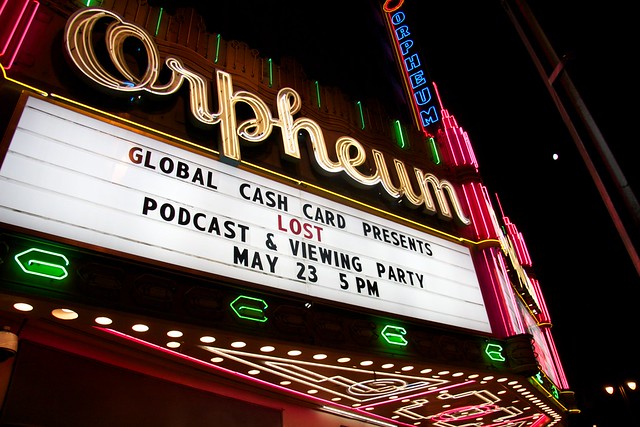
The party was held in the eighty-four year-old former vaudeville and motion picture palace, which recently underwent top-to-bottom restoration. In addition to screening the 153-minute finale of the series, Michael Emerson entertained the audience for over an hour with a very courteous question-and-answer session.

Having just taught a class last week on the advent of widescreen cinema to compete with television in the 1950s, it is very tempting to see Forbidden Planet this Friday and Saturday at the restored Loew’s Jersey theater in Jersey City. Even if you’ve seen this film before, you’ve probably never seen it on the BIG, w-i-d-e Cinemascope screen.
I’ve been wanting to see a film there since it’s been completely restored to its old Nicholas Schenck-glory days, although I won’t not be able to make it, as I’ll be out of town for “fake” Thanksgiving.


