Remember those documents that hackers took from Sony Pictures Entertainment at the end of last year? Did the North Koreans retaliate against Sony’s plans to release The Interview? Were they upset because it depicted an attempt to assassinate its supreme leader? Or did they want to spare us a really bad movie? In any case, the hacking escalated to the point of involving the White House. And today, those emails and documents are available for anyone to read.
Wikileaks released a searchable version of the hacked Sony Archives, including internal documents and emails. Some were released last year, but today, they are all searchable in one place. Wikileaks founder Julian Assange rationalized the release of these documents because it “shows the inner workings of an influential multinational corporation. It is newsworthy and at the centre of a geo-political conflict. It belongs in the public domain. WikiLeaks will ensure it stays there.”
Apparently, Wikileaks is very interested in showing the connection between Sony Pictures and the Democratic Party. The press release mentions some key interactions between the multinational media company and the US political party over the years, including:
Sony Pictures Entertainment CEO Lynton attending dinner with President Obama at Martha’s Vineyard
Sony employees being part of fundraising dinners for the Democratic Party.
Setting up a collective within the corporation to get around the 5,000 USD limit on corporate campaign donations to give 50,000 USD to get the Democratic New York Governor Andrew Cuomo elected as “Thanks to Governor Cuomo, we have a great production incentive environment in NY and a strong piracy advocate that’s actually done more than talk about our problems.”
Also, the artwork used to illustrate the Sony microsite consists of the “Sony” wordmark and an illustration of Spider Man, a Sony Pictures property, lifting his mask to reveal the donkey logo long used by the Democratic Party.
The New Preservationists?
As a media history scholar, digging in the archives of a film studio, a broadcast network, and even a government agency was fun—because you got to browse through a lot of old material—but also very time consuming…and expensive. For example, anyone wishing to research the early years of NBC, a company founded and headquartered in New York City, had to travel to Madison, Wisconsin.
The papers of people working in this New York City building are located in Madison, Wisconsin.
That’s great for researchers at the University of Wisconsin, but it was a frustrating experience raising money to travel about 1,000 miles to research the activities of a company located two miles north of my Greenwich Village apartment at the time.
Looking at papers, tucked away in folders, and stored in boxes is one thing, but what about digital artifacts, such as email messages, spreadsheets, and other communiques? What will historians, particularly those who labor in the archives, do when researching this digital age when the paper archives of a private corporation or individual will not exist? Will hackers and the NSA’s PRISM collection project be our new preservationists?
Just as our long, brutal winter ended in the northeast, major league baseball swiftly returned last week to usher in the new spring season. It couldn’t come soon enough.
Although I didn’t mention it on this site at the time, baseball—along with late-season bicycling—was a welcome distraction last fall as my life was basically falling apart. Baseball seemed like an unlikely source of solace at the time because I had essentially missed the entire 2014 regular season. As a cord cutter, it was impractical to watch a game on television. Also, watching baseball at home was, to me, not unlike drinking—it’s kind of fun but socially unacceptable unless you’re doing it with other people.
Even more unusual for me, I didn’t attend a single baseball game in 2014. I hadn’t gone an entire season without going to a baseball game since the Clinton administration. The closest I came to following the 2014 baseball season was catching a few occasional glimpses, such wood-cover notebooks for the hipster set that resemble baseball bats, better-than-perfect games, a film about the late Doc Ellis, and yes, Derek Jeter retiring. It was so bad that I was basically shocked to learn that the Washington Nationals were considered a favorite to win the World Series.
As I was sleeping on a friend’s couch in late September, I learned via Twitter that the As and Royals were playing perhaps the best one-game playoff in the history of the game. That excitement, that connection to other people, and that feeling of not-knowing the outcome are why I loved watching baseball in the first place. After that game, I was determined to watch as much baseball as possible to reconnect with friends and strangers alike. I had felt alone for the past two months and, even if I was always around my friends, they were around mostly to console me. With the baseball playoffs, however, it was an activity we could all share that wasn’t about my own emotional pain. In the end, I watched every almost game of the playoffs anyway I could: on a television screen at a friend’s place, on a projected image at a local bar, or through a streaming device using a VPN. By the time the World Series finished at the end of October, my life seemed to make a little more sense than it did before the that crazy game in Kansas City.
For all the relief baseball brought me last year, I had basically missed spring training and was vaguely aware that baseball was starting this year. But last week, while I was in California for a wedding and some other business, my brother came through with an irresistible offer: he had tickets to Opening Day at Dodger’s Stadium.
I forgot how exciting it is to go to an Opening Day game. It had been close over ten years since I had been to one, most recently at the now-demolished Shea Stadium. It had been even longer, since 2001 or so, since I had seen an opening day game at Dodger Stadium: I remember Chan Ho Park pitching a shutout against the Milwaukee Brewers.
Last Monday was a truly exhilarating experience that included several highlights.
The Dodger Stadium Express bus didn’t exist more than five years ago, but it was a very popular way to get to the stadium that day. When we saw the long lines of people waiting board the bus, one guy in our crew called an Uber to take us to the stadium. It was a foolish decision because the driver couldn’t get us any closer than a mile from the stadium. We ended up getting out of the car and hiking up the hill. After the game, however, we waited patiently to board the bus, but it took close to an hour to travel down the hill to Union Station. The interminable trip however did not dampen our mood: most everyone remained festive recounting the game’s highlights and debating about the best option for post-game revelry. By the way, the duration and popularity of this shuttle bus service convinced me there are two places in Los Angeles that could really use direct rail service: LAX and Dodger Stadium. I hope to see it happen in my lifetime.
Two things happened around the same time. Pitcher Yimi Garcia entered the game in the seventh inning to relieve Clayton Kershaw, and new Dodger and veteran shortstop Jimmy Rollins hit a three-run homer to break a 3-3 tie in the eighth inning that ultimately won the game for the Dodgers. First, we learned to pronounce Garcia’s first name—Yee-mee!— in the seventh. We later repurposed it for Rollins in the eighth—Yee-mee!
Getting reacquainted with Mexican slang and their colorful uses at a ballgame. Although this is hardly what I would call a “family blog,” I won’t get into any details here.
Watching the game in person was not only the best way to watch the game, it was probably also the only way for most people. For the second season, most fans can’t watch the Dodgers on TV because of a retransmission dispute between SportsNet LA and most area MVPDs, including DirecTV. My guess is that the game was available on TV for as many people in 2015 as it was when Dodger home games were available only on ON-TV in the 1980s.
It was not only a great way to start watching baseball again, it was the best way end this awful and depressing winter.
For some years now, Hotel Tonight has been offering last-minute rooms for some above average hotels. I haven’t yet been able to use the service because I have a brother who works at a major hotel chain and usually comes through with a family discount.
Today, Hotel Tonight announced Hack Tonight. The service, currently in Beta, is for people who are staying up all night writing code:
Up late coding? Unable to get home… or leave the office? We’ve got your back. Starting today, we’re rolling out HackTonight. HackTonight takes mobile to a whole ‘nother level – it’s the hotel experience that comes to you!
This sounds like a great service! I especially could use the Blue Bottle Drip and the Hoodie Dry Cleaning services. Please offer one for academics, too, and you got a lifelong customer.
Mad Men props and costumes are going to the Smithsonian (AP Photo/Manuel Balce Ceneta).
The final seven episodes from the “seventh” season of Mad Men will begin to air next Sunday night on AMC—and begin streaming on Monday for cord cutters like me. As the program wrapped production, the producers donated many of the props and costumes from the series to the Smithsonian’s Museum of American History.
Brett Zongker from the AP reports…
Curators at the Smithsonian were particularly interested in “Mad Men’s” real 1960s-period relics, from cigarette cartons and liquor bottles to shaving kits and tooth brushes that were used in the show, along with costumes that were recreated for the period. Some objects, including Draper’s suit, will be featured in an exhibit on American culture slated for 2018.
Relics from a television series ending up at the Smithsonian reminded me of my friend Derek and the time he worked as a docent at the Paley Center—formerly known as the Museum of TV and Radio and sometimes referred to as the Museum of TV and Television. When he would greet visitors, informing them that they can request to watch almost any TV program from the history of the medium, many visitors would ask to instead see props and costumes from television shows. One common request, he told me, was to see The Puffy Shirt from Seinfeld.. He would inevitably disappoint everyone when he informed them that, although patrons could watch the episode at the museum, the museum did not have the shirt or any similar objet. That’s because the shirt is at the Smithsonian.
I always found that curious because the Smithsonian Museum of American History is the closest thing we have in the US to an official national museum and ministry of culture, and this was an almost official endorsement of television as part of our national heritage.
By the way, those in New York can already indulge in the world of Mad Men at the Museum of Moving Image in Astoria until mid-June. However, you’re too late to get a $19.69 prix-fixe, “era-appropriate” lunch special for Mad Men Dining Week.
Unlike the seemingly continual Restaurant Week, this special was only good for a single week.
In the last few weeks, I started watching television again. I stopped because most of my television watching was with Sarah, and in my new living situation, watching “my shows” was going to be a solitary affair. And, lately, I have been in no mood to do much of anything by myself.
One of the programs I’ve started to watch again is Broad City on Comedy Central. It is an absurdly funny series featuring Ilana and Abby, two twenty-something–year-old women living in New York. Not only is the second season as pee-your-pants funny as the first season, Andre is also a fan. Over the last few weeks, we have watch each episode of the second season with each other.
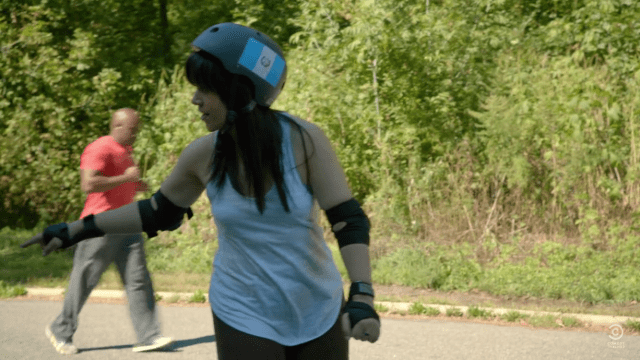
The most recent episode, “The Matrix,” involves Abby and Ilana leaving their phones at home to escape the digital matrix enabled by their digital devices. To aid in their pure, unmediated experiences, they decide to ride their roller blades to a dog wedding at Brooklyn’s Prospect Park. (I told you this show was absurdly funny.)
Almost immediately, I noticed on Abby’s helmet a sticker bearing an image of a familiar flag. A subsequent, close-up shot reveals that the image is of a Guatemalan flag.
Whoa! Coming from a Guatemalan family, I couldn’t help but notice it and point out this easter egg. After all, how can I not notice a quetzal?
I imagine that this is a nod to Arturo Castro, the Guatemalan-born actor who plays Abbi’s roommate Jaime on the series.
Monday’s Apple event wasn’t just about an ultralight notebook computer that I really want and a watch that I don’t. There were also two announcements regarding television that were quite interesting.1
The price for the current Apple TV dropped to $69. This third-generation model has been on the market since 2012 and was available for $99 as recently as this past weekend. I imagine that this is an intermediate move on Apple’s part. There are clearly better options for OTT streaming devices, even for die-hard Apple nerds, and I would hope Apple plans to release an improved version in the near future for the $70 same price. (Or not… what do I know?)
HBO Now will launch exclusively on Apple devices for $15 per month. In some ways, this move is big because it marks the first time HBO is available without a multichannel TV subscription and could be a threat to multichannel TV as we know it. Consumers begged HBO to offer something like this, and now we know that it will be a full-featured service, not a crippled version that only the pay TV subscribers get.
In my most recent New Media class, I addressed the second announcement as an example of a technology adapting to our needs. We were discussing how social network sites were great for, you know, networking socially. Facebook has been great for sharing with your nearby friends, distant classmates, and obsessively doting relatives. After a while, though, we learned that our unsavory activities, such as our party pics, can be found by a potential employer, a college recruiter, or that human you are trying to date. The sharing aspect of Facebook is great, but the permanence is not. So, we now have something like Snapchat, and that is where we share indiscriminately because of its evanescence. We found a technology that better suited a particular need.
HBO Now is intended to provide stream HBO to those without pay TV subscriptions. But a lot of people I know already stream HBO programming with HBO Go. They just use someone else’s credentials to access it. As intrepid cord cutters, we already figured out how to get the product we need without HBO offering it. I’m not going to guess whether HBO Now is going to succeed. It could be a decade-long lifeline as iTunes was for the music industry or it could be as negligible as News Corp making an iPad-native Daily newsmagazine.
The Technology We Deserve
Net Neutrality plays an important role with this OTT service. Chris Morran at Consumerist speculates about the power of an ISP without net neutrality rules, where one could theoretically “throttle HBO Now while still allowing HBO Go to get through at full speed, effectively saying that the only way to get a decent HBO streaming service is if you have a cable package.” But with net neutrality rules, the two services should operate at the same level of performance. I won’t need to have my TV polluted with reality TV shows and shitty reruns in order to watch The Wire in 1080p.
The only not-neutral thing about the HBO Now service is that it will initially launch on only Apple devices, such as Apple TV, iPad, and iPhone. Roku, Amazon Fire, and Chromecast users will have to miss out on Game of Thrones until midsummer. Perhaps Mark Cuban was right when he said that we shouldn’t worry about the power of ISPs and that instead we should “worry about Google and Apple” because they make the operating systems of our mobile devices.
The Technology We Don’t Need
A few years ago, only the most devoted Internet libertarians were cognizant of that an ISP could potentially throttle or block a service it didn’t “like.” Today, even casual Internet users are skeptical about the control their ISP could potentially wield. For example, after the HBO Now announcement, Comcast subscribers were unable to access the http://hbonow.com website. It turns out that it was a technical problem caused by a DNS issue on HBO’s part, not some sinister shenanigans at the hands of Comcast. But because everyone hates their cable companies and because Comcast is as big as a cable company gets, the Internet reflexively blamed Comcast.
It’s hard to shed a tear for Comcast though. As I mentioned earlier, when a technology fails to meet our needs or desires, we move on to something else. Cable television as we know it evolved from two converging technologies: Community Antenna TV and satellite cable.2 CATV was a demand-side technology. Starting in the 1940s, CATV operators piped TV signals to TV set owners living in areas where an over-the-air signal wasn’t available. CATV was almost a necessity for people living in a valley, such as in rural Pennsylvania, or in densely populated and overbuilt area, such as Manhattan, because the terrain blocked the radio signals necessary for TV reception. Satellite cable, on the other hand, was a supply-side technology. Beginning in the 1970s, it allowed national distribution for emerging television channels, such as Ted Turner’s WTBS-TV in Atlanta and the Manhattan-based Home Box Office. In both cases, CATV and satellite cable—eventually merging as the modern cable TV industry—enabled TV viewers to get what the broadcasters were failing to provide them. Today, however, the cable companies are the ones failing to provide us what we want, and that’s why we’ve migrated to something that does.
And, I’m sorry, Apple. As of right now, I still can’t figure out why I need a smartwatch.
The above link to Amazon is an affiliate link. If you buy something that link, I will earn a commission fee.
It’s been an exciting week for Internet advocacy in the United States. To put it in crude, succinct, and kinda androcentric-and-infantilizing terms, the Federal Communications Commission grew a pair and ruled to…
regulate ISPs as a Title II Common Carrier instead of a Title I Information Service Provider.
prohibit restrictions against community broadband, such as those in Chattanooga, Tennessee and Wilson, North Carolina, where they get faster and cheaper Internet access than in New York City.
Everyone has gone gaga over the first ruling, but I think the second one is just as crucial. Why? If net neutrality is “Obamacare for the Internet,” community broadband is the “public option” we didn’t get with the Affordable Care Act. It subjects commercial ISPs to competition that is primarily concerned with serving its citizens rather than enriching its shareholders.
The commercial ISPs have complained that if they were subject to Title II common carriage regulation, they would be less inclined to invest in their infrastructure. They would be less likely to expand access, and they would be less likely to increase broadband speeds in the coming years. In other words, they would act like a telecommunications monopoly with little incentive to improve their product. Guess what? They already behave that way.
Most of the country lacks access to viable broadband. For many of those who do have access, they face a Hobson choice when selecting Internet service providers. As for average broadband speeds, at 11.5 Mbps, the United States is hardly in the lead. We rank somewhere between Taiwan (9.5 Mbps) and Singapore (12.2 Mbps) among Asian nations and between Israel (11.4 Mbps) and Finland (11.7 Mbps) among EMEA nations.1
Throughout the twentieth century, AT&T, the telephone monopoly in the US, improved the technology to connect local and long-distance calls more efficiently, but the end-product was more or less unchanged for seven decades. AT&T held a monopoly over US telephone service beginning in 1913, under the Kingsbury Commitment, until 1984, when it was forced to fragment and sell its local exchanges into seven regional Baby Bells. In that time, there were very few functional improvements to the telephone receiver.
A very old AT&T phone from the 1930s.
A phone that would be a common sight in the United States.
Comparing two receivers—one from the 1930s and one from the 1980s—it’s hard to tell what specific improvements there were. Both receivers consisted of a dial and a corded handset, and you could have one in any color you wanted… as long as you wanted black. Why was there no speakerphone? Where is the touchtone keypad? Why couldn’t someone put a call on hold or mute the receiver? If someone missed a call, why couldn’t the phone indicate so with a notification? And, why could someone not walk around any further than the length of the receiver’s cord?
The Carterphone from the late 1960s allowed telephone users to bypass the telephone cord.
The key reason why AT&T did not innovate and improve its product for the consumer was not because it was closely regulated as a utility and that it had to provide universal access, it was because it was a monopoly and no had little incentive to innovate. It was not until the 1980s that consumers were finally able to connect foreign attachments to their telephones, such as answering machines and modems, purchase their own phones, including cordless and touchtone devices, and choose their own long-distance telephone provider and calling plan.
Touchtone “dialing” finally arrives in the 1980s. Was that really so hard?
In other words, with viable competition in underserved markets, commercial ISPs will be forced to, in the words of countless entrepreneurial free-marketeers, “innovate or die.”
Updated because the new WordPress for iOS app turned my Markdown into HTML. Yuck.
Teaching this past semester has been a bit different than it has been recently because I’ve been teaching two non-intro classes: New Media and Media Criticism. Although New Media is technically called “Introduction to New Media,” I’ve always run it like an undergraduate seminar with a lot close readings. The same goes for Media Criticism, where the students and I criticize criticisms of media.
One of the results of doing so many close readings this semester—especially ones that I have not read since being an undergraduate, if at all—is that I’ve become self-reflexive about some academic practices and rituals.
For example:
Why does seemingly every essay start with a premise that the author immediately challenges? I prefer the illustrative case study.
Why must we literally turn a page before we get to the author’s central method for challenging that premise? My advisor indoctrinated me that a reader should know your topic and approach before turning a page.
Why does seemingly every argument take a twist or turn about 60-70% through the text? What’s wrong with sticking what you outlined in the methodology?
One of the stranger practices in academia, especially among film scholars, is to say…
I’m not sure I’ve seen that film all the way through.
Allow me to decode that. That’s academese for…
I haven’t bothered to watch that film, and I’m too ashamed to admit it. Also, I can’t have a conversation with you about it because I must have missed the part of the film you’re describing.
Why not just admit that you haven’t seen it?
It’s a clever trick, and I’m guilty of having used that once or twice. In fact, I kind of did that when, back in November, I announced that filmmaker and scholar Laura Mulvey was coming to Pratt. I said that I had wished I had scheduled her film, Riddles of the Sphinx, for my experimental film class, but didn’t because it was “too long” for our class. Truth be told, I didn’t schedule it because I never bothered to watch it “the whole way through,” which is to say not at all. But, in my defense, no film we screened in class was longer than ninety minutes, and I was not going to speed up this film.
To atone for my scholarly and pedagogical sins, I’ll be heading to Pratt on Tuesday, March 10, for the screening of Riddles of the Sphinx, with introduction and Q&A by scholar-in-residence/filmmaker Laura Mulvey. You should go, too.
Kristin Strayer, a volunteer at the Carnegie Museum of Art and a lecturer of Film Studies at the University of Pittsburgh, wrote something about the nature of curating experimental film that caught my attention.
She criticizes contemporary curators and scholars who write about experimental film and generally only address “those already converted” at the expense of less-knowledgable but receptive viewers. She writes:
The authors address a rather small group of filmgoers: scholars, filmmakers, artists, and occasional cineastes. Whether amateur or professional, these are viewers who haven’t just seen particular films but know the historic details surrounding the films, or which filmmakers worked with other filmmakers, or stories of how so many films were made by circles of friends with little money or resources.
This was one of my chief complaints about the recent screening of Gil Wolman’s L’Anticoncept at Light Industry. To “get” this film, I needed to be fluent in French and well-versed in Lettrism and the mid-century French avant-garde. I confess: I am neither. This is where a curator can really shine, explaining the importance of this film and suggesting an approach for watching it. Curating a film involves more than just selecting it. You need to describe the work—sometimes overly pedantically—so your audience can appreciate it as much as you do.
Another challenge experimental film faces in contemporary exhibitions, according to Strayer, is the gallery setting itself. She notes that “the exhibition gallery is radically different from a theater that shows [a] traditional cinematic text.” Whereas “a theater expects a stable subject who watches and the consistency of a darkened room,” a gallery accommodates the visitor’s physical movement around the space. This poses a challenge for any experimental film or video longer than five minutes because people can’t stand still much longer than that.
As I wrote last week, the staff at Light Industry mitigated some of the major challenges of screening this work. They procured an appropriately sized white ballon for a screen, instead of simply projecting the video on to a white wall as they do for their other screenings. They distributed printed copies of the English-language translation of the narration. And, to their credit, they seated us in a darkened room to watch in a theatrical setting. As a testament to that last bit, a patron even shushed us and asked us to leave for ruining his experience.
And because we didn’t know how to watch this film or how to contextualize it, we left as quickly and as quietly as we could.
As a man of a certain age, I have been an active Internet user for over twenty years, beginning with email and USENET. I have also been using the graphical web since about late 1995 or early 1996, around the time I figured out how to set up a dialup SLIP connection at home. As someone initially intimidated by computers, getting my Quadra on the Internet via a phone line—without a commercial service like AOL, Prodigy, or Compuserve—was an initial step in becoming the lonely, over-inquisitive technophile that I am today.
Over that time, I have collected (and lost) a bunch of web bookmarks. We all have. In my days of doing desktop support, my users bemoaned getting a new computer because they feared losing their documents, which we diligently transferred, and their bookmarks, which we also migrated to their new browser.1 Each user’s bookmark collection was like a box of digital heirlooms.
Some of my own bookmarks are really, really old. They have migrated from one browser to another—Netscape to Internet Explorer to Safari—and outlasted about a half-dozen Macs, starting with a PowerMac G3. Over the weekend, I was typing some address in the Safari web location bar. After a few keystrokes, the auto-complete feature suggested something long-forgotten, though kinda-familiar: The Standpipe Gallery at http://standpipegallery.com. Don’t bother following that link because it’s dead. In fact, after clicking through my other bookmarks, especially those dating from when I still organized them into folders, very few sites still exist today. That was kinda depressing.
A fun resource, probably where I looked up the term “grass widow”
Dead
I’d go on, listing more of them, but I already feel old and sad enough without plunging any further. At one time, my bookmark collection, and the sites collected therein, meant something to me. They either provided some utility, some insight, or even a laugh, but now, years later, they’re gone. And had I not impulsively followed one of them, they would all have been forgotten, too.
There’s some truth to the claim that the Internet never forgets, a fact that makes me think twice before I post something here. But there’s something else that’s also true about us and our digital artifacts. Someday, we will all be dead. And once our domain registrations expire and our hosting plans don’t renew, our web sites will be dead, too. Just like us.
As for the Standpipe Gallery that initially piqued my curiosity and triggered this post, I figured out that it was a gallery founded by Alison Pierz, the wife of a grad-school colleague. Much like the website, the gallery no longer exists. However, there’s an “archive” available of the work shown there over the years. It survives as a Facebook page.
If I remember correctly, for a time, there was even some issue with browser lock-in. Your Netscape bookmarks would not easily transfer to Internet Explorer, or vice-versa, or maybe, I’m just making that up. ↩