Late to the party yet again, I finally watched the first two episodes of the new Mike Judge–helmed comedy series, Silicon Valley. If you haven’t yet traded for someone’s HBO Go credentials, you can watch the first episode, temporarily, of course, on YouTube.
The series traffics in some of the most well-worn stereotypes of software engineers and Internet entrepreneurs that are familiar to even the most casual observers of the tech-business world. The series centers on three budding software engineers living in an incubator started by a veteran of the Valley. Played by T.J. Miller, Erlich cashed in on his start-up years ago. Housing these engineers is his way of giving back, but not without taking a ten-percent stake in any product they develop while in residence.
The first two episodes of the series portray some of the more ludicrous aspects of Silicon Valley. As I watched it, I kept thinking of Evgeny Morozov’s latest book, To Save Everything Click Here: The Folly of Technological Solutionism. Morozov argues that the titans of tech are guilty of two hubristic sins. Solutionism is the relentless need to solve problems, including those than might not even need solving, and to strive for perfection. The second, Internet Centrism, is the fervent belief that the Internet and digital technologies are the tools to solve every problem. As I am yet to finish the book, it appears that these two function as rhetorical justifications for creating new digital industries that enrich those developing these solutions. In short, it’s about getting paid.
We see the vapid speeches given at a TED Talk where audiences listen in awe of rhetorically flashy speeches on changing the world without much substance. We see an anti-intellectual venture capitalist who, like Peter Thiel, advocates that young people take $100,000 of his money to drop out of college to pursue their entrepreneurial ideas.[1] We learn that an algorithm, properly deployed, can do something as mundane as search through a compressed data stream or something as important as curing cancer, the ultimate human miracle. We also see how spiritual advisors coddle super-rich CEOs are hell-bent on disrupting everything and are out to change the world, provided they make a ton of money doing so. Real money, too, not Bitcoin.
Read the book and watch the series for two contemporary and poignant critiques of an industry that is inflated in just about every sense of the word.
The above link to Amazon is an affiliate link. If you buy something that link, I will earn a commission fee.
Evegeny Morozov, To Save Everything Click Here: The Folly of Technological Solutionism, New York: Public Affairs, 2013, 129. ↩
Yes, folks, it’s Tax Day in America. Some taxpayers might have received refunds and are spending them on vacation homes, boats, or funding some silly Internet start-up. Some, like me, have put off until today to pay the government treasuries in Washington and Albany. Either way, unless you filed for an extension, the tax year known as 2013 is over. Congratulations, you made it!
Now that the tax year is finished, let’s reflect on what we’re going to do with all that money.
To get in the Tax Day spirit, the White House set up a web widget to show you how your money is spent. Enter some of your tax data and the tool will show you where your Social security, Medicare, and income taxes go.
Take a minute to fill it out. I’ll wait right here until you’re done.
I bet you most of your income tax money goes to war. How did I know? Lucky guess…
In my case, defense and health care each get about $1,700 of my taxes. However, only $112 of it went to elementary, secondary and vocation education, and a little more than $75 went to science, space, and technology programs. For whatever reason, a negative amount of my federal tax money, $-1.35, went to financial aid for college students. This must be my share of any tax credits or deductions that I’ve been milking for almost of my entire adult life, which is why I get it back.
This breakdown seemed especially poignant after finding a U-Matic tape of an independent news-documentary television series from the 1990s, titled The ’90s. In trying to identify the tape, I searched the web for the series and came across an especially timely segment about persons who refuse to pay taxes that fund war. The segment has been digitized and available on YouTube.
One person in the segment says that half of tax revenue goes to war. Do you think they would feel differently if I told them it was only a quarter? Probably not.
On Monday morning, I bought the season pass for the final season of Mad Men on iTunes, and I noticed the price was $35, based on fourteen episodes, not seven for this year and seven for next. Apple figured it out and even included an explanatory note: “Mad Men, The Final Season is expected to include 14 episodes (actual number of episodes may vary).”
The price is a little steep because of the upfront cost of buying fourteen episodes. It’s not as nice as getting the early adopter credit of buying the first eight episodes and getting the back eight free. However, come next year, I’ll be relieved to find seven episodes appearing each week in my queue, ready to stream.
Since leaving CNN to make room for Piers Morgan, Larry King has been hosting two shows distributed through Ora TV: Larry King Now and Politicking. Last night, after an exhausting day, I watched a few episodes of both shows. The most recent installment of Politicking was an engaging interview with Errol Morris. Morris has been making the rounds in support of his upcoming documentary on former Secretary of Defense Donald Rumsfeld, The Unknown Known.
http://www.hulu.com/watch/614498
I rarely watched Larry King Live during its long CNN run, but I appreciated him revealing his opinion on this program, acting more like a commentator than an observer. He revealed his skepticism about invading Iraq at the time, which he did not do on his CNN show, and he was self-reflexive on how Rumsfeld’s charisma and double-talk was both deceptive and convincing.
As far The Unknown Known, it’s easy to see this as a sequel to The Fog of War: Eleven Lessons from the Life of Robert S. McNamara (2003), as both are films about secretaries of defense responsible for two long, calamitous wars. Based on the snippets in this interview, both films also trace how each man arrived at these positions of power and how they reflect on their decisions. But it looks like both men reflect on their decisions in different ways. Perhaps regret is that “unknown known,” whatever that really means.
Watch the whole interview. It’s funny and infuriating at the same time. Also, not since The Fog of War have I been looking forward to watching a Morris film: Standard Operating Procedure was too depressing for me to watch at the time.
The above link to Amazon is an affiliate link. If you buy something that link, I will earn a commission fee.
It’s been a busy month for those of us who love streaming video and are suspicious of the cable or telco companies that function as our broadband providers.
Dan Rayburn, who writes for the insightful Streaming Media blog, takes issue with the coverage of the Netflix-Comcast deal.
Many of these same people are also implying that because Netflix has to pay Comcast, consumers will foot the bill for this as Netflix will have to charge more for their service. This could not be further from the truth. Those stating this have no clue how Netflix delivers their content today or what costs they already incur. If they did, they would know this is not a new cost to Netflix, it’s simply paying a different provider, and it should be at a lower cost. It should actually be cheaper for Netflix to buy direct from Comcast, and they also get an SLA, which also improves quality and that’s a good thing.
Netflix and Comcast: Get a Room
I’m still trying to figure this out, but it appears that with this agreement, Netflix connects its own routers with Comcast’s. That obviates the need for Netflix to use and pay a third-party content delivery network, such as Cogent or Level3, to route its traffic directly to the ISP. Instead, Netflix will have a direct connection to the Comcast’s pipes and to its broadband customers.
One of the crazy facts about the Internet is that is very much like the telegraph network of a century and a half ago. Yes, both disrupted our conceptions of space and time, but they also share two technical details: both are based on a binary code, and both rely on relays for interconnection. Almost every single transaction you do on the Internet is converted to binary, grouped together as a stream, and then broken up into packets[1]. It then goes through a series of routers that transit your packets to your intended destination. In the days of the telegraph, your message would transit from one telegraph office to another until it finally arrived at its final destination. Messages were priced according to length and distance because you were using up more resources than someone sending a short message to the next town.
A popular Internet service such as Netflix doesn’t have just one server to distribute all of its video content. It has dozens of them. They are located in places that are nearest to their customers. The aim is to minimize not only the distance each data packet has to travel but to also minimize the number of hops. Netflix contracts with companies that provide this service, each is known as a CDN. It appears that this deal merely cuts out the “middle man,” a third-party CDN that transits the data in this case, and allows Netflix connect directly to Comcast’s routers and have access to its customers all the way to the final mile without a third-party intermediary. Comcast subscribers should have a better experience streaming video from Netflix.
Is This Neutral?
With this deal, Netflix on Comcast will be better than Netflix on Verizon. Netflix on Comcast will also be better than another comparable video service (YouTube?) on Comcast that doesn’t have an interconnection agreement. But it should not impact upstart content providers. One of the major concerns of net neutrality is whether smaller players will have their traffic treated equal to the major players. In this case, it appears that the answer is no.
That argument however doesn’t consider Netflix’s size and its footprint on broadband networks. If it truly accounts for nearly a third of all Internet traffic in the US during primetime, it has few, if any, peers. Netflix has joined a new tier of Internet content providers, something like:
Websites, blogs, and commercial services hosted on one server. If you’ve ever paid for a web hosting account, chances are you did this. You can get away with doing this because you are not serving much content and can stay within the bandwidth limits of your hosting plan. A dedicated server would be next option once you outgrow your shared hosting account.
Websites, blogs, and commercial services hosted across different servers. Once a website becomes even more popular, it could outgrow that one server, and will have to shift its content across a number of servers. Many sites pay a CDN for the trouble of locating servers across different locations because it can be expensive— think rent and utility bills.
Netflix. It is in a class by itself, connecting directly to the ISPs network. It has outgrown the third-party CDN model and struck a deal with the ISP itself. It is both a content provider and a Tier 2 network.
Again, I’m still trying to understand all of this, but it appears that net neutrality is still important even if it doesn’t apply to this case. Content providers in the first category above are safe because their volume of bandwidth is relatively low and won’t overwhelm ISP networks. Content providers in the second category should also be safe should they not overwhelm ISP networks. However, content distributors might have cause for concern if too many of their customers are like Netflix and begin overwhelming their peer networks. It’s just hard to determine what the line might be and how much it will cost to join this elite class of an upper-tier network. It’s also hard to predict if peer agreements effectively constitute preferential treatment.
The above link to Amazon is an affiliate link. If you buy something that link, I will earn a commission fee.
This is largely metaphorical. Forgive me if my use of this terminology is imprecise. ↩
Late last night, news broke that Comcast is buying Time Warner Cable, a company that was recently spun off from its Time Warner media conglomerate parent. The two companies rarely compete against each other because cable television distributors, also known as MVPDs, operate as regional monopolies. Moreover, cable television companies see as competitors over-the-top services, such as Netflix and Hulu. They insist that while there will be fewer firms in the MVPD space, there will still be plenty of competitors in the TV distribution space.
This merger might be about getting MVPDs having better leverage during retransmission disputes. But the masterminds behind this acquisition wouldn’t be earning their money if they weren’t aiming to consolidate broadband Internet access. Free Press points out that “Comcast is the country’s #1 cable and Internet company and Time Warner Cable is #2. Put them together and you get a single giant controlling a massive share of our nation’s TV and Internet-access markets.” It’s hard to imagine that they wouldn’t put the squeeze on those same over-the-top services that they see as competitors.
We need to keep the pressure on regulators to impose net neutrality–type restrictions on these broadband providers. Or regulators can block the merger altogether.
A local bar in Long Island City was showing the telecast of the Grammy Awards last night. From where I was sitting, you could see it on two TV sets, each set at two different refresh rates. If I turned to my right, the video looked relatively normal, as it was set at 60 Hz. But if I turned to my left, the video looked like a soap opera. It was set to 120 Hz, double the frame rate of the first.
“Transferring from one frame rate (30 Hz) to another (24 fps) causes some distortion in this kinescope of Ben Grauer (1949) by National Broadcasting Company. Wikimedia Commons.
The subject in the foreground of the image, such as your telegenic host, appears to move out of sync from the background. Some people might like that effect as it allows the figure in the foreground “pop” from the background, but it is a far cry from the creative blur and shallow depth-of-field that we like in still photography. Instead of looking professional, it looks cheap.
Motion Interpolation
There’s a technical reason for the “soap opera effect.” The refresh rates of the TV signal and the TV set don’t match. In the case of last night’s Grammy Awards telecast, CBS was broadcasting the signal at 1080i/60. That means it has a resolution 1080 lines. The “i” means that the video signal is interlaced, how the television “draws” the picture. It first draws the odd lines (e.g., the first, third, and fifth lines all the way through the 1079th line.), and then it then draws the even lines (i.e., second, fourth, six, all the way through the 1080th line.), and so forth.
The “60” refers to the signal refresh rate: it refreshes 60 times per second. Historically, it is 60 due to the “refresh” rate of alternating current in the United States (60 cycles per second). To draw a full picture, it requires two fields: one odd and one even. Thus a 60 Hz interlaced signal is equivalent to 30 video frames per second.
The television to my right was set to 60 Hz. It was taking the broadcast signal and basically passing it on to the display without any significant processing[1]. The television on the left, on the other hand, was set to refresh the screen 120 times per second. One way to make that work would be to take the 60 Hz screen and double it by drawing each frame twice, but that would be wasting a key feature of the TV set. Instead, most high frame-rate TV sets will draw intermediate fields to approximate the look of motion captured at 120 Hz. Since the signal contains only 60 fields, the processor in the TV “guesses” what the intermediate field should be. Perhaps, a processor with the proper algorithm could make the fields look “natural,” but I’ve yet to see do so. Consequently, when I can, I disable the high refresh mode on any television set I watch and have access to the remote control.
Adapting a Faster Refresh Rate
One possible solution would be increase the frame rate of the signal, increasing it to 120 Hz. While older sets could just drop every other frame to display the signal at 60 Hz, that doesn’t seem feasible as it would require new cameras to record at 120 Hz, higher bandwidth to broadcast the signal, and reconfiguring a ton of video hardware. But this is not the first time we’ve dealt with differing frame rates. In fact, we’ve done this for almost 90 years since the coming of sound. Here are some common frame rates for film and video.
Medium
Resolution
Frames/fields per second
Application
silent film
N/A
usually 16 frames
movies before 1927
sound film
N/A
24 frames
movies after 1927
NTSC video
525 lines
30 frames, interlaced
TV in North America and where alternating current is 60 Hz
PAL video
576 lines
25 frames, interlaced
TV in Europe and where alternating current is 50 Hz
You’ve probably watched all of these types of content on a video screen at one point or another, and it’s probably not looked as bad as what I see when I look at a 120 Hz television set. The fact that we’ve been able to watch movies on television for over 60 years without discussing a frame rate issue is quite impressive. While battling insomnia last night, I tried to figure out how film, at 24 frames per second, was adapted to television, at 30 frames per second. As I tossed and turned, I remembered something from the closing credits of many TV shows.
Telecine
Posed with the challenge of transferring film at 24 frames per second to video at 30 per second, you can probably imagine a few solutions. Allow me to eliminate some of them with the following requirements.
You can’t drop or add any frames because the result would look jittery.
You can’t speed up or slow down the film because it would shorten the length of the film and change the pitch of the audio.
How do you do it?
The short answer is run it through a telecine machine. While that explains what to do, it doesn’t explain how it works. The best description of a telecine explains that the solution requires both interlacing and electronically blending the frames. That allows you to maintain each film frame and the total running time of the original film.
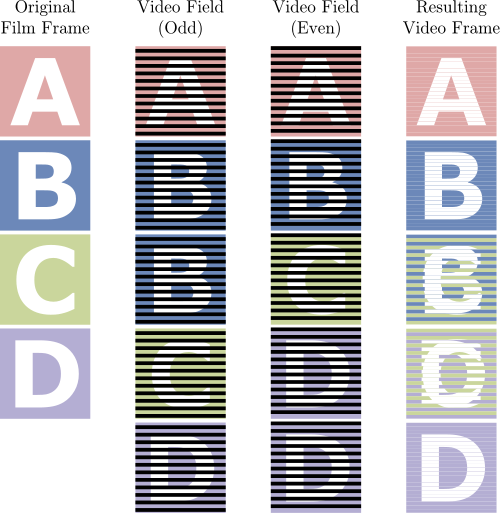
The most common approach is known as a 2:3 pulldown. This process involves recording every four film frames on five video frames (or ten video fields). Below is a graphic from Wikimedia that illustrates the process.
Each film frame is captured at least twice on a two or more fields. The first field, for example, captures the odd field of the first film frame. The second field captures the even field of the first film frame. The third and fourth fields do the same to the second film frame, but the fifth field doubles back and captures the odd field of the second frame. The sixth field then captures the even field of the third film frame.
This table might do a better job at outlining the process of capturing four film frames in ten fields.
Video Field
Film Frame
Odd or Even
Result
1
1
odd
TV Frame 1
2
1
even
3
2
odd
TV Frame 2
4
2
even
5
2
odd
TV Frame 3
6
3
even
7
3
odd
TV Frame 4
8
4
even
9
4
odd
TV Frame 5
10
4
even
If you’re wondering if there’s something to this ratio, in fact, there is.
4:10 is equal to 24:60. There are 24 film frames in one second of a film as there are 60 video fields in a second of NTSC video.
It’s Better Not to Guess
Interlacing and blending probably wouldn’t work too well when the frame rates are doubled, such as displaying a 60 Hz signal on a 120 Hz display, but it does suggest alternatives to interpolating intermediate frames. The reason the telecine worked so well, other than jagged interlaced artifacts that can be easily smoothed out, is because it didn’t “guess” what was in the image. It used the image itself.
“Insignificant processing” might include color saturation, contrast, tint, and all those settings we’ve seen on TV sets for over 60 years. ↩
She’d feed a six-hour tape into the recorders late at night. She’d wake up early the next day to change them (or conscript family members to do the same if she wasn’t home). She’d cut short meals at restaurants to rush home before tapes ended. And when she got too old to keep up, she trained a younger helper named Frank to run the various recording equipment.
Having researched television news over the years, it’s surprising where you’ll find some of this material. I’ve seen some tapes for sale at flea markets or on eBay. Sometimes a rogue producer will donate a copy of a news program to a library or museum. A television station will submit a program for an award, such as a Peabody Award, and the material was kept. And where would we be if not the for the television news archive at Vanderbilt University? And weren’t they once sued for copyright infringement?
Sadly, the producers of these programs are often a last resort either because they simply don’t have the material or they’ll charge an exorbitant amount of money to access this footage. After begging and promising not to publicize the material, I once paid NBC News $75 for a thirty-minute, episode of Chet Huntley Presents from 1963 that I used for a conference paper.
According to this story, the Internet Archive is going to digitize the material and make it available on their website. That sounds great but also really daunting. Let’s look at the math. If indeed Stokes recorded 140,000 Extended Play tapes, at six hours each, that amounts to 840,000 hours, or 35,000 full days, or almost 96 years of video. Digitizing analog material, such as VHS, happens in real time, plus the time it takes you to load the tape, press play, and start the recording. That’s going to take a lot of VHS decks, each connected to video capture card and a relatively zippy computer.
Crowdsourcing might be a solution. I have a VHS deck and an Elgato analog video capture card lying around. Can I sign up to digitize 100 hours or so of this? Or will a donation suffice?
Everyone is going gaga for the final episodes of Breaking Bad these days. Although this is the sixth year the show has aired, it’s still technically the fifth season. It just took them two eight-week runs, over 2012 and 2013, to complete it.
Because I watch Breaking Bad via an iTunes season pass, I was elated to see that Breaking Bad “Season 5” was selling for $22.99 in 2012. I bought the season pass for what I thought were the sixteen episodes of Season 5. Last month, however, when I went to download the first of the new batch of episodes, I found that had to buy anotherseason pass for the “Final Season.” It was confusing, given that the episodes airing in 2013 are still part of Season 5.
It turns out that I was not alone in my confusion. After a class-action lawsuit, Apple has given us a buy-back:
We apologize for any confusion the naming of “Season 5” and “The Final Season” of Breaking Bad might have caused you. While the names of the seasons and episodes associated with them were not chosen by iTunes, we’d like to offer you “The Final Season” on us by providing you with the iTunes code below in the amount of $22.99. This credit can also be used for any other content on the iTunes Store. Thank you for your purchase.
Sweet!
It’s unclear who is at fault here, but Apple and AMC better figure this out before the final season of Mad Men, also due to air over two years in 2014 and 2015.
Since the beginning of September, Turner Movie Classics has been running a ridiculously long festival of movies representing the history of cinema. The festival last fifteen weeks, into December, which happens to be the same duration of a college semester. Each week, TCM airs an episode of the 2011 documentary The Story of Film and a program of representative films to accompany each episode.
It doesn’t happen too often, but events like this make me miss cable. Sometimes.
The above link to Amazon is an affiliate link. If you buy something that link, I will earn a commission fee.