Although I don’t see him as often as I did just after he was born, I spent a lot of time with my nephew around the New Year. One of the things that we share is that he likes baseball.
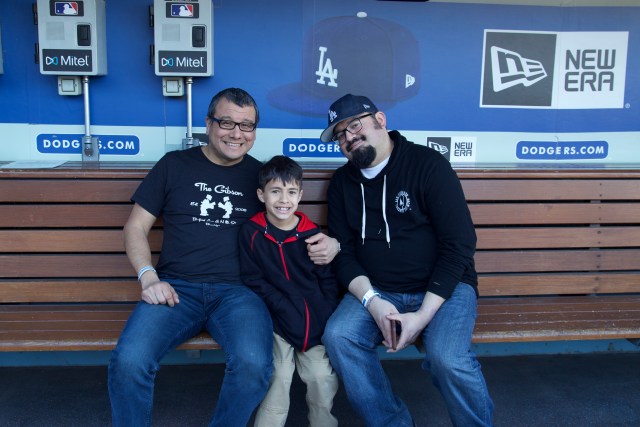
My brother, my nephew and I sit in the Dodgers dugout during a January 2019 tour of Dodger Stadium.
My dad, my brother, my nephew, and I all toured Dodger Stadium one January afternoon, and after that he wanted to practice catching fly balls in the outfield.
Alex gets put in the outfield a lot, and he wants to get better. Here he practices catching a fly ball.
On more than one occasion, I practiced with him a bit for his league. Much like his Tío, he likes to hit to the opposite field.
Unfortunately, I didn’t get to see him play because, in what is certainly usual for Southern California, his game was rained out. Instead, we played a port of NES Baseball that came with his Nintendo Switch.
Old Meets New: The Nintendo Switch port of NES Baseball.
I found it funny that we were playing a game that…
is as old as his dad, and
I found downright primitive compared when it was around. RBI Baseball was a much better game.
Thankfully, it doesn’t always rain, and he’s been playing in a real league. My brother occasionally pings me with updates about some of his feats. He reported that Alex got an RBI and later scored run on his first at-bat of a game last month.
His youth league is raising funds for field repairs, building a snack bar, and keeping the league running. I peeked at the league’s most recent IRS Form 990, and I noted a couple of things:
This is an all-volunteer effort: no one gets paid,
It is expensive to run a baseball and softball league for 400 children. Expenses ran over $200,000 in 2015.
I donated $50, but if you can spare $10 or so, it would go a long way to helping these kids enjoy this game.
Show a film in the basement of a century-old library and the filmmaker dies.
This might resemble the premise of a horror movie, but it’s something that actually happened last Thursday after I screened Agnès Varda’s 1962 film, Cléo from 5 to 7 in class last week. The doyenne of the French New Wave passed away last Friday at the age of 90.
My History of Film class at Pratt Institute meets in the basement of the Pratt Brooklyn library. The library was built in 1896 and is a pretty exquisite building. It is one of the oldest buildings at the Clinton Hill campus, and it features Tiffany stained glass throughout the building. Another ornate feature is that the book spine labels in the stacks are handwritten in a pretty distinct yet clearly standard style.
Varda’s Cleo from 5 to 7 is an existentialist exploration in life and death.
When our class met this past Thursday, a student remarked that he had heard that Varda had died, and it struck him that he was familiar with her work due to our screening Cléo in class days earlier. The timing was eery for him and for me.
This past week’s class involved a survey of eight American experimental films, and sensitive to the timing of Varda’s death, I noticed that of the eight films, the filmmakers of seven had already died. These are the films and the filmmakers:
Film
Year
Filmmaker(s)
Born
Died
Manhatta
1921
Charles Sheeler Paul Strand
1883 1890
1965 1976
Rose Hobart
1936
Joseph Cornell
1903
1972
Meshes of the Afternoon
1943
Maya Deren
1917
1961
A Movie
1959
Bruce Conner
1933
2008
Wonder Ring
1959
Stan Brakhage
1933
2003
Bridges Go Round
1958
Shirley Clarke
1919
1997
T,O,U,C,H,I,N,G
1968
Paul Sharits
1943
1993
Scorpio Rising
1964
Kenneth Anger
1927
As you can see in this list, of the films I screened on Thursday, only Scorpio Rising‘s filmmaker Kenneth Anger remains alive today.
Symbols of death recur in Anger’s best known film, Scorpio Rising.
Being a superstitious fellow, I worried that we would somehow curse Kenneth Anger. He is far from a young man, aged 92 years old and as old as Scorpio Rising is, he actually completed his first film in 1947.
So far, forty-eight hours after our class, Anger appears to be alive, and I wish him many more years.
At some point after updating my MacBook Pro to 10.14.4, a series of notifications appeared alerting me that my “Google Password [was] Required.” In all, three notifications appears, one for each of my three Google accounts.1
Clicking on the notifications brought me to the Internet Accounts pane in System Preferences where I was prompted to re-authenticate each of my three accounts.
But as Stephen Hacket and Kirk McElhern posted in their blogs, as well as dozens of other users posted on an Apple Support Communities discussion page, the authentication process doesn’t finish and we are asked to “Enter the password for the account: user@gsuitedomain.xxxx. Google requires completing authentication in Safari” as illustrated below.
The problem only occurs on my MacBook Pro running the latest version of Mojave 10.14.4, and it has not affected an older iMac I use at work running High Sierra 10.13.6, even after I updated to Safari 12.1. The authentication scheme in the older version of macOS used a different browser window to complete authentication.
Safari 12.1 has two different build numbers: 13607.1.40.1.5 for the one running on 10.13.6, and 14607.1.40.1.4 for the one running on 10.4.4.
The different builds for Safari 12.1. The one on the left is for High Sierra 10.13.6, and the one on the right is for Mojave 10.14.4. Note how the Mac is running High Sierra because it’s too old to run Mojave and that it as a non-Retina display.
Users have been posting a bunch of suggestions to clear up this problem, but none of their suggestions have helped me. For the record, here’s some of the steps I have taken:
I removed account from all my computers and re-added the account to both computers. I can/could access the three Google accounts on the older iMac (10.13.6) but only one of them the MacBook Pro (10.14.4), as I noted above.
I deleted Keychain entries for anything related to Google. As soon as I successfully re-authenticate with the one account that works, noted above, I see three new Application Password keys for com.apple.account.Google.oauth-token.
I turned off content blockers in the Private Window.. The new authentication scheme in Internet Accounts uses a Private Browsing Safari window, which looks a bit like how you sign in to a Wi-Fi’s Captive Portal page. There’s an option to turn off Content Blockers.
I disabled 1Blocker in Safari. I use 1Blocker in Safari and disabling it did not solve the problem.
I cleared all my cookies in Safari. And now I have to re-authenticate to everything, not just these three Google accounts.
I turned off “Prevent Cross-Site Tracking” in Safari. I can’t authenticate whether this option is activated or not.
In Google’s Security settings page, I removed access for “Mac OS” to access my Google account. But after you authenticate, Google detects that macOS has been granted access again, yet macOS can’t connect to the account.
Yes, I rebooted and logged off. I actually did this first because this almost always fix the problem, right? Not in this case, sadly.
At this point, I’ve resigned to using the web interfaces for Gmail and Google calendar on these accounts until releases an update to address this error.
Update: I have been using third-party apps to access my Google accounts on my Mac.
For email, I had tried out Airmail on two occasions over the years. Once back with version 1 and again with version 3 last fall. I have had mixed results with third-party clients, such as using Sparrow in 2012. However, I reinstalled Airmail 3 until Apple figures out and patches this bug.
I actually have four Google accounts, and such is the life of the contract employee. ↩
With each subway and bus fare increase the MTA board has approved over the years, I wondered how long it would take before the fare would have doubled since I moved to New York in 2001. I no longer have to wonder. The price of a 30-Day Unlimited Metrocard in April 2019 will be double what it was in 2001.
In 2001, the base fare was $1.50 and the 30-Day Unlimited Metrocard cost $63. Below is then-New York governor George Pataki introducing Metrocard in 1997, which allowed riders to buy unlimited passes.
Gov. George Pataki holds the Metrocard, a transit fare card, during a press conference Monday, Dec. 8, 1997, in New York, to announce the unlimited-use for $63 a month or $17 a week. The flat-fee cards would effectively reduce the $1.50 one-way fare for riders who take round trips on buses or subways every day, but not for people who use transit only to get to and from work. (AP Photo/Ed Bailey)
Is it me or does he look somewhat disappointed? As if he’s thinking, yup, that’s the best we can do. But it’s going to make it so much easier to raise fares.
In 2001, one could buy a one-day unlimited pass, called the “Fun Pass,” for $4. I used to buy one on days when I was planning to ride a lot of trains, busses, or a mix of both. I really do miss the Fun Pass.
Last week, the MTA Board voted to raise fares effective on April 21, 2019. While the base fare will remain at $2.75, the price of the thirty-day unlimited Metrocard will rise to $127. That means that the price of the unlimited thirty-day card has doubled since I arrived as a bright-eyed, optimistic graduate student with a full head of coal black hair.
Clearly, a lot has changed since 2001.
Incidentally, the last time I bought a thirty-day unlimited card—colloquially known as a “monthly”—was in April 2002. It was then that I started regularly riding a bike to get around and paying-per-ride to occasionally ride the subway or the bus.
One of my first rides in New York was around the west side of Manhattan on an unseasonably warm day in February 2002. I had parked my bike is on W 187th Street in Washington Heights.
As I mentioned earlier, the base fare remains at $2.75. Until it reaches $3.00, it won’t yet be double what it was when Metrocard was introduced in 1997. Perhaps, it will have doubled by the time the MTA introduces the OMNY payment system over the next few years.
Late last year, my roommate passed away after suffering a weekend-long heart attack that both he and I thought was just a bad stomach cramp. The experience was sad, painful, and shocking—and it left me with emotions that I don’t feel comfortable sharing here… at least now. However, I will say this here: if you experience any unusual pain and you feel that your body is “telling you something,” act on that intuition and visit a medical professional and have it checked. It could save your life and spare everyone in your life a lot of grief.
Michael’s cat Ninja and Beagle Sam on my unkempt bed. (Sorry, mom.)
When Michael passed away, he left behind a dog and a cat. His girlfriend who gifted him the dog some years ago—and who also happens to be one of my oldest friends—took custody of the dog. However, I do see Sam(antha) the Beagle pretty often, and I occasionally take care of the beagle. We sometimes go out on town and meet friends for dinner and drinks.
But finding a home for the cat was a bit more complex. I didn’t know if I was going to be able to stay in the apartment, and if I had to move, I thought it best to give the cat to someone with a stable living situation. I even considered asking my parents if they wanted to take her—but a cross country trip seemed like a lot for this house cat. At most, I wanted the minimize the cat’s moves and for her to move once and not again.
It turned out that I can stay in the apartment, and the cat and I have bonded over the last few months. In the last month, I’ve gone on two Costco runs specifically to buy cat food and cat litter. The latter was tough because I carried the forty-two pound bag in a backpack as I rode the bus home.
Baseball’s spring training season in Florida and Arizona got started with the preseason, exhibition games over the weekend so a lot of people are excited about baseball coming back. As it signals that winter will soon abate and that spring will soon be here.
1889 was the year the league finally found the right balance. The threshold for a walk was lowered to four balls — and the three strike/four ball standard would remain in place up through the current day. Batting averages and run scoring immediately rebounded to previous levels.
When I was around six or seven years old and first learning the rules of baseball, probably at my dad’s side while watching a game on television, I remember forming an immediate opinion about the ratio of four balls–to–three strikes. To my young brain, it seemed fair, logical, or perhaps even moral that it should be harder to get a “free pass” than it was to strike out. Not much harder…just a little bit: four balls to three strikes.
I didn’t realize it had such a long complex history, but then again just about everything around has a long complex history. It’s just that we often do not know it.
In order to unify our country and rebuild our civic fabric, we must address this lack of trust in the media that Logan identifies. Trump calls out media bias and is the strongest industry watchdog that conservatives have had in decades. This in part helps explain his sky high approval ratings among Republicans. Even if journalists dislike him, they owe it to the American people to respect and give a fuller picture of his policy approach. They need to quit playing the role of activist and stick to the role of reporter.
I disagree with her premise that reporters owe us a “respectful” and “fuller picture” of Trump’s policy approach. Both Sheffield and Logan imply that a full picture means providing what conservatives call “balanced” coverage. That for every critical story or aspect of a story, a reporter should also include a positive piece as well. That is not what a trained journalist should aspire to do.
Christiane Amanpour says as much in an interview with Preet Bharara on his Stay Tuned with Preet podcast, explaining the difference between truth and neutrality. The latter seems to mean something similar to what to Sheffield and Logan regard as”balanced.”
I don’t think it should be confusing. There’s the truth, and there are facts. And there’s empirical evidence. That’s truth, (and that’s being truthful when you seek and report in those parameters.) Neutrality is often confused by people for objectivity. People sometimes think that our golden rule, which is objectivity, means neutrality. It does not.
Neutrality is when you essentially put two opposing thoughts on the same platform, and give equal weight to two opposing thoughts. Now sometimes you can, but often you cannot. And let’s just take genocide for instance, which is where I learned my craft. There is no moral or factual equivalence between the gross violation of humanitarian law and mass killing of people based on their ethnicity or their religion. There’s no equating the perpetrators with the victims.
Emphasis mine.
As I’ve written before on this site, trained journalists work like trained clinicians. They follow a set of procedures and practices to produce an accurate story—or diagnosis—lest the public suffer harm due to such negligence. They should be able to put aside their individual biases and contexts to do a professional job.
Sheffield and Logan note: there are “many courageous truth telling journalists who want to serve the public, and our hats are off to them as they inform and inspire us.” However, Sheffield dismisses the rest of the press entirely by referring to others as “mainstream journalists.” As we know, “mainstream” is code for the cadre of reporters who, according to Sheffield, conservatives, and right-wingers alike, “do not provide balanced and accurate information regarding [Trump’s] administration.”
Let us remind Sheffield that “balanced” and “accurate” have been co-opted by the right to sully the reputation of the professional, trained journalists who seek out the “truth” and “work in the public interest,” but may publish something critical of the president. Ultimately, that is what reporters owe the public: holding truth to power.
At Queens College, there was an event scheduled for Monday, February 25, that was announced a few days ago in the weekly email newsletter, This Week at QC for February 19.
Amazon Information Session.
12:15-1:30 pm, location TBA upon registration for event. Amazon visits Queens College to discuss work culture and interview process, current paid internships and jobs, and how to plan your academic and career pathway. RSVP: http://bit.ly/AmazonInfoSession2019. Information: qc_career@qc.cuny.edu.
But today, the Center for Career Engagement and Internships announced that the event was cancelled.
I think we can all figure out why the event isn’t going to happen anymore, but it still seems wrong to not hold the event, regardless of last week’s announcement.
Reports indicate that Amazon already has something like 5,000 employees, It seems reasonable that the company could probably still hire a few Queens College students, with a normal rate of turnover, even without building a second headquarters here. This could have provided some opportunities for some college kids. But instead, by canceling [sic] this event, Amazon is acting true to its characterization by many in the press as childish, taking its proverbial ball and going home.
Over the last year or so, a few people have told me that they stumbled upon the syllabus for my Experimental Film at Pratt Institute and have adapted it as the basis for their own similar courses. I imagine that for each person who has gotten in touch, there must be some order-of-magnitude more that have used the syllabus but didn’t alert me to that fact. Let me be clear: I don’t mind anyone using my syllabus. This is why it’s available on the open web, and not hidden behind some walled-off LMS.
However, I would like to know how others have used this syllabus so that I can improve my own course. As I’ve noted before, the syllabus for this course draws heavily on an undergraduate course I myself took in the 1990s, taught by Constance Penley at UCSB. I made a few adjustments in designing my own course. For example, I added more New York-centric films to reflect the fact that I teach these courses in New York City. Another change is dealing more directly with the early days of video art. This in turn was to reflect what I learned in a graduate course on video art at NYU, taught by Chris Straayer. Ending the class with video art allowed me to wrap up one major narrative thread about my approach to studying experimental film: video in the 1970s was like film in the 1920s, generating great enthusiasm among artists to create new visual works that were previously impossible with other forms of art.
As much as I like the narrow focus of the course, especially in its one-semester, weekly format, I feel there are many improvements that I can make, and I’d like to know how others have approached teaching this material. First, I know there is a ton of great work that has emerged since the 1970s—nearly fifty years ago at this point—that should factor in to a survey course like this one. Second, there are a lot of titles in my current syllabus that are similar to each other. I would welcome some diversity to this course. Third, how should I incorporate experimental “film” that is born digital? This question has nagged at me for decades now, but honestly, there’s so much work out there—of varying quality and subjects—that the mere thought of figuring out how to summarize even some of it seems overwhelming. For example, does Fortnite count as a born-digital experimental work? (It doesn’t, but these are the kinds of questions that haunt me in revising this course.)
In the spirit of academic collegiality and cooperation, I request anyone who has used my Experimental Film syllabus to please contact me and share your syllabus with me. You reach me via email or via the contact form on this website.


 RSS - Posts