After much anticipation and excitement, I finally rode my bike from New York to Philadelphia for Bastille Day weekend. After riding from Long Island City to Manhattan to catch a PATH train to Newark, the ride covered two states, and each state offered a very different experience.
The New Jersey part of the ride, from Newark to Pennington, was cycling nirvana after completing the first five miles, from Newark to Springfield. Those first five miles along Springfield Avenue went through some relatively blighted parts of the city with some pretty poor roads to match, but thankfully, traffic was light for a weekday morning, but I swear I must have watched every signal turn red as I approached it. The rest of the ride was on some very pleasant back roads. There was one significant climb in Springfield but once I crossed I-78, it was an exhilarating downhill.
I rode through the first quarter of the ride at a pretty good clip, averaging close to 16 MPH, and it was much faster than I had anticipated. For example, I had planned to reach my first breakfast stop in South Bound Brook around 9:30. I arrived there around 8:30.
After eating breakfast, I followed the Raritan and Millstone Rivers along Weston Canal Road but encountered a road closure. My planned route had me head north on the Manville Causeway, but the bridge that spans the Millstone River is closed for repairs. I had to detour by continuing south on Mettlers Road and then west on Amwell Road. The benefit of this detour is that I came upon a duck crossing, and to my surprise, the drivers of New Jersey patiently waited until every duck had crossed and without a single one of them blasting their horns.
I had arrived at the fifty-mile mark, in Hopewell, by 10:30 AM.
I figured that if I kept that pace, I could arrive in Philadelphia as early as 2:30 PM. While that might sound great, it presented a logistical challenge. My friends weren’t due to arrive until much later in the day, around 5:00 PM at the earliest, so I decided to take my time once I arrived at the New Jersey–Pennsylvania border, 62 miles from the start, at about 11:30 AM. I slowly walked my bike across the Delaware River, toured the Washington Crossing historic site, took some photos, and made a few phone calls.
A little after 12:15 PM, I headed out on the Pennsylvania section of the ride. My route basically followed the Delaware, keeping the river on my left. For the first four or five miles, through Yardley, the ride was absolutely pleasant. But once I crossed Trenton Avenue, into Morrisville, the ride became much uglier. First, there were long stretches of industrial sections and the roads were in terrible shape with potholes. Second, because I was riding between the Delaware River, I-95, and the Northeast Corridor rail lines, my route was dotted with various distribution centers. That explained the endless stream of eighteen-wheeler trucks passing me as I headed towards Philadelphia. At one point, I had to turn on to a short section of Tyburn Road in Morrisville and to get on what seemed like a highway on-ramp to ride over a railroad. Compounding the danger was that the bridge was undergoing construction so there was no shoulder for me to ride next to high-speed traffic. I had to wait for a sufficiently long break in traffic and sprint for about a half-minute until I reached the first off-ramp. That was the most death defying riding I had done in a long time.
As if merging onto a highway with no shoulder wasn’t bad enough, I had to salmon on a narrow road with high-speed commercial traffic barreling towards me. For whatever reason, the eastbound lane of Bristol Pike east of Tullytown just ends. My route sheet instructed me to continue riding, and I did so because there was no other way for me to continue riding, other than to ride on, US-13, an actual highway. There was however a three-foot-wide shoulder on the left side of the road. As soon as I saw that, I carefully rode my bike like a velocipede on that narrow shoulder.
Finally, much like the beginning of the ride in Newark, the ride went through some blighted neighborhoods, and despite the presence of bike lanes on Torresdale and Aramgino Avenues, the roads were in terrible shape. Much like the beginning of my ride through Newark, it seemed like every stop light I approached turned red.
I arrived in Philadelphia’s City Center just before 4:00 PM. I checked in to our weekend rental, and immediately grabbed a shower. I needed it!
And, yes, there will be a next time. I had a great time in Philadelphia, and if you know a better way to get there, other than by bicycle, I’d like to hear it!
One of the more challenging parts of the ride is getting to New Jersey. One option is to go all out and ride over the George Washington Bridge and head southwest towards Philadelphia. It’s something better suited for riders living in upper Manhattan but not for someone in Long Island City, Queens. A second option is to take the ferry from Manhattan, at either West 39th Street or Wall Street, and go to Paulus Hook in Jersey City. This is a very common option and an especially nice one because it keeps you above ground the entire day, and it’s a quick trip that would only cost $9 for me and my bike. A third option is to take a train, either NJ Transit or PATH, to Newark and start there. This is the option I have selected.
My plan is to start from home and ride to the World Trade Center to catch an early morning PATH train. From there, I will cross the Hudson River into New Jersey and continue to the end of the line in Newark. I will start pedaling just outside of Newark-Penn Station. Part of me feels like a cheat for taking the train and starting in Newark, instead of New York proper, but two factors changed my mind:
There’s only one feasible way to get from Jersey City to Newark, and it sucks. This requires you to cross two rivers, the Hackensack and the Passaic, along US-1/US-9. From all accounts, it’s a treacherous route. Traffic is heavy and moves fast. There is little room on the shoulder to ride. There’s also a steel bridge to cross, and I’m terrified of crossing steel bridges on a bicycle. This seems like a terrible way to start a long day on the bike.
Continental United Airlines refers to its northeast hub as New York/Newark, NJ. If they get to pretend that Newark is the same as New York, so do I!
My planned route will go through the hills of Summit and Middlesex before descending into South Bound Brook, briefly following the Raritan River as it splits into the Millstone River, which I will follow for about 20 miles. I will then head southwest through the towns of Hopewell and Pennington and then crossing the Delaware River where George Washington himself did in the town, appropriately called Washington Crossing. The rest of the route follows the west and north banks of the Delaware River to Philadelphia.
I have planned a few stops for food and fluids:
Mile 28. The town of South Bound Brook has some fast food chains and independent delis where I can have breakfast. It comes after riding through the most significant hills of the day, which appear to be rollers in the elevation profile.
Mile 64. After crossing the Delaware, the town of Yardley offers some sit-down and more casual options for lunch. I’m considering the Yardley Inn, which offers a three-course lunch for $15, or maybe opt for a simpler lunch at Cafe Antonio.
Mile 85. I’ll be going through a few towns as I follow US-13/Bristol Pike, and there appear to be a great deal of shops, service stations, and eateries for that last stretch into Philadelphia.
The one part of the trip I can’t control is the weather, and it looks like I’m getting a great day tomorrow. The forecast high will be in the low 80s, with little humidity, and it even looks like I’ll have a slight tailwind as get through central New Jersey. That’s so much better than my last really long ride with a steady headwind over a 150-mile route.
Next week, if all things go according to plan, I’m planning on finally riding from New York to Philadelphia.1 It’s one of those rides that all New York City bicyclists talk about doing, such as riding to Montauk, but I’ve never headed that far south on a bike. I am really looking forward to doing that.
Despite now living in New York City for almost thirteen years, I’ve only been to Philadelphia four times.2
The first time was for a baseball game at Veteran’s Stadium. It was Labor Day 2003, the game was between the Red Sox and the Phillies, and it was Mike Schmidt Bobblehead Day. The nine-inning game lasted about four hours, the score went back and forth, and the game was decided by Trot Nixon hitting a grand-slam off maligned Phillies reliever Turk Wendell. My friends and I drove home after the game.
The second time was for another baseball game, between the Dodgers and Phillies at the new Citizens Bank Park in 2005. Although the two ballparks were located close to each other, you can experience the difference between a 1970s cookie-cutter, multiuse stadium and a 2000s retro inner-city ballpark. You really can feel the forty year time-warp. Again, we drove back the same day.
The third time did not involve a baseball game. It was for a talk at the University of Pennsylvania. While I didn’t drive this time, I did take the “ghetto train,” using SEPTA and NJ Transit, with a connection in Trenton, back to New York City.
Last April, Sarah and I needed to burn a free night at the Omni Hotel, and we booked a one-night stay around it. It was the first time that I got to explore the city a bit, and I really liked it. I immediately regretted that we didn’t book a second night.
But next week, after cycling through New Jersey and crossing the Delaware, George Washington–style, I am going to stay not just one, but two, two, two nights. Sarah is taking the train, and my friends from Washington, D.C. are also coming up to spend Bastille Day weekend in one of our nation’s earliest capital cities. To bone up on the city and its people, I listened to an episode of the podcast, Like I’m an Idiot, where a guest explains a topic to the host, Josh Cagan, like he’s an idiot. In this episode, native Philadelphian Mike Monteiro explains why Philadelphians are angry.
The episode reveals that the anger stems from various nationally known incidents, such as fans throwing batteries at sporting events and Frank Rizzo, the mayor of Philadelphia, ordering the police to bomb a part of his own city in 1985. We also learn that Philadelphians now wear that anger as a badge of distinction. Good for them!
Towards the end of the episode, Cagan reveals that despite living in New York City for many years and on the East Coast his entire life, he only went to Philadelphia three times.
You see? I’m not the only New Yorker who doesn’t go to Philly!
I’ll technically start pedaling either in Jersey City or Newark to shave off some miles and riding through some automotive wasteland, specially US-1/US-9 between Jersey City and Newark. ↩
I did pass through Philadelphia as part of a vacation/mileage run to Portland, via Houston and Seattle, back in April 2011, but I’m not going to count it. ↩
A year ago, when I first rode in the B STS, we had the option of riding a graduation ride in the Shawangunk Ridge, west of New Paltz, New York. I passed on riding with the group because I was already signed up for the Ride to Montauk, and both rides were happening on the same day. But ever since then, I have been tempted to ride up there, even if it was on my own, just to see how challenging it could be.
Forward to this year, 2014, and I still hadn’t ridden up there.
Yesterday, two guys from this year’s STS group and I drove to New Paltz and rode through the Gunks. We followed the 68-mile Medio Fondo route of the Grand Fondo Gunks. (There is also a 110-mile Grand Fondo course, but we weren’t interested in such madness.)
The ride including two long climbs. The first is a three-mile climb on NY-52 between the Walker Valley and Ellenville, known as Cragsmoor for the road and small village at the summit of the hill. The second climb is about five-miles long along US-44/NY-55 to the top of Minnewaska State Park. Both were much gentler than I had anticipated, and I was able to pace myself and still remain in my second and third smallest gears for most of the time on those climbs. You can see the two climbs on this elevation profile.
Another reason why the ride didn’t seem as hard as I had feared was because I occasionally stopped to take a few photos of the sweeping views.
And of course, what better way to capture a panoramic vista than with a panoramic photograph.
Seeing the Sights
There were many points of interest along the route.
First, we spotted a BBQ smoking pit in Verkeerderkill Park, a public park in the town of Pine Bush. It’s not something city-folk like ourselves expect to see on a casual Sunday morning.
According to the sign, a brewery, Rough Cut Brewing, is coming to that location. However, in the half minute I spent searching for “Rough Cut Brewing,” I found no references to a New York-state brewery, only an IPA brewed in Oregon. Also, that sign looks more weathered than the signage for the closed restaurant.
Perhaps the strangest sight of the day was the Redwood Driftwood sculpture garden on Clove Valley Road.
An artist named Pamela Phelps sells prints of these redwood driftwoods. According to her description of the work, these driftwoods are the product of both industrial forces and natural causes:
This is one of many Redwood Driftwood pieces, remnants of the 1860-1930 logging era, shaped by natural forces. In early years the trees were uprooted as they were logged from millennia old virgin forests. When it was realized that new trees sprouted from left in the ground roots, the practice was discontinued.
The driftwoods were carefully arranged along a field on Clove Valley Road in Minnewaska. It is hard to miss these pieces even as we were racing down this road at about 20 MPH.
The facility was great because it served as a free parking spot, allowed us to take badly needed showers, and, yes, it is a pool so we took a short swim before they closed at 7:00 PM.
Had we staged a foot race to the car from the pool, this would have been my first triathlon.
Amtrak will be getting new baggage cars on their long-distance trains. Those trains include the Lake Shore Limited, a twenty-hour train between New York and Chicago, and the Cardinal, another train that travels between Chicago and New York but takes twenty-six hours. The most exciting part of the baggage cars is that they will enable passengers to bring their bicycles on the train without boxing up the bikes.
The new baggage cars will be used on all 15 long-distance routes, which means the benefits of improved reliability and an enhanced climate-control environment for baggage will be available to our long distance customers by the end of 2014 . Also, the new cars will be equipped with built-in luggage racks that will be able to secure unboxed bicycles…
Yes, it’s exciting to see one nineteenth-century form of transportation (the train) supplement another nineteenth-century form of transportation (the safety bicycle). It also makes taking a train a viable and affordable option for traveling to distant bicycle events, such as October’s Hilly Hundred in Indiana. Last year, I had to box up my bike, take it to Newark, and then ship it to and from Indianapolis.
As great a step forward this is, it’s still not the same as allowing bicyclists to walk their bikes onto the train, as is the case on certain trains in California and the Midwest. It’s also nice to have that option aboard our the Metro North and Long Island Railroad commuter lines.
Allowing bicycles onto Amtrak trains that run north of New York City would immediately open up new destinations in upstate New York, such as Rhinebeck and Hudson, and parts of Vermont for some great foliage rides.
And if you want to read about today’s passenger rail travel in the United States, Kevin Baker takes a long-distance trip on the “Twenty-First Century Limited” in this month’s Harper’s.
Searching for short-sleeve wool jerseys on eBay, I found a lot for sale consisting of an assortment of wool jerseys at a pretty decent price. I was intrigued by the orange color, and upon further shopping, it appears that these jerseys bear the Amazon logo with a cycling gear inset.
Sadly, they're out of my size, but if you keep them free of moth balls, I have a feeling that one of these jerseys could easily outlast Amazon as a company.
Sarah’s dad passed away last March, and we miss him everyday, especially on Father’s Day. One of the things that David loved to do was ride a bike. When I first visited the family home, I saw his road bike hanging in the garage. The bicycle is a beautiful English-made Raleigh steel frame with drop-tube shifters, Campagnolo components, and a classic Brooks B17 saddle, and it serves as a testament to his love of cycling. Some time in the 1980s, he and his brother Charles started the tradition of riding the Hilly Hundred in southern Indiana, which I rode for the first time as the family revived the tradition last year.
To remember David on Father’s Day, Sarah and I rode to Peekskill, New York. There’s nothing significant about Peekskill with regards to Sarah’s dad, but we chose that destination because of a few practical matters:
I know a few different ways to get there,
It’s a comfortable distance from the city,
There are some good eating options in town,
There is a Metro North station that will get us home relatively easily.
That made for an easy ride because it was relatively flat, and there were no cars anywhere on the trails. To avoid the bothersome junk miles in Queens, Manhattan and the South Bronx, we elected to ride the subway to Van Cortlandt Park and cycle to the start of the trail in Yonkers. My initial plan was to take the 4 train to Woodlawn, but the 4 train was not running past 149th St-Grand Concourse. Instead, we took the D train to Norwood and pedaled the rest of the way to the start of the trail.
Incidentally, here’s how to get from the D train in Norwood to the start of the South County Trail in Yonkers:
Start at Bainbridge Ave and 205th St,
Head North on Bainbridge Ave,
Continue onto Jerome Ave,
Right on E 233rd St,
Left on Van Cortlandt Park East,
Right on MacLean Ave,
Right on Tibbets Rd,
Left on Alan B Shepard, Jr. Place,
Right onto the South County Trail.
There were a few times we had to leave the trail to continue. The first time is in Elmsford. The South County trail ends there, and were forced onto the local roads. There are two ways to get to the North County Trail, none of which are marked as far as I could tell.
The easiest, most direct way is to make a right on NY–119, where the trail ends, then a left onto US–9A, and another left turn on Warehouse Ln. From there, the North County Trail is on your right just before you reach the end of the road.
A more bicycle-friendly way, with a lot less traffic, is to do the following:
Right on NY–199, where the South County Trail ends,
Quick Left on to Vreeland Ave,
Continue on Hayes St,
At the end on Hayes St, Right on North Payne St,
Left on US–9A. Here I prefer to ride on the sidewalk,
Left at the next traffic signal, on Warehouse Ln,
Right at the beginning on the North Country Trail.
Another time we had to leave the trail is just north of the Croton Reservoir. Although I’ve never seen it myself, the word on the street is that there is a big sinkhole in the trail that required us to detour onto the roads. The bypass was around two miles long and included the first climb of the day.
The rest of the way was pretty easy. We took the trail the rest of the way to Yorktown Heights and then followed US–202/NY–35 west to Cortlandt. Most cyclists prefer to head south on Croton Avenue to take the Blue Mountain Reservation, and that’s the way we took. A more direct and presumably less scenic route is simply to stay on US–202/NY–35 into Peekskill.
Let’s Eat
Once in Peekskill, we ate at Birdsdall House, a very nice gastropub with ample outdoor seating. I was tempted by the fried chicken plate, but at $25, I passed. The menu and prices reminded me of Alobar in Long Island City, a place with solid food that is priced about 50% more expensive than it should be. Instead of the $25 fried chicken, I opted for the $14 pulled pork nachos. It was delicious option and was made with pork that was either organic or sourced from a neighbor’s yard. Either way, these were clearly not your ordinary nachos. Despite the inflated prices, I would definitely go back since the staff was nice enough to unlock their gate and allowed us to park our bikes in their huge outdoor patio. Also, their cocktails and desserts looks really good.
Peekskill brings to mind a few things. One is that it was the setting for the 1980s sitcom The Facts of Life, even if it was filmed in California. Another is the infamous 1949 Peekskill Riots. But one thing that may not come to mind is the Guatemalan presence in the town. I first noticed it last summer when I passed through Peekskill on my heat stroke ride to Cold Spring. I noticed a Guatemalan bakery on Washington Street, and then I saw a few people driving around town that looked like me. On Sunday, I noticed another panederia on Park Street. I wasn’t sure if it was Guatemalan until I saw their truck parked outside: I spotted a quetzal, the Guatemalan national bird, painted on the side of the truck. Clearly, my people were here.
At the end of the day, after stopping at a couple of other places, we headed down to the Brewery to await the 9:35 train back to New York. Although Sarah hasn’t really been on the road much this season, she did very well on this ride. She was only a few seconds behind me the entire day, and she climbed the hills like a champ. I know her father would be proud of her.
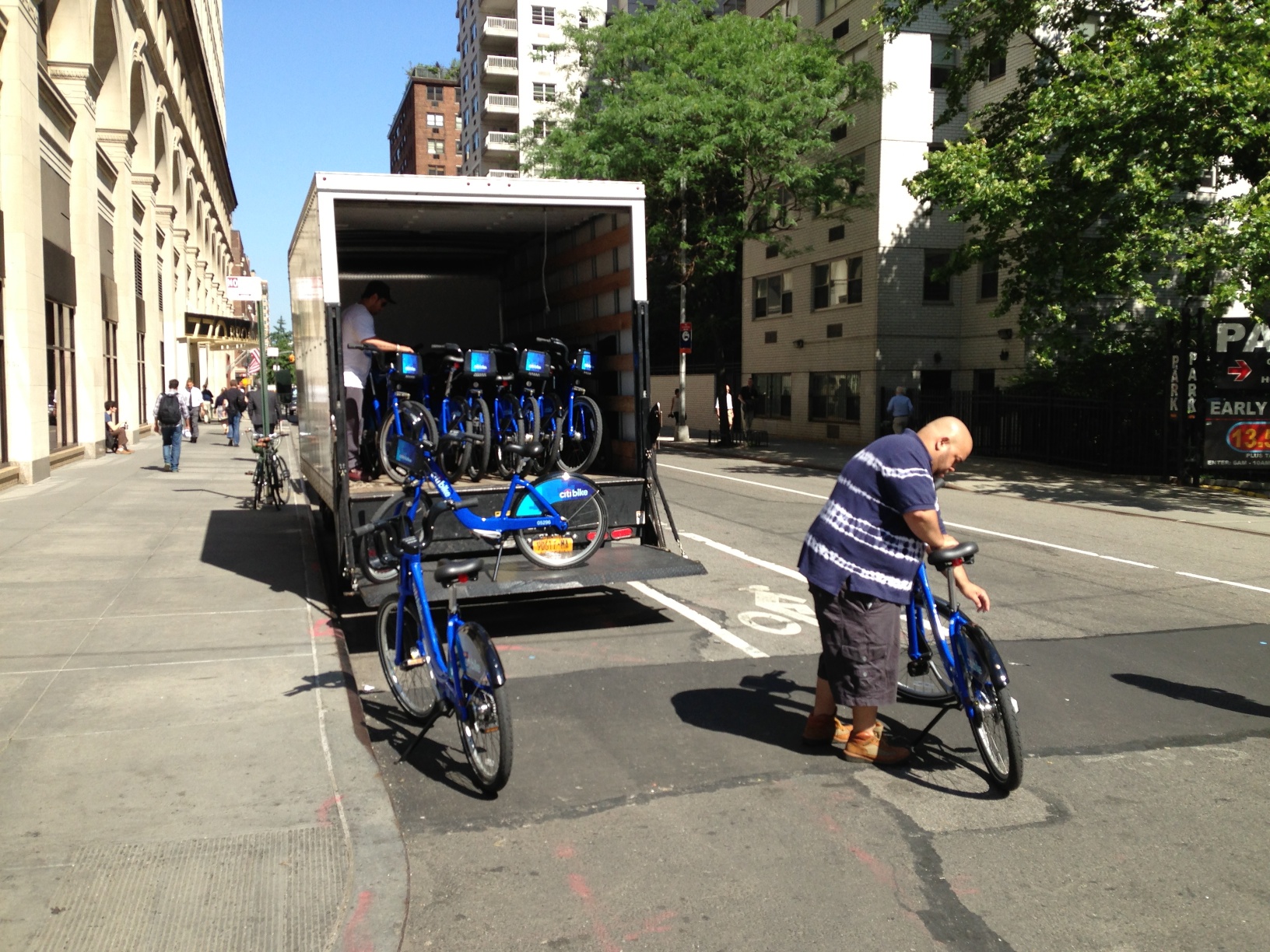
Today, marks the one-year anniversary of my joining New York City’s bike-share program, better known as Citi Bike. Because I signed up for the $95 annual membership, I am supposed to renew today. But I am not going to renew. At least not yet.
Citi Bikes need rides, too.
Last year, I was really excited about the program. I recommended it as a good alternative to buying a bike if you just wanted something to get around town. You could save yourself hundreds of dollars in buying a bike and ride it only when you needed it. You also never had to worry about it getting stolen because you never parked it for an extended period because it started to rain or you had too many adult beverages. You just found another way to get home.
With a Citi Bike, I can transport a “silk” screen.
Some people who signed up for the program saw it as a great utility. Dan Frommer emphatically wrote that Citi Bike was as useful as an iPhone, and that it changed how he moved around the city. Citi Bike for me was a great alternative to taking the subway. For days when I needed to make a series of short trips around the city, Citi Bike moved me from place-to-place, with unmatched economy, that hasn’t been possible since the days of the unlimited one-day Metrocard, affectionately known as the “Fun Pass.”
After my Citi Bike fob broke, I now have a wallet-sized card, which has the same dimension as a Metrocard.
With Citi Bike, I’m a stereotype on wheels. I can transport my $11 salad on a Citi Bike.
Ideally, for someone who already owns two bikes, the bike-share program would fill in for those days when I can’t ride my own bike. Today, for example, it rained in the morning so I couldn’t ride to NYU. Instead, I rode the subway into Manhattan. In the afternoon, the rain had stopped, and I could have biked somewhere else, if not home then to meet a friend or whatever. But at the end of the day, I have to either ride the subway or take a bus to get home. In this scenario, which is pretty common because it rains about once every three days in New York City, I may was well not even have a Citi Bike membership.
Because it can’t supplement my own bike or our city’s developed mass transit, I am not renewing my membership. There are however a couple of factors that might change my mind:
I open a bank deposit account at a credit union. Credit union members get a discounted, annual membership for $60 plus tax. If I pay with a Citibank-branded card, I also get a $15 statement credit. A yearly membership, with these discounts, would cost a little more than $50. That’s a bargain.
They expand to Williamsburg, Greenpoint, and Long Island City. It’s still incredible to me that Citi Bike is not available in Williamsburg north of Metropolitan Avenue and nowhere in Greenpoint where residents rely on G train or a few bus lines. Expanding to Long Island City and these parts of Brooklyn would mean I could take Citi Bike to where I normally live, work, and play. In this case, Citi Bike could actually be as useful as an iPhone.
In the meantime, however, I’m sticking to pedalling my own bike and, on occasion, swiping a Metrocard.
One of the highlights of riding to Montauk last weekend was stopping at Tully’s Lobster in Hampton Bays for a lobster roll. Growing up in California, I am relatively inexperienced when it comes to lobster rolls, as it’s not as much a thing as it is out here, so I can’t tell you if it’s the best lobster roll in the Hamptons. All I know is that I like what I like, and I like the Tully’s roll a lot.
Another bonus to stopping there for lunch, aside from not having to fight hungry and tired cyclists for scraps at the depleted rest stop in Westhampton, was that I earned airline miles for eating there because the Backbay Grille, the restaurant operation at Tully’s, participates in the Rewards Network dining program. A few friends of mine are really into earning miles while we eat, and we each have stories about getting that surprise email informing you that you dined at a participating restaurant a few days.
That’s what happened to me. I had to have a conversation with myself to figure out where I earned these miles:
Where on earth is the Backbay Grille? Did I really eat there on Saturday?
But I rode to Montauk on Saturday….
Oh, right!
As a VIP member, I get five miles per dollar[1]. My twenty-dollar lobster roll, with tax and tip, earned me 118 airline miles, which puts me 1/169th of the way towards a domestic economy-to-business class upgrade. All I had to do was ride almost as many miles on my bike, 101.8 miles apparently, which makes riding for airline miles a pretty terrible deal.
And if that calculation is not bad enough, because I was cycling, I was primarily eating for energy. I don’t want to know how much I paid per calorie.
In the halcyon days of the dot-com bubble, it used to be ten miles per dollar. ↩
On Saturday, I rode to Montauk on a bicycle for the sixth time since 2008. Like last year, I pedaled 150 miles, from Long Island City to the other end of Long Island in Montauk.
Hit-and-Run Crash in Long Island City
The day had an inauspicious start. I woke up around 4:30 AM and, as I was preparing to go, I heard outside of my window, the sound of screeching tires followed by a crash. A small sports utility vehicle, which was blaring music at a very high volume, had just rear ended a minivan that was stopped at a red light on Vernon Boulevard at 48th Avenue. I then heard a woman’s voice in the minivan scream in a slurred voice, “Shit! Let’s get the fuck out of here!” The small SUV then went in reverse uncontrollably and almost hit the curb on Vernon Boulevard. Luckily, there were no cars parked on the street or else they would have been crushed for sure. The driver in the minivan got out of the car, inspected the damage, and made a phone call, presumably to the police. As I continued getting ready for my ride, I would go back to the window to check if the police had arrived. After several minutes, I saw that the driver and passenger in the SUV swapped seats, and then the SUV accelerated south on Vernon Boulevard, blew past a red light, and fled the scene. Ten minutes after the crash, the paramedics arrived, and they proceeded to check the driver of the minivan. By the time I went downstairs to hit the road for my ride, the police had still not arrived to investigate a hit-and-run collision that was also likely a DUI. Thankfully, no one appeared to be critically injured, but because the police didn’t respond for at least twenty minutes, with a precinct only two blocks away, I can’t trust the NYPD’s ability to respond to felony hit-and-run and drunken driving.
Watching a hit-and-run crash right outside my window made me very anxious about pedaling through Brooklyn, Queens, and Nassau County, knowing there would be a bunch of residual drunken drivers on the road at 5:00 AM and that they would proceed undisturbed.
Thankfully, my initial concern was unfounded as I saw very few cars out on the road at 5:00 AM, and since I knew there wouldn’t be any police out there anywhere, I blew threw just about every light and stop sign until I got into Nassau County. After all, Montauk is very far away, and I have only thirteen hours to get there.
Headwind, Heartburn, and My Hammy
The ride itself was a lot harder than last year. First, I had not been on my road bike since my last club ride on May 3, and there’s always some comfort issues going between my road bike and my commuter bike. Around mile 35, my right hamstring cramped up. After eating a shot block, drinking a bunch of water, and stretching my legs, I returned to the road, but because I was anxious about cramping up again, I wasn’t able to pull up on my pedal and wasn’t able to go very fast.
Second, I had not eaten an especially good pre-ride meal. Instead, I ended up at Corner Bistro devouring a chili burger when I should have gotten something with rice or pasta. For the first third of the ride, I had some pretty bad heartburn that didn’t clear up until I got to Patchogue, around mile 60, and it was bad enough that I didn’t get any beer at the Blue Point Brewery.
Third, there was a significant headwind the entire ride. Everyone I spoke to complained about the wind, and although it wasn’t so strong that it threatened to blow you off the road, it did force you to pedal hard the entire route. You weren’t coasting for very long on this ride. Last year, I finished the 150-mile route in a little more than nine hours of riding. This year, I pedaled for more than ten and a half hours. The wind was toughest on those long flat stretches, such as the nine-mile stretch of Union Avenue, east of Babylon, the seven miles of Dune Road, between Westhampton and Quogue, and the final sixteen miles of the Montauk Highway, east of Amagansett. That last stretch included some hills, which blocked the wind a little and gave you a nice descent after you reached the top. I have never been so happy to see hills!
Riding for a Lobster Roll… and Pie
As I suspected would happened, food was scarce after the Westhampton rest stop. There were a few energy bars left, and I ate a couple to give me a bit of energy. I didn’t need that much because I was planning on getting a lobster roll at Tully’s in Hampton Bays. And that’s exactly what I did.
In years past, the pie from Briermere Farms is available at the rest stop in Water Mill, but this year, it was at the last rest stop in Amagansett. I skipped this stop last year, but this year, I needed a bathroom and water break, so I stopped there. And I had a slice of cherry pie.
I finished the ride around 5:40 PM, and I had a great time despite the wind, heartburn, and sore legs.
Despite ruining a lot of people’s plans by shrinking the ride, the cops in Southampton and East Hampton provided a few police officers to guide us through some tricky intersections. That was nice of them, but I couldn’t believe how young a lot of the traffic cops looked. Is that what kids do for jobs now that we don’t have video stores for them to work at?
At least it’s nice to see cops patrolling traffic somewhere!
Sarah, for one, was planning on riding the Montauk-to-Montauk loop, after spending 12 hours route marking the week before. She had even brought her bike out east a few days earlier, but then she had no ride to do. ↩