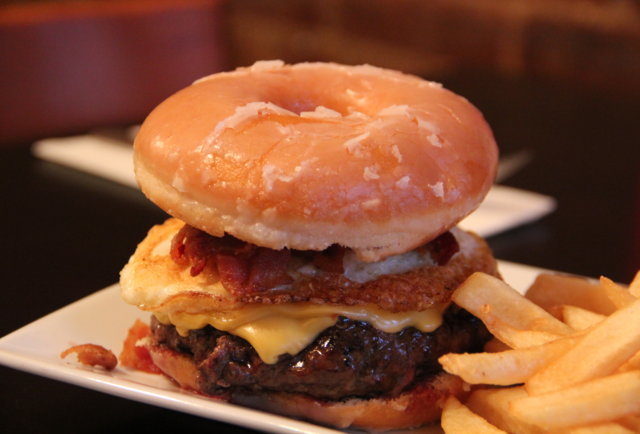
It’s not just fast food that will kill you, you know?
Since Groupon made a splash a few years ago with meal deals, it seems like there has been a glut of offers for pretty unhealthy meals, especially here in New York City. And it’s not just Groupon. Any number of the “daily deals” sites feature pretty savory but fattening food. Today, for example, Thrillist catalogs twenty-one places where one can munch this weekend. Their featured image is of a burger and fries. Topped with bacon. And an egg. And instead of a bun, there’s a donut. I’m old enough to remember thinking this kind of burger was a joke. But now, I’m tempted to dig in.
For a long time, I had complained that New York food catered to bland palettes. Living here for over a decade cost me a healthy tolerance for spicy food and can probably never eat at Los Angeles’s Jitlada unless I move west. But since about 2006 or so, there has been an explosion of comfort food. Have you noticed? How many BBQ have opened in the last seven years? Blue Smoke, Fette Sau, Fatty Cue, Mabels, and Hill Country are among the standouts. Have you noticed how easy it is to get chicken and waffles in New York City? And although I do love a good burger, is it possible to get a burger patty smaller than a half pound that is not considered a “slider”?
Can anyone explain the proliferation of these comfort establishments? Has it been to cater to transplants from the South and Midwest? Is it a way to have flavorful food but still cater to these bland palettes? A cheap way to add flavor is to add salt, sugar, or fat. Adding all three would be a flavor explosion, right? And now it’s easier to get a slice of Paula Deen than it is a slice of pizza.
Belinda was nice enough to buy me an Aeropress for Christmas. The Aeropress is hardly a new invention, and its affection among coffee nerds is nothing short of fanatical. But to the less obsessed coffee drinker, the Aeropress is a strange contraption. It looks nothing like mainstream coffee brewing machines, such as a Mr. Coffee dripper or a Keurig single-server. It is very inexpensive, costing only about thirty dollars. It requires no electricity: to brew you need only hot water, freshly ground coffee, and a cup. You need a filter, but you get about a year’s supply when you buy your very own Aeropress.
Despite its simplicity, the Aeropress is an extremely divisive coffee machine. Obsessive coffee drinkers love the Aeropress for the same reason that a casual coffee drinker may not like it. It comes with a very poor set of directions. The printed pamphlet (PDF) instructs you that for every scoop of medium-coarse coffee, add 175° Fahrenheit water to the corresponding mark on the side of Aeropress chamber, stir, plunge, and add water to taste. The resulting coffee is pretty good, but it lacks the finesse of a barista’s touch that you get with, for example, a four-minute pourover.
There are countless recipies floating around the Internet for brewing with the Aeropress. Some vary the ratio of coffee to water. Others use water as hot as 210° or as cool as 165°. Others even flip the damn thing and brew "inverted." Almost everyone has a preferred method. For example, there are more Aeropress recipes on a website of professional brewing techniques than any other method. There’s even a World Aeropress Championship, and the winners, most of whom are from Nordic countries, share their winning recipes. You could also lose entire days on YouTube watching total strangers brew coffee with a piece of plastic. Other than using bottled or filtered water and freshly ground coffee from a burr grinder, there’s no such thing as "best practices" with the Aeropress.
After nearly two months of experimenting with various methods for brewing with an Aeropress, I have settled on a method that works for me. It might not work for you, but that’s because you’re not me and with the Aeropress, you really have to develop your own technique.
Me and My Aeropress
Aeropress, right-side up.
Medium-Fine grind on my trusty Capresso Infinity burr grinder. I use the notch corresponding to the second-finest of the "Medium" settings when using the paper filters. (I prefer to use the second-coarsest of the "Fine" settings when using the Kaffeologie S Filter.
16:1 water to ground coffee: With 320 ml of water, I use 20 grams of coffee grounds.
Freshly drawn, filtered water heated to 95° Celsuis (203° F)
I add the grounds to the Aeropress and then some hot water to begin the bloom. Using the rule-of-thumb method of 2 ml of water for each gram of ground coffee, I pour very slowly over the grounds trying to wet them all. I let the bloom "develop" go for thirty seconds.
I then slowly pour the remaining water, again circulating the water around the brewing chamber. I stir with the Aeropress paddle for ten seconds and then quickly insert the plunger and allow a vacuum to keep the brew in the chamber for another ten seconds. I then plunge slowly, for about twenty seconds, just until I hear the "hiss" of the brew extracting.
Total brewing time is about two minutes. With this method, I get a ten-ounce cup of full-bodied brew. There’s a small amount of bitterness at the beginning and other more complex flavors afterward. Delicious!
If you don’t like it, develop you own technique. You’ll be in good company.
The above links to Amazon are affiliate links. If you buy something through those links, I will earn a commission fee.
Since we announced our decision last week to reduce the alcohol content (ABV) of Maker’s Mark in response to supply constraints, we have heard many concerns and questions from our ambassadors and brand fans. We’re humbled by your overwhelming response and passion for Maker’s Mark. While we thought we were doing what’s right, this is your brand – and you told us in large numbers to change our decision.
You spoke. We listened. And we’re sincerely sorry we let you down.
So effective immediately, we are reversing our decision to lower the ABV of Maker’s Mark, and resuming production at 45% alcohol by volume (90 proof). Just like we’ve made it since the very beginning.
The unanticipated dramatic growth rate of Maker’s Mark is a good problem to have, and we appreciate some of you telling us you’d even put up with occasional shortages. We promise we’ll deal with them as best we can, as we work to expand capacity at the distillery.
Your trust, loyalty and passion are what’s most important. We realize we can’t lose sight of that. Thanks for your honesty and for reminding us what makes Maker’s Mark, and its fans, so special.
We’ll set about getting back to bottling the handcrafted bourbon that our father/grandfather, Bill Samuels, Sr. created. Same recipe. Same production process. Same product.
As always, we will continue to let you know first about developments at the distillery. In the meantime please keep telling us what’s on your mind and come down and visit us at the distillery. It means a lot to us.
While they say that they will maintain the alcohol level, they make no mention about how they will “deal with” anticipated shortages. The release also does not mention anything with regard to price, which I think will be higher.
There has been a great deal of noise since Maker’s Mark announced that they were going to reduce the alcohol-by-volume (ABV). It was enough that the company had to publicly respond and even reverse its decision. However, the irony is that very few people drink bourbon whiskey neat. Almost everyone “waters” it down with something. The only way that Maker’s Mark would taste much different would be if it they were changing the ratios of corn, wheat, barley, and rye. But unless you’re drinking barrel-proof whiskey, it’s already watered down, and it’s still whiskey.
Last week, the distillers of Maker’s Mark announced that they will begin bringing down the alcohol in (watering down) their very popular whiskey as a way to meet demand. Premium whiskies, such as most bourbon, Scotch, and Irish varieties, take a long time to reach the market because they have to age. (That’s how whiskies get their color and acquire a less fiery flavor.) By definition, bourbon has to age at least two years, but most premium bourbon ages much longer than that. Maker’s Mark, for example, ages their whiskey seven years, if I remember correctly. Knob Creek famously ages theirs for nine years, and it’s not uncommon for Pappy van Winkle’s to age their whiskey long enough that their bottles can apply for learners’ permits. The longer a whiskey ages, the more expensive it is, not because it is inherently better, but because it is inherently rarer.
Distilling bourbon is like investing in whiskey futures. You distill some whiskey one day and about a decade later, you finally have some bourbon to sell. What the demand will be then is, of course, anyone’s guess. Also, factor in the usual spoilage and evaporation (the so-called “angel’s share”) to figure out that you better be patient if you’re going to sell bourbon whiskey. It’s possible that in 2005–2006, when what is being sold today was being distilled, Maker’s Mark miscalculated the demand for their whiskey, and the bourbon-loving public has nearly drunk them dry. If that’s the case, they will have to either raise the price of their whiskey, or they can add more water in the bottle to keep the yield about the same.
Maker’s Mark miscalculating its demand for bourbon in 2005–2006 does not seem plausible to me. A large corporation, such as the one that owns Maker’s Mark, usually has a team of bean counters that are pretty good at forecasting demand. And even if they’re not that good, they probably wouldn’t curry favor with their bosses if they show them a sales projection chart with a line pointing down. Moreover, Maker’s has been a consistently popular brand for as long as I can remember, and although I don’t have sales figures for their whiskey, I can’t imagine they bet against the steady or even rising popularity of their own bourbon.
If Maker’s Mark was not feeling bullish about their sales prospects, why would they be running low on the good stuff? It’s probably because around 2005–2006, corn prices were really low and in fact were at their lowest since the end of the Clinton Administration. I won’t get into the specific prices, but you can see in this chart of corn futures that the price has gone up since 2006 when they reach stratospheric highs around 2008. I think all of us in New York remember the high price of grain when we started to see more expensive pizza slices in early 2008. According to the linked chart, the price of corn plummeted around 2008–2009, when the global financial crisis hits, but then recovers back to around its decade-high price after the recovery begins.
It is unlikely that Maker’s Mark bought less corn and other grains, and was making less whiskey. Doing so would have put a huge strain on their supplies, in the face of increasing demand, and forced them to significantly raise their prices. This also would have jeopardized their place as a mass-market premium whiskey.
The other option would be to use a different “mash bill”[1] for the batches we’ll have for the foreseeable future. This would allow Maker Maker’s Mark to produce about the same amount of whiskey as before 2006, and it allows them to recover the increased cost of grains by increasing available inventory. The latter makes a lot of sense because as far as I can tell, the bourbon craze is far from fading and you don’t want to run out when the party is just getting started.
a mash bill is like recipe of grains, such as corn, wheat, rye, and barley, that are first fermented into beer and then distilled into white whiskey, or “moonshine.” ↩
Remember the “Freshmen Fifteen”? Someone once told me that it was a reference to the weight gained by new college students who spent their first year overindulging on dorm food. To me, that seemed like a plausible phenomenon with an implausible explanation: I think it is more likely due to these new co-eds discovering, among other things, the magical combination of pizza and beer. And after enough beer…more pizza. I don’t exactly remember whether I gained much weight during my freshman year, although it seems likely that I did because I remember eating a fair amount of pizza and burritos, although I didn’t drink back then.
The idea of the “Freshman Fifteen” was in the front of my mind when Sarah suggested that I not only try the many lunch specials in Long Island City but to also document them. Since I work from home on Fridays, I’m having lunch at various eateries in Long Island City over the next fifteen weeks of the spring semester. The challenging part of this project comes not from the quality of the food: the places in this neighborhood are actually pretty good, and there are some deals to be had. With some lunch specials starting as early as 11:00 AM and ending as late at 4:00, I will have to resist the temptation to eat at more than one place in a day. Doing so might force me to retitle this project the Friday Forty, after the number of pounds I’d gain.
I begin putting on the “Friday Fifteen” on January 25.
Brewing coffee has been a daily activity for me for almost twenty years. At first I was content with drinking a cup of flavored coffee with enough milk and sugar to render the coffee itself undetectable. But over the years, my taste and expectations for coffee has changed, and I have been using different methods to brew a cup of joe.
Those methods have included the following:
Drip
This might be the most common method for brewing coffee with a machine. Almost everyone has done it, and while it is certainly convenient, it almost never produces good coffee, partly because the water is not hot enough.
Espresso machine
One of the first appliances I had my mom buy for me when I left for college was a $60 Krups espresso machine. It was a perfectly servicable way to brew coffee, except that after several moves, including a cross-country one, I have no idea where I lost it. I also found that my own coffee was too bitter, but that’s because I didn’t know much about coffee, such as tamping, steam pressure, and properly “pulling the shot” to get crema.
French press pot
The first sign of a serious coffee drinker is that he or she owns press pot. It is often the final step in a coffee drinker’s evolution. What I really like about the press pot, and all of the subsequent methods of brewing I catalog here, is that you never have to spend much money on a machine to get a good brew.
About 2002, I moved on to a press pot. My coffee was good enough, but now I realize that the water probably was too hot for brewing with a press pot and that my grounds were bad because, until 2004 or so, I ground my coffee with a blade grinder. When I bought a burr grinder, my coffee changed dramatically because those grinders will produced evenly ground coffee. Since then, I can almost always get a really good cup of coffee from a press pot.
Slow-pour drip
Around 2002, a roommate of mine had one of those plastic, cone filter holders that would hold your grounds. It’s basically the same concept as the drip method, but instead of requiring an electric drip coffee maker, you only need a kettle and a stove. It’s a very simple and effective way of brewing coffee provided your water is really hot, that you use a fine grind, and that you pour the water slowly and evenly over the grounds. If someone recently charged you a mint to make coffee this way, you stumbled on to the pour-over trend. Be sure you watch them make it. You’re paying for the show.
Siphon pot
This method was completely foreign to me until I was told about it about two years ago. Until I broke it, I had a stovetop vacuum coffee maker. It uses water pressure for just-hot-enough water to escape a heated chamber to another chamber with coffee grounds. After removing the pot from the heat source, a vacuum siphons the coffee through a filter and produces a very smooth cup of coffee.
Cold brew
Summer has always been a hard time to drink hot coffee. For years I used to make iced coffee by brewing coffee at double strength and pouring it over ice cubes. But about two summers ago, it became impossible to do that because having the stove became intolerable. Cold brewing makes great coffee without requiring any heat. Over time, I settled on using the New York Times ratio: two parts course coffee grounds to nine parts of room-temperature water. I leave the grounds in a Mason jar for fifteen hours. Straining it, yields a double-strength coffee mixture that you can pour into a half-glass of ice water.
Regardless of what brewing method you use, you cannot make a good cup of coffee without a burr grinder. You also need freshly ground coffee and filtered tap water at the correct temperature, both of which depend on your particular brewing method.
Earlier today, I used yet another method to brew coffee. After hearing and reading about it among a particularly finicky set of coffee drinkers, I brewed using an AeroPress. This method produces espresso, which I normally don’t drink, so once I figure out how to make a proper Americano, I’ll report on my experience with the AeroPress.
The above links to Amazon are affiliate links. If you buy something through those links, I will earn a commission fee.
The Crosby Connection was a literal hole-in-the-wall on Crosby Street, just south of Bleecker Street. Joey Cramarossa, the shop’s proprietor, made the freshest sandwiches, all made to order. The shop has, like just about any longtime resident in Manhattan, forced to move over the years.
I started eating at the Crosby Connection around 2001, and regularly went there for years until I moved out of Greenwich Village in 2008. I probably ate several dozen “Italian Stallion” sandwiches, among countless Meatball subs and various others. They moved around during my hiatus, installing themselves inside of Parisi Bakery, where they procured their bread, and at the now-shuttered Bleecker Street Theater. It was there that I found them in 2009, when I started working at NYU-TV, and I quickly became a regular there again. I even turned on a few co-workers to their sandwiches, but sadly, our go-to sandwich shop didn’t last much longer.
But last night…
Joey Sez: Hi World….I'm back. What have you been eating?
According to their stream of tweets in the last few days, they will start as a catering operation, in time for the holidays, and aim to operate again some time in the new year.
I miss the Italian Stallion. Both the sandwich and Joey.
As you likely know, Superstorm Sandy devastated a lot of homes and businesses throughout the American east coast. While we were lucky to not have experienced any specific damage, others in Long Island City are not so lucky. The Waterfront Crab House sustained a lot of flooding, but they were not the only businesses that suffered because of the floodwaters that came ashore. The evolving gastropub Alewife has been through a lot of changes since it opened in 2011, but it was dealt a pretty tough blow after Sandy. They managed to reopen on Election Day Tuesday, and are raising money so that they can rebound after basically rebuilding from scratch.
Their new executive chef, Gregorio Pedroza, has posted a very personal video asking everyone to support Alewife, either through patronizing it or making a donation.
Please consider donating, spending some money there, or both. Even when they were unable to open, they were taking donations for victims in the Rockaways.
Last night, I took a tour of the neighborhood with a few friends to get out of our apartments. As much as we’re thankful that we were relatively unaffected by the storm, we are getting a little stir crazy from sitting at home.
We discovered that the Waterfront Crab House, one of the oldest restaurants in Long Island City’s and one of my favorite neighborhood institutions, was closed. As its name implies, the restaurant sits near the East River and, as one would expect, it was flooded by Monday night’s storm surge and tidal flooding.
I walked by there this afternoon to see how the restaurant had fared. It’s bad!
One of the cooks took me through the dining room, which was completely dark because the restaurant does not have power, to show me the kitchen. Even in near-complete darkness, I could see that the furniture was soaked. The wood floor not only felt wet but also warped, presumably from the water damage. When we reached the kitchen, I saw all of the appliances and shelves all across the floor, as if someone tossed and ransacked the room. The flood waters had reached high enough to float everything in the kitchen and redeposit on the floor as the water retreated. We could see that the water level had reached about three-feet above the floor.
It’s truly sad to see the local crab house in such a state. But I’m encouraged by two facts. First, they rebuilt after a serious 2009 fire. Second, there were about a dozen men and women working on the restaurant, draining the water from the basement and removing the seat cushions from the dining room chairs to air dry them. They look determined to rebuild. And I really hope they do, again.
Having gone on a weekend trip to Cooperstown, New York, Sarah and I visited a few local spots, such as the Baseball Hall of Fame and Museum and the local Farmer’s Museum. One of the other spots we visited was the Fly Creek Cider Mill. It was the annual Cider Festival on the Saturday we were there, and as much as this makes me look like Ned Flanders, I will admit to being completely mesmerized watching a couple of volunteers peel three apples at a time in a matter of seconds.
We did get to sample some of the cider at the snack bar. It was outstanding, and has inspired a number of autumn beverages.