New York City
Warning: Undefined variable $category_id in /home/juanmonr/juanomatic.net/wp-content/themes/monroy2014/category.php on line 7

After struggling to print t-shirts yesterday afternoon, Sarah and I headed to National Train Day at Grand Central Terminal. This celebration takes place in only four cities: Los Angeles, Chicago, Philadelphia and New York City. Since we live only one subway stop from Grand Central, it seemed like we had to go.

While there were a lot of events for the occasion, we skipped most of them in favor of touring the train cars. There was an Acela train consist, a 40th Anniversary train (complete with gift shop), and a current Viewliner. But the highlight was the Twentieth Century Limited. This train consisted of vintage private cars, including the Hickory Creek, Tavern Lounge 43, the Cannon Ball, the Epicurus, the Birkin, and the Kitchi Gammi Club. We took our time touring these cars and were incredibly excited to learn about the Wine ‘n Dine Train that travels through the Hudson River Valley to Albany for a five-course meal and cocktails.

Weekend jaunt, anyone?
From my friends in the Queens College Educational Technology Community:
Knowledge in the Digital Age: Teaching, Learning, and the Googlization of Everything with Dr. Siva Vaidhyanathan
All are invited: LaGuardia’s Library Media Resources Center is once again pleased to offer its annual Knowledge in the Digital Age speaker’s event. This year, Dr. Siva Vaidhyanathan has accepted an invitation to speak on the issues revolving around technology in the lives of faculty and students.
When: Tuesday, May 8, 2012 at 2 p.m.
Where: LaGuardia Community College, E Building, Poolside Cafe
Cost: Free
Refreshments: Definitely
LIMITED SEATING AVAILABLE, register ASAP. To do this and to get more information on the event go to:
http://knowledgeinthedigitalage.eventbrite.com/
The Library Media Resources Center and the organizing committee would like to thank LaGuardia’s College Association and the CUNY’s LILAC council for co-sponsoring this event.
Should you need ADA accommodation, please contact Charles Keyes by phone at 718-482-6018 or by email: ckeyes@lagcc.cuny.edu
(Via CUNY Academic Commons.)
Saturday was my first Obscura Day. This year’s lineup didn’t seem as exotic as past last year’s events around the New York area. Sarah, for instance, went to the Vanderbilt Museum on Long Island, a place that I never would have visited on my own. I didn’t go in 2011 2010 because I didn’t want to miss a softball game, but this year, I was ready to make an early-season sacrifice.

The one event that caught my attention was Thirteen Steps Around Dutch Kills, a walking tour of Newtown Creek. It was led by a true expert of the area, so I was excited to take the tour. It was an eye-opening perspective. It’s not like I haven’t been around the industrial zones of Long Island City and Greenpoint. I have either biked or driven past those spots over the last several years. It’s just that one tends to overlook the industrial blight around Newtown Creek. Perhaps the best part was finally taking the ironically named Nature Walk path around Whale Creek, behind the new sanitation plant.

In the evening, I sacrificed yet another softball game for a tour of nineteenth-century drinking establishments. It was basically a tour of watering holes in Lower Manhattan that have been around for a long time, such as Fraunces Tavern, Delmonico’s, and the Paris Café. Despite having lived in New York for over a decade, I had never been in these spots since I never went below Chambers Street unless someone was in town or I had to report for jury duty. I felt a little under-prepared as there were people there in costume. I really appreciated that because it made the experience a little more authentic.
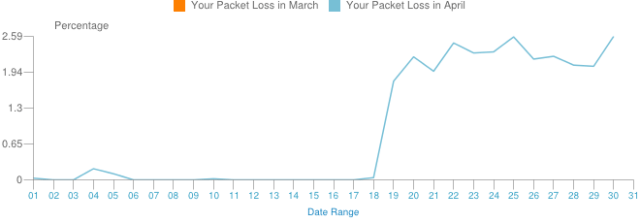
We have Verizon FiOS in Long Island City, and in April 2012, our connection significantly worsened on the upstream.
In March, our Verizon FiOS broadband had significantly improved, not in terms of upload and download speed, but the latency and packet loss had improved dramatically. I had posited that Verizon technicians had done some work to improve our connection. I was very happy.
The monthly SamKnows report arrived today, and it looks like it reverted back to a pretty poor connection. SamKnows performs hourly tests for download, upload, latency, and packet loss. In April, our download speed remained robust at a little over the advertised 25 Mbps rate. However, around April 18th, the upload speed plunged to about 7 Mbps, less than a third of the advertised 25 Mbps rate.


At the same time, the packet loss climbed dramatically suggesting that there was a compromised connection on the upstream causing this problem. This is unacceptable. The reason I came to Verizon was for the robust upstream. I upload a lot of files, as is the joy of being a media scholar and shutterbug, and I need a zippy symmetrical connection.
If anyone in the neighborhood finds this and wants to report their results, please share in the comments.
While the New York Post received Mayor Bloomberg’s nomination for the Pulitzer Prize in fiction, it was another story that sent a few chills down my spine. Will Hulu be tied to a pay TV subscription?
the move by Hulu toward the new model — called authentication because viewers would have to log in with their cable or satellite TV account number — was behind the move last week by Providence Equity Partners to cash out of Hulu after five years, these sources said.
The major networks founded Hulu to prevent everyone from circumventing revenue-producing way of watching television. The move has been great. It has been a formidable way to get TV shows, and I have been a subscriber of Hulu Plus since the service launched. The appeal has always been that I can watch the television shows I want to watch and when I want to watch them.
This move could threaten the a-la-carte model that Hulu provides in favoring of bundling a package of channels that I’m never going to watch. While the Post article indicates that Providence Equity Partners is behind this strategy, I question that thinking for two reasons.
- the fact that one of the owners of Hulu is Comcast, the biggest and least favorite cable MSO in the United States, and a deal like this really help retains its customers; and…
- Hulu was up for sale last year, but then the sale was pulled due to its “unique and compelling strategic value”.
Free Press has launched an online petition to save Hulu from its possible fate as some “TV Everywhere” service that will only inflate cable bills.
(Via TV News Check.)
The New York Nineteenth Century Society is among other things staging a series of games according to different set of rules.
The Columbus Capital Base Ball Club plays by the rules and regulations of base ball as adopted by the National Association of Base-Ball Players on December 12th, 1866, when the team was founded.
The Gotham Base Ball Club of New York play games according to 1864 rules, when pitchers pitched underhanded, a foul ball was not a strike, a ball caught on one bounce was a put-out and the fielders wore no gloves. The team was founded c. 1853.
The Flemington Neshanock Base Ball Club plays by 19th century rules, uses authentic replicas of 19th century equipment and wears 19th century uniforms. As was the custom in the middle 19th century, all fielders play barehanded and do not wear gloves. The original Flemington Neshanock were established in July 1866 and comprised mainly of the town’s prominent constituents.
I am most intrigued by the Gotham Club and the 1864 rules. The lack of fielding gloves makes it seem a lot like Chicago style softball.
I guess there’s always next year.
As I bicycled to and arrived at NYU this morning, there was a huge security detail around the Stern Business School. While there was the usual presence of NYU Campus Safety and NYPD officers, a new batch of guards wearing Tribeca Film Festival badges were also on the scene. After some quick online searches, I found that the Tribeca Disruptive Innovation Awards ceremony is here today at Stern.
The third annual Tribeca Disruptive Innovation Awards, hosted by NYU Stern School of Business, on April 27. The 11th edition of TFF runs April 18 to 29.
Lifetime Achievement Awards will be given to Jack Dorsey, founder of Twitter and Square, and John Wood, founder of Room to Read. Wood has opened over 13,500 libraries around the world at a cost of $5,000 per library. The Book of the Year honor will go to Thinking, Fast and Slow by Nobel Laureate Daniel Kahneman. DARPA (Defense Advanced Research Projects Agency) will be returning this year with Agency Program Manager Dr. Gill Pratt showcasing the Hummingbird, DARPA’s prototype nano-drone, as well as a new prototype making its debut from DARPA’s M3 program—the Cheetah. The roster of other award winners is a colorful and eclectic group spanning several realms of culture and society, among them pop superstar Justin Bieber and manager Scooter Braun, honored for the historic discovery of Bieber on YouTube and his subsequent social media rise; producer Rick Rubin, for founding Def Jam Records 30 years ago in an NYU dorm room; and oncologist Steven A. Curley for his advances in cancer treatments.
While there are a good number of heavy hitters attending, I suspect that the larger-than-normal detail is due to Justin Bieber.
I don’t think I saw this level of security when David Cameron spoke on campus in March, and he’s only the Prime Minister of the United Kingdom.
(Via We Are Movie Geeks.)

On April 1, NYC Runs staged a ten-kilometer race on Roosevelt Island. Steve asked me to come over and take photos for this race, hoping that I would shoot photos from the Central Park Ekiden in February. After finally clearing a bunch of to-dos from my list, I have processed some of the photos from that day.

I have to admit that these are not very great shots. During that weekend, I was not very mobile due to a painful ingrown toenail that hobbled me for the better part of a year. Consequently, I basically sat or stood in one spot and snapped shots as runners scurried past my camera. Most of the shots were of runners crossing the finish line. As a result, almost all of these shots are of runners reaching with one hand to turn off his/her stopwatch. The composition of most shots were similar, with the runner in the center of the frame, a consequence of relying on auto focus.
After I had shot the photos, Steve asked if there were any shots of the Manhattan skyline or of the tram. Unfortunately, because I shooting the runners crossing the finish line as I facing east towards Queens, most of the shots featured a power plant in Long Island City. Getting the tram would have been difficult, in any case, because I didn’t even see the tram while I was there. The only saving graces were a few shots of the Queensboro Bridge and of the FDR Drive in the background. I hope those help create a sense of the race’s location.
Anyway, I’m glad that my toe is feeling better and can move around.

When I was first thrust into teaching media classes covering subjects that I did not study in college or in graduate school, I had to quickly learn about industries, such as newspapers, magazines, and advertising. I suspect that every teacher has gone through this experience at one time or another. After all, nothing makes you a better student than to become a teacher. Although the finer points of these “new” media industries were fascinating, none rivaled radio as an exciting subject. It really seemed like magic and was reminiscent of what the Internet seemed to me when I first used it.
The Bowery Boys, who produce one of my favorite podcasts, released an episode on the origins of radio in New York City. They cover all of the major milestones in the development of radio, albeit from the perspective of New York City history. They cover Nicola Tesla’s early experiments in the late nineteenth century, the establishment of American Marconi, Lee deForest’s audion, the Titanic disaster, David Sarnoff, RCA, Edwin Armstrong, the early radio stations in New York, and the beginnings of the radio networks with flagship stations here in New York.
Focusing only on radio history in New York doesn’t leave out too much from the standard accounts on the development of radio. For better or worse, the history of radio is very New York City-centered. Only the major accomplishments of Heinrich Hertz, who first transmitted a radio signal in Germany, Reginald Fessenden, who first transmitted the human voice in Canada, and Frank Conrad, who started the first bonafide radio station in Pittsburgh, receive mention in the mainstream histories of radio. Curiously, New York also looms large in the history of newspapers (as the birthplace of the American penny press and yellow journalism), American advertising (Madison Avenue), and motion pictures (as the base of Thomas Edison and his Trust).
Download or subscribe to the podcast from their website.
One more thing: if the Bowery Boys, Greg and Tom, ever find this post, I’m pretty sure it’s pronounced “Goo-yell-moh.”
After foolishly riding through Central Park yesterday, to go from the east side to West 72nd St., and encountering a bunch of inexperienced cyclists and park dwellers, these ten essential cycling tips for experienced cyclists could prove useful as the warming weather brings more people into the park.
(Via New York Cycle Club.)


