Tagged: CUNY

Siva Vaidhyanathan to Speak at LaGuardia Community College’s “Knowledge in the Digital Age”

From my friends in the Queens College Educational Technology Community:

Knowledge in the Digital Age: Teaching, Learning, and the Googlization of Everything with Dr. Siva Vaidhyanathan

All are invited: LaGuardia’s Library Media Resources Center is once again pleased to offer its annual Knowledge in the Digital Age speaker’s event. This year, Dr. Siva Vaidhyanathan has accepted an invitation to speak on the issues revolving around technology in the lives of faculty and students.

When: Tuesday, May 8, 2012 at 2 p.m.
Where: LaGuardia Community College, E Building, Poolside Cafe
Cost: Free
Refreshments: Definitely

LIMITED SEATING AVAILABLE, register ASAP. To do this and to get more information on the event go to:
http://knowledgeinthedigitalage.eventbrite.com/

The Library Media Resources Center and the organizing committee would like to thank LaGuardia’s College Association and the CUNY’s LILAC council for co-sponsoring this event.

Should you need ADA accommodation, please contact Charles Keyes by phone at 718-482-6018 or by email: ckeyes@lagcc.cuny.edu

(Via CUNY Academic Commons.)

Big Majority Excel on “History of Cinema” Midterm Exam

The students in my History of Cinema III class at Queens College took their midterm exam last week, and as I did last spring, I am publishing the aggregate results here.

I was very impressed with the way students performed on this test. Fifty-seven percent of students scored a B or better, and nearly a third of the entire class of seventy-one students scored an A.

Midterm Exam Aggregates

The mean score for the test looked a bit low for my liking but it was consistent with a large lecture class. Students averaged a 74.25, a “solid” C. The median score was a little better at 81. I’d tell you who got that score, but that’s not allowed.

There was a significant difference this year. Three students scored 100% on the exam, which did not happen last year. Also, there were a lot of students who scored either 98% or 99% on their exams, too. That made me very happy!

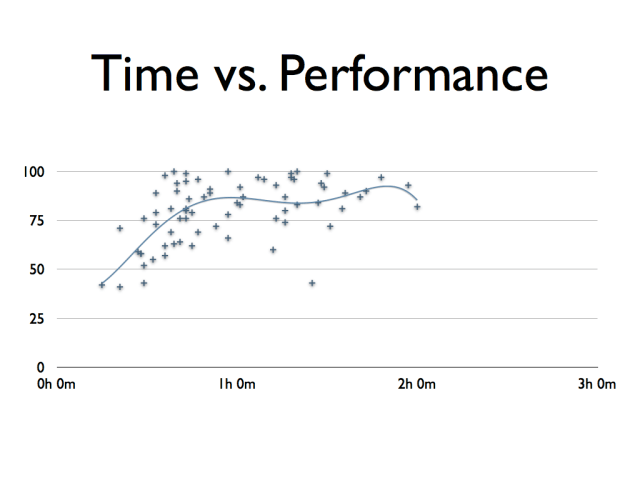
Students were given two hours to complete their exam, and it appears that many of them finished in less than an hour. The average of the best three scores, 0:58:40, was very close to the average time of 0:57:38 that the 71 persons who took this exam.

Midterm Exam Letter

The letter grade distributions skewed heavily towards the top and bottom grades. Almost a third of the class scored an A, but a troubling high portion of the class, 14%, failed the exam. On the bright side, 57% of the class scored an A or a B. Clearly, there were some students who did very well.

Midterm Exam TimeVPerformance

And finally, I have an obsession with recording how students perform against their time.

<

p>The only metric I didn’t use was attendance since I haven’t been coding the sign-in sheets yet.

“Internet Overload”

When I first read that the Internet was “overloaded,” I thought it was a hoax.

CUNY/CIS/Networking has informed Queens College that hardware used to connect the university to the Internet is overloaded. Queens College’s connection to CUNYNet and the Internet is attached to the overloaded equipment. CIS expects to restore normal network speed by the end of April.

We ask for your assistance by cutting back on any network use that is not needed to do your work or studies.

I suppose they mean that some network hardware is overwhelmed, probably because a parallel router, switch or hub went down, and things are slow. However, it’s odd that someone chose to say that the “Internet was busy.” Don’t worry folks, no one can overload the Internet.

King Hall is Too Hot at Queens College

IMG_0124

In my over three years at Queens College at CUNY, Room 105 in King Hall has to be one of the most miserable classrooms I’ve ever used. The classroom is in a basement level below ground level, which makes it a sad place to teach and learn, but I can get over that. At least, we get a little sunlight through our windows during the day and we can see people’s feet as they walk. However, when the fall comes around, the heating system makes the room almost uninhabitable, and my overheated students are almost passing out from the excessive heat. The heat is bad. Today, I brought a thermometer to class, and the reading at the podium was 83°, a temperature more suited for the beach in August than a classroom in December.

IMG_0125_001

There are two ways to cool off, neither of which is really effective. The first option is to turn on a window-mounted air conditioning unit. The major problem is that when the unit is running, no one can hear me over the noise. I don’t keep it on for long because it is rather ineffective at actually cooling off the room. The second option is to open the windows, which does cool off the room because the windows are above directly the radiator, allowing the heat to escape. However, this option makes it hard to be heard because our classroom is along the flight path at LaGuardia Airport, and the intermettant aircraft noise is too loud for my students to hear me.

The reason for the excessive heat is the overpowering radiator. It runs way too hot for a classroom of our size. Our room is small, probably about 150 square feet, and the radiator runs along the length of the entire room. When I checked the temperature today with an infrared thermometer, it was almost 140°. I believe that’s hot enough to smoke pork.

I received a call about this problem from the labor union, and they were going to publish a story about it in hopes of fixing the problem. That was two years ago, and, except for the college installing the air conditioning unit, nothing has changed. At any rate, I don’t consider this a labor issue. It affects the students as much as it affect my working conditions. It is truly detrimental to student learning, and I hope the college addresses it soon. After all, wouldn’t turning off the heat save money?

Midterm Exams on Halloween

Costumed Student Robert

My students at CUNY Queens College took their midterm exams on October 31, Halloween, and I figured that offering students who dressed up for the occasion a few points of extra credit on their exams would bring much-needed levity.

In my American Film Industry class, a handful of students took advantage of my offer, and two even accepted my challenge to dress up as a midterm exam. In the photo above you can see the winner of the Best Midterm Exam Costume prize, which was worth all of five points on the midterm exam. Other students who dressed up for the occasion received a measly three extra-credit points.

Costumed Student Andrew

The New Technologies class also dressed for the occasion, and a few of them actually had some pretty great costumes. One student, from the Film Industry class, tried to double dip and wore his costume to the evening class. I’m not sure how to handle the logistics of the extra credit.

Costumed Student Lore

Costumed Student Michael

If you think that it’s distasteful to offer students extra credit for wearing a costume, please keep in mind that getting credit for a costume equated to less than the value of one true-false question. Anyway, I don’t see the extra credit skewing the results of the exam too much since I suspect very few students will take advantage of the offer.

In any case, I really hope that I don’t have to teach class again on Halloween or, worse, have to give a midterm exam.

See, Taking Your Time and Attendance Counts

Last week, in my History of Cinema III class, I gave a midterm exam. The exam was designed to have an equal number of questions from each week of class, and that the questions would weigh lecture material more than reading material. The exam contained thirty-six questions, six on each of our six class sessions, and consisted of 55% objective questions and 45% subjective short essay questions. The greater weight to the objective questions was designed to test students on recall of lecture material, and the subject portion would be designed to test student’s comprehension of major themes in each class session and was graded relatively generously.

The results of the exam were not too surprising for a class of sixty three students who took the exam.

MEDST146-Midterm-1

The exam was worth 200 points, and as you can see, the average score was 148.61, which is a 74.3%, a C average. This is consistent with a large lecture survey course. Someone in the class scored 193 points, which was the highest score in the class. And the average students finished in just less than 52 minutes.

However, when we look at the grade distribution, the scores look a little less impressive.

MEDST146-Midterm-2

One usually expects there to be a lot of Bs and Cs, and we indeed have that. There are however not very many As and quite a lot of Ds and Fs. I would have liked to have seen more As and fewer Ds so these results are a little discouraging.

Now, when I wonder what might have contributed to the lower than expected scores. I looked at two other metrics: how long did students spend on the exam, and how much did students come to class.

In terms of how long did students take on the exam, we see that the time spent on the exam was indeed significant. Once we discount the first person who finished, who performed rather well, we see that performance slightly improves when students spend a little more time on the exam. But then after a while, we see that performance begins to drop. Presumably, those who finished later simply struggled and tried to answer as many questions as they could.

MEDST146-Midterm-3

Finally, since we cannot use attendance to factor into students’ grades, I wanted to see whether student attendance factored into their performance on the exam. Remember, I designed the exam to test recall on lecture material, partly to reward those who come to class. But let’s see if there a relationship between performance and attendance.

MEDST146-Midterm-4

The above chart shows a strong positive relationship between attendance and performance. The small number of students who came to every class didn’t do as well as the many more than simply missed one class. But nonetheless, we see a strong trend showing that more attendance results in a better exam performance.

One thing to note is that I make podcast recordings of the lecture available, but if they listen without attending, it’s unlikely that it helps their performance. One question I would have is whether the students who attend a lot also use the podcast to review, but it’s not possible for me to tell at this point.

The conclusion that I see here is that aside from the one or two students who just “get it,” taking one’s time on the exam somewhat helps your performance on test day, but coming to class significantly helps your performance overall.

Multimodal Commute ends in a BLOWOUT

Today I travelled a lot more than I usually do and it basically involved taking the subway to Forest Hills and riding my bike the rest of the way to Queens College. Yes, it was a multimodal commute.

Tire Blowout in Forest Hills

On my way back home, I rode my bike through a pretty dark and high speed section of Jewel Ave. I got through it okay but once I emerged in a more residential stretch, my rear tire hit a pretty big pothole on 108th St. And then I heard a loud pop, and my bike was basically riding on the bare wheel. When I stopped I found my inner tube wrapped around the rear cog and all over the brakes, too. There’s a photo below.

I’m still trying to figure out how this happened. I did notice a big gash in my tire’s sidewall, which explains how the tube got out, but I’m still not sure how the tube wraps around in at least three different directions. And now I need a new tire.