New York City
Warning: Undefined variable $category_id in /home/juanmonr/juanomatic.net/wp-content/themes/monroy2014/category.php on line 7
As a kid, my vision of the future seemed marvelous. We would have space colonies, interconnected computers on our wrists, instantaneous global travel, and cities without any trash. Of all these, in 2014, we’re closest to only achieving that last one.
Back in college, I lived in the rear apartment of a duplex, which outside of New York refers to a single building structure with two separate apartments. The tenant in the front was responsible for paying the garbage-collection bill, and we were supposed to split the cost between the two units. However, after a few months of living there, he stopped paying the bill and our garbage cans sat full as the hauling company stopped collecting our trash. Although my roommate and I appreciated saving the cost of having our garbage picked up, we realized that we couldn’t very well let our trash cans still full on the curb. A different neighbor down the street was nice enough to let us stuff some of our trash into his cans, but this was not an ideal solution.
We managed to toss a fair amount of garbage in unlocked dumpsters at night, but we also cut down on the amount of trash we produced. That’s where I learned to recycle as much as possible: cans, bottles, paper, boxes, and even scrap metal all were hauled to a local recycling center. Since then, I’ve been unable to toss a sheet of paper or an aluminum can into a trash receptacle. It feels as wrong as eating without first washing my hands.
When I first moved to New York, one of the greatest benefits of living here was the free curbside trash and recycling program. Having the city pickup my trash and recyclables and sparing me trouble of a weekly, illegal dump seemed like an absolute luxury. But since my recycling habits were deeply ingrained, I still recycled a fair amount of my refuse. But instead of driving it to a recycling center, I just put into a clear bag and left it on the curb on the designated collection day. Easy peasy.
Since last April, New Yorkers have been required to recycle all rigid plastics, and that has completely changed our balance of recycleables vs. trash. Our trash container is much bigger than our recycling containers. But since we stopped tossing plastics in the trash, our recycling container fills up in a day or two. Because the sanitation department picks up garbage three times a week but recycling only once a week, we have to empty our recycling container several times throughout the week and leave the clear bags in a holding area downstairs. Meanwhile, our garbage bags sits nearly empty for a week or until it begins to stink.
Another remarkable facet of the new recycling regime is how little we throw away from a typical takeout meal. A typical take-out meal will be packed in an assortment of plastic containers, buttressed by random pieces of cardboard, and accompanied by plastic utensils and paper napkins. All of that will go into a paper bag and then toted in a plastic bag. Aside from the napkins and the plastic bag, it’s all recyclable.
Perhaps, I’ve come around earlier to recycling everything than others, having been conditioned to obsessively do so since the late–1990s, but I would hope that the sanitation department adapts to the greater volume of recyclables and swaps a trash collection day to collect recycling.
And for the food scraps, which is not recyclable and always forced me to make frequent trash dumps around town during my college days, I can drop that off with the lovely woman from our local compositing program.
One of the drawbacks of being on the western edge of Long Island City is that for nearly half the year, we don’t have weekend access to our main subway line. This year, we were scheduled to go twenty-two weeks without weekend service on the 7 line between Queensborough Plaza and Times Square.
But we’re expecting a snow storm Sunday night, and the scheduled repair work is cancelled.
The following Weekend Planned Service Change is CANCELLED.
No 7 service between Times Sq–42 St and Queensboro Plaza. Originally scheduled for: 2 AM Sat to 5 AM Mon, Mar 1 – 3
The cancellation now leaves us with twenty-one weekends of no 7 train service, provided they don’t tack on another weekend to make it up.

Graffiti on Number Seven Subway. Andy Nguyen, 1980. Washington Square Park and Washington Square Area Image Collection, 1850-1990. New York University Archives.
Twenty-one weekends sounds like a long time, and many local merchants bemoan that these repairs keep Manhattanites out of Long Island City. I don’t know if they ever thought about the locals who are trapped and might be compelled to eat a meal, have a drink or watch a comedy show or dance performance in our own neighborhood. Why not create some 7-themed special like $7 cocktail, appetizer, or cover specials? We’re all in this together, right?
As for me, the weekend work doesn’t bother me all that much. I rarely pine to ride the rails out of LIC. But if I did, thankfully, my club’s Spring Training Series starts next week, which means I’ll be spending most of my Saturdays on a bike again.
Heaven forbid I have to spend a weekend in Long Island City.

Flush a toilet, drop something down your sink, or watch rainwater go down a storm drain around North Brooklyn, and the wastewater will likely end up at the Newtown Creek Wastewater Treatment Plant. Here the wastewater is screened and disinfected before being dumped into the East River. Before it goes out to sea, however, it goes into one of eight digester eggs that break down the raw sewage into a mushy solid they call “cake.” It’s basically what happens in your belly when you make poop, but on a much larger scale.
The Visitor Center, designed by performance artist–turned–architect Vito Acconci, is open by appointment. They also conduct special tours of the Digester Eggs on Halloween, Easter for a Digester Egg Hunt and Tour, and on Valentine’s Day.
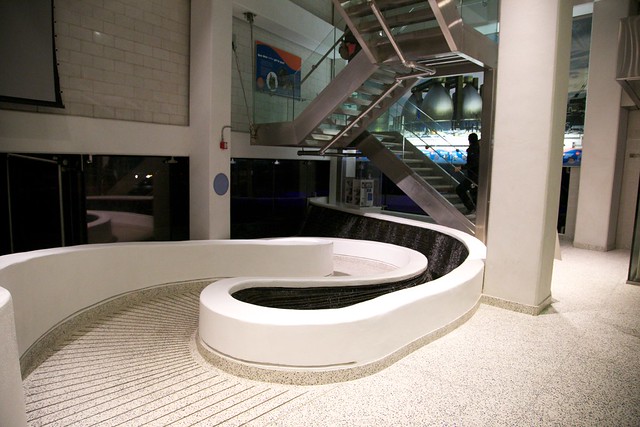
They postponed the Valentine’s Day tour last week because ice dangling from the digester eggs posed a threat to visitors. Tonight was the make up date, and we went. What better way to spend a Tuesday evening than to learn about and tour the facility that processes our poop before heading out to sea?

The superintendent conducted an hour-long presentation about the whole treatment process. It turns out that poop doesn’t go out to sea at all. Close to 94% of all the wastewater New York City dumps to our waterways is actually clean water. Consequently, the waterways surrounding New York City are cleaner than they’ve been in over 100 years. The other fascinating but bothersome fact was that the digester have trouble processing non-organic material that can’t be broken down by the digestion process. One such product is pharmaceuticals. Every pill a New Yorker pops and passes will eventually go into our waterways, turning our fish into overmedicated drug addicts.

Although the entire tour was long, it was really entertaining. Everyone at the plant appears to love their job and feel a sense of purpose. If we could all be so happy and fulfilled at work.
As far as gimmicky Valentine’s Day events, this is way better than booking a table at White Castle.
Now that I’ve lived more of my adult years in the state of New York State than I did in California, twelve years versus six, it’s time I had an opinion on how far you have to go before you’ve reached “upstate New York.” My first true trip out of the city was to Mamaroneck, and it seemed like upstate to me at the time. If you’re laughing at me for mistaking a suburban Westchester County town for upstate, I absolutely deserve it.
But as I’ve lived here longer, visited friends as far as Rochester, ridden aboard the Lake Shore Limited through Buffalo en route to Chicago, and have cycled around the Hudson River Valley, I have a better idea of what is “upstate” and what is just suburban New York City.
My working definition of upstate has been Albany or equivalent distance from NYC, excluding Long Island. Other longtime residents, including many of my students, define it as anywhere outside of the five boroughs, Westchester and Long Island. Some will even lump Westchester towns such as White Plains and Yonkers as upstate.
The New York State government actually has a specific definition, and it’s not unlike mine:
Albany’s working definition of upstate New York is based on what lies outside the Metropolitan Transportation Authority’s commuter rail area. Besides New York City and Long Island, it excludes Westchester, Rockland, Orange, Putnam and Dutchess Counties.
There you have it. Now let’s never argue about this again.
On Saturday, Ten10 Studios in Long Island City hosted three music performances at its 47th Road studio space. As the show was literally around the corner from home, I went to snap about forty photos of the night’s performances.

The night was capped by a performance by Ken Butler, a renowned music instrument builder, who played about a dozen handmade instruments he built over the years. All of the instruments are built from found objects, as you’ll see below, and converted to musical instruments through the strategic placement of a contact microphone. He would also use a sound processor to loop percussive sounds as a back beat.
-

-
He started with playing a golf club.
-

-
He plays a guitar-like device with two strings and tennis racket.
-

-
He then played a shovel with strings.
-

-
Butler plays another guitar-like instrument that resembled a machine gun. Note the comb that resembles an ammunition clip.
-

-
An umbrella makes for a variety sounds when it is closed and opened.
-

-
Although it has a string, he also played a sword as a percussion instrument.
-

-
Speaking of sharp objects, here Ken Butler played a smaller knife.
-

-
He also utilized the bristles and the handle of a toothbrush against his teeth to create various sounds.
-

-
Running out of props, he resorted to the zipper on his pants…
-

-
By the end, he used his body and finished with playing his head as a drum.
It’s both incredible and empowering to see how many possible musical instruments Butler made with the everyday objects.
As New Yorkers, we stand in line for some pretty stupid stuff that isn’t free: cronuts, brunch, and modern art installations, and San Franciscans have taken note.
Taking place at Dear Mom, the Mission’s magnet of mediocrity, budding restauranteurs importers Sonya Haines and Wes Rowe unveiled their “Eastside Bagels” hustle, which sees Russ & Daughters bagels flown in from New York and flipped for $6 (bagel with cream cheese) to $12 (full bagel sandwich).
We get it, San Francisco. No one is confusing you for LA, which we know you hate more than any place on earth. But you really need to stop trying to be New York. We’re not buying it.
(Via NY Today.)
I was all set to lecture this morning on the telegraph for my Introduction to New Media class, a topic that Communication and Media Studies students study a lot, but then we got another storm today. If I’m counting correctly, that makes this the fourth winter storm this year.

By the way, if you ever noticed that New York City has almost no overhead utility lines, it’s because they caused havoc during the Blizzard of 1888.
This storm is a different than the previous two as it brings with it wintry mix. As lovely as it sounds, wintry mix should be renamed winty misery. You’re going to get wet, the streets are essentially covered in slush, and as soon as the slush hits the ground, it freezes to create ice. And ice makes travel a dangerous enterprise.
Consequently, my morning class at Fordham University, Lincoln Center was cancelled. As my only scheduled commitment today, I’m turning it into a GTD day.
But what about my other colleges?
- Queens College is defying the weather gods and is open all day.
- Pratt opened late, at noon, allowing the sanitation department to clear the roads.
- NYU opened late at 11:00 AM to similarly let things clear up.
I don’t understand what factors schools consider when closing due to a storm, as there seems to be little consistency, but apparently New York City public schools consider snow accumulation, temperature and windchill.

Another winter storm is upon us, and my schools of employment are again responding to the weather.
- Fordham announced this morning that they were closing all campuses on Monday. Too bad I don’t have a class there until Wednesday.
- Around 2:00 PM, Pratt announced that they were closing at 3:00 PM. Too bad I don’t teach there this semester.
- NYU insisted they were going to remain open today. Although I had a library shift there today, it didn’t bother me having to go: it’s a pretty easy trek since my entire trip is underground via subway.
Unfortunately, Queens College, where I teach an evening class on Mondays this semester, did not close for a few snowflakes, as their emergency webpage emphatically reminded us:
Queens College will be open on Monday, February 3. Please be careful when traveling to and from the college and when walking on campus as the pathways may be slippery.
It usually takes me an hour and a half to travel the eleven miles from NYU to Queens College. The subway portion of the trip is a slog in itself, as the E train starts relatively empty at West Fourth Street but picks up the rush-hour crowd along the way to Queens. And after arriving at Forest Hills, there’s a short but very slow bus ride: it takes about 15 minutes to travel two miles. And after that, there’s a five minute walk from the bus stop to campus.

After all my belly aching, it actually took less time than usual. An hour and ten minutes after leaving NYU, I arrived in the winter wonderland that was Queens College.

My dad taught me a long time ago that solid state devices, those without moving parts, almost never go bad. If it doesn’t wear, it won’t tear. There are some exceptions of course, and today, I learned that Citibike key fobs can in fact go bad. Mine was completely dead.
Usually when you insert a key fob, you get a reassuring (or completely confusing) set of lights. Today, at the station at West 3rd and LaGuardia Place, I got nothing. Maybe the station is down, I thought.
I walked to a nearby station at Bleecker and Mercer Streets. As I approached, I saw a guy trying to check out a bike. Telling him about my difficulty, I asked him if he could get one. He, in fact, could. But then when I tried my key fob, there was no response. Time to call Citibike support.

Thankfully, there are a lot of stations in downtown Manhattan.
The agent reviewed my account and closed out some open trips. This seemed routine to her, but I was a bit alarmed that I had "open trips." Don’t they charge you $1,200 for a lost bike? By this time, I had started walking toward my destination and was approaching my third Citibike station of the evening at Lafayette and Houston Streets. The agent asked if I could use my key here. No dice!
With my key fob apparently bricked, she ordered a new one for me. It’ll arrive in two-to-five business days. Thinking that we were done, she then asked me if I wanted to get a 7-day pass. What?!? I get a loaner?
The only catch was that the touch screen at the station was down. On to a fourth station at Mott and Prince.
To get a temporary seven-day membership, I basically had to get one like any non-member: provide a credit card, phone number, and consent to a $100 deposit against my card. As I agreed to all the terms and conditions, the agent gave me a coupon code. That code discounted the $25 fee for a seven-day pass. After getting a five-digit code to unlock a bike, I grabbed one and headed to the Rivington and Suffolk.
By the time I started pedaling, I had covered half the trip on foot.
If you’ve visited New York or moved here from somewhere else, like I did many years ago, it might seem like things move fast. Indeed, the pace of a big city can seem blinding compared to a small town or country village. When I first moved here, time seemed to pass a lot quicker in New York than it did, where I lived before, in sleepy Santa Barbara, California.
While the frenzy of city life might have something to do with that, I’ve always wondered whether there was an astrological or geological reason that time “felt” faster here, even on days I didn’t leave my apartment. Could it be that being farther north, at a higher latitude, made time pass more quickly?
Seth Kadish, an Oregon-based geologist, has made a simple formula for determining how fast you are rotating around the earth’s axis.
cos (latitude) × 1040 = tangential speed in mph
At the poles, you are basically standing in place, not really rotating at all. But at the equator, Kadish determined, you are whipping around the earth at 1,040 miles per hour, hence why the above formula uses a constant of 1040 mph.

Is this why time seemed to move faster in New York than it did in Santa Barbara?
| Location |
Latitude |
Rotational Speed |
Time to rotate 6,000 miles |
| Santa Barbara |
34.417° |
857.95 mph |
6h 59m 31s |
| New York |
40.783° |
787.47 mph |
7h 37m 8s |
Time may have seemed faster because I experienced time, not as a velocity, but as a distance. For example, in Santa Barbara, it would take me just under seven hours to “travel” 6,000 miles around the earth’s axis. If I woke up at 9:00 AM, it would be about 4:00 PM when I “travelled” that distance at 34° N latitude. In New York, however, traveling that same distance would take more time. Assuming the same 9:00 AM wake-up time, it would be 4:37 PM, closer to 5:00 PM, by the time I travelled that same distance at 40° N latitude. In other words, it would feel like I“lost” 37 minutes. No wonder I’m often late.
To experience time differently due to latitude, you probably need to travel pretty far. That would require traveling by airplane. But then jet lag, traveling across time zones, could disrupt your sense of time anyway. Traveling for a few days, such as leisure or business trip, is also quite disruptive to how you experience time because you’re on a different schedule, often more hectic, than what you’re accustomed. To really get this effect, you probably need to be settled in one place having just left some other place. That probably only happens when you’re relocated across a “tall” country like the US, Mexico, Brazil, Argentina, Chile, India, or China or between countries at different latitudes, such as UK to India.
Until I saw Kadish’s post, this was all speculation. I didn’t have to scientific tools to approach this problem. But his using basic trigonometry, tools I haven’t used in a long time, compelled to outline my theory here.


